Field guide
The Jackelian Sequence: A Field Guide
A map, a compass, and a few sensible warnings about the local wildlife, before you set off into Stephen Hunt’s seven-novel secondary world.
Every field guide worth its salt starts by admitting what it isn’t going to tell you. This one is not going to spoil the endings. It is not going to list the ISBNs. It is not going to review the individual books, because that job is being done rather more slowly by the calendar as each of them keeps failing to go out of print. What it is going to do is what a field guide is for: hand you a map, a compass, a few sensible warnings about the local wildlife, and point you at the trailhead.
The trail in question is Stephen Hunt’s seven-novel Jackelian sequence — a set of stand-alone adventures which share a world so densely built it makes most fantasy cartographers turn their maps sideways in the hope of finding somewhere else to put a mountain. If you are the kind of steampunk reader who has grown a little weary of Victorian London with brass goggles glued on, the Jackelian books are for you. If you are the kind of steampunk reader who has always privately suspected that a good steampunk world ought to have proper opinions about God, class and thermodynamics, they are especially for you. And if you have never read them, this is where you start.
The lie of the land
The dominant polity of the Jackelian world is the Kingdom of Jackals, and any traveller from our own timeline will recognise its bones. Parliament sits in a capital called Middlesteel. The pneumatic post arrives on time. The gas-lamps run late into the fog. The monarchy has been formally diminished for excellent historical reasons that involve a large blade, a small chapel, and a piece of ceremonial furniture nobody in the House much wants to talk about. Britain, if you squint. But Britain in a mirror that has been cracked, re-silvered, and left too near the fire.
To the east lies Quatérshift, the Commonshare, which is what happens when a revolution wins and then keeps eating. Governed by a First Committee, punished by a device called the Gideon’s Collar, and populated largely by exiles who left just before the exiles started being burned in effigy, Quatérshift is Hunt’s long, sustained portrait of utopianism turned punitive.
To the south, across a great deal of hostile desert, sits the Caliphate of Cassarabia — a theocracy ruled by the Caliph Eternal and served by the womb-mages, who practise a biological sorcery in which weapons and servants are grown out of living flesh. Cassarabian craftsmanship is famously beautiful and famously other. A Cassarabian assassin’s blade will remember your face. A Cassarabian scout’s mount will grow you a saddle.
To the west and north lies the Steammen Free State: a sovereign kingdom of intelligent, brass-bodied machines who fought beside Jackals against the old aristocracy and never went home. Ruled by King Steam, defended by devout orders of steamman knights, and quietly running a monopoly on celgas — the buoyant lift-gas that keeps every airship in the sky — the Free State is the cycle’s most consistent ally to the Kingdom and its most theologically distinct citizen population. Steammen worship their ancestors, who are called Loas, and they are exactly as offended as you would expect by the local human habit of getting religion wrong. Hunt’s Mechancia covers this steam-driven civilisation in full.
Beyond those four, the world stretches on. The Catosian League: a confederation of philosopher-republics in which the women run the politics, the military, and most of the mercenary contracts you will meet the wrong end of. The Holy Pericurian Empire: winged lashlite reptiles with a complex theology and an even more complex diplomatic history, whose alliances swing across the cycle like a weathervane in a squall. Liongeli: an equatorial jungle in which an insect-collective civilisation called the daggish has forgotten precisely nothing about the last war. Jago: an island ringed by a sea of magma and defended by an atmospheric-support system whose warranty expired several centuries ago. And beneath the ocean, the ab-locks — the gill-necks — who have opinions about the surface world and periodically rise to voice them.
Also, buried under everything: the Camlanteans. The utopia that fell. Their politics, even in ruins, will pull at your sleeve for the entire sequence.
The machinery
Steampunk readers arrive with a checklist. Hunt ticks it, then adds several boxes of his own and quietly moves the whole checklist somewhere more interesting.
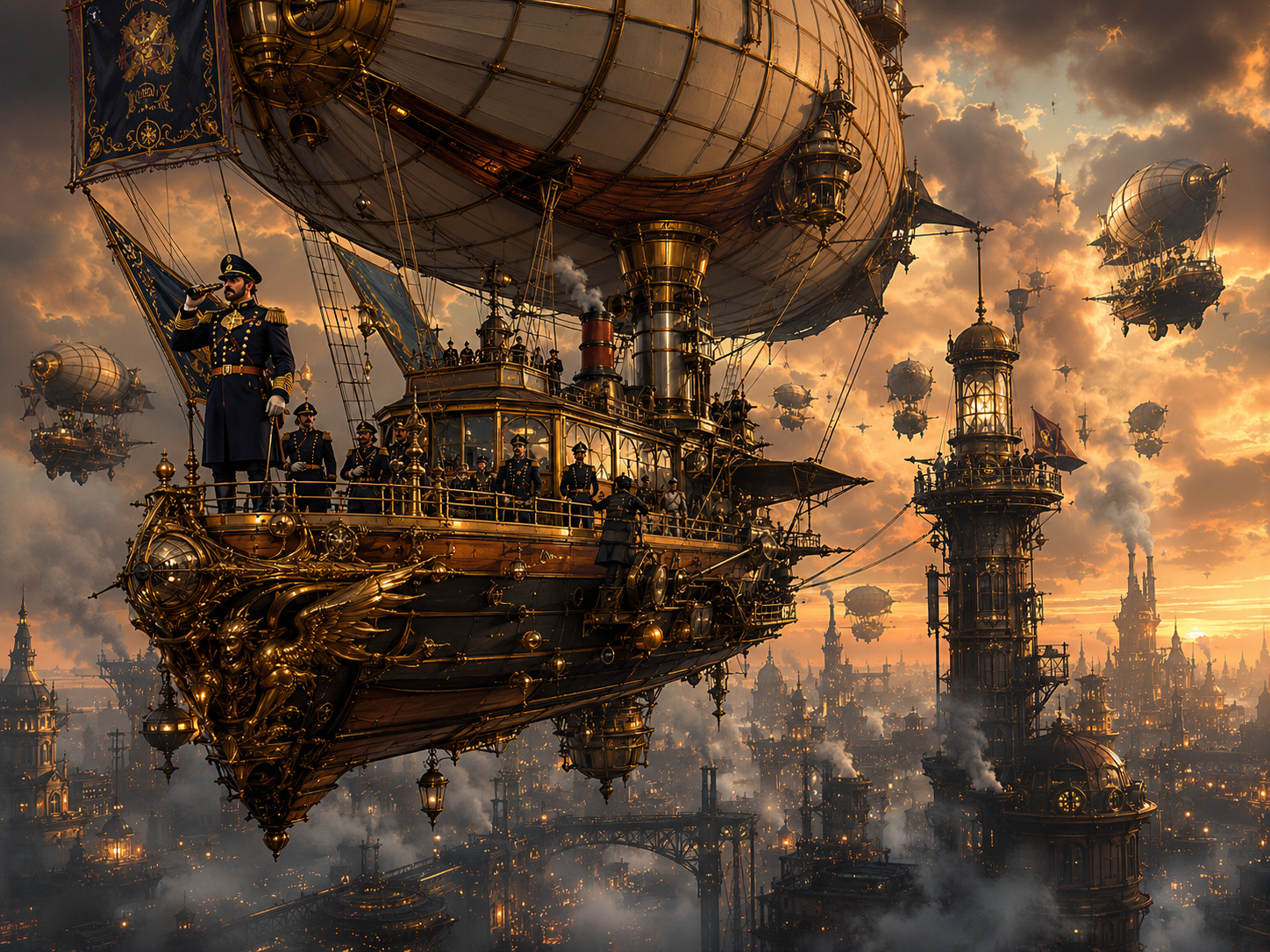
Airships? Yes: the Royal Aerostatical Navy runs the sky, and Hunt gives it Patrick O’Brian-grade texture — the watches, the ballast, the celgas, the smell of the crew mess, the way a middle-aged lieutenant can be broken by having the wrong shirt on the wrong bell. Automata? The Steammen Free State is a nation of them, and none of them enjoy being called that. Mechanical computation? The RAN’s airships are steered by valve-minds — thinking-engines built on the same premise as the kingdom’s Transaction Engines, and quite capable of making our current AI discourse sound like a small child re-arranging a box of matches. Sorcery? Yes, and this is where Hunt gets properly clever.
The Jackelian world’s sorcerers are the worldsingers, and their job is not to wield magic. Their job is to suppress it. Magic in the Kingdom is treated as a wound, and the worldsingers are the surgeons: registration, containment, and if necessary the collar and the cell. The most powerful magical citizens in Jackals — the feybreed, altered by long exposure to the world’s leylines — are drafted into the Special Guard and turned into state assets. This is the exact opposite of the usual fantasy default, in which wizards get better as they get older. In Jackals they get quieter, and the state prefers it that way.
Cassarabia takes an entirely different view. So do the ab-locks. So do the Camlanteans. And underneath all of that, embedded in the crust of the world, sleeps the Hexmachina — a god-machine so old that “machine” and “god” have stopped being usefully distinct words for it.
The politics (which is to say, most of the plot)
The Jackelian novels are political without being preachy — a distinction the cycle takes seriously. Every one of the world’s polities gets its shot at the wheel, and every one of them gets held up to the light. Quatérshift’s ideals are honestly stated; Quatérshift’s practice is honestly reported. Cassarabia is not a caricature: the palace politics, the theology, the reformist underground and the sheer aesthetic reach of the Caliphate are all given proper weight. The Kingdom of Jackals — the cycle’s least bad option — is not flattered either. There are still poorhouses, there is still a registration office, and there is still a Special Guard with a collar for anyone who inconveniences the state at scale.
Hunt’s instinct here is one of the reasons the cycle wears so well. He believes in adventure, and he writes it at full speed. But he also believes that adventure has a setting, that the setting has stakes, and that the stakes are cheap if the world doesn’t cost anything to run. His world costs plenty. The Special Guard’s collar is not decorative. The Gideon’s Collar is not a metaphor. The womb-mages’ work is not tidy. That’s why the airships, when they lift, feel earned.
What kind of adventure is this, then?
Every Jackelian novel is built around a real plot. Book one, The Court of the Air, is a chase novel about two orphans who have accidentally become the fulcrum of a theological conspiracy older than the kingdom. Book two, The Kingdom Beyond the Waves, is an expedition novel about a disgraced archaeologist going up a jungle river in a u-boat to find a city nobody believes existed. Book three, The Rise of the Iron Moon, is an apocalyptic-invasion novel — the cycle’s biggest canvas, and its darkest. Book four, Secrets of the Fire Sea, is a locked-island murder mystery introducing the cycle’s finest double-act. Book five, Jack Cloudie, is the aerial-warfare novel: two coming-of-age stories on opposite sides of a war. Book six, From the Deep of the Dark, is detection-plus-heist opening onto a very old question about who was here first. Book seven, Mission to Mightadore, returns to the cycle after a long absence and opens up territory the earlier books only ever pointed at.
None of them ends on a cliffhanger. All of them stand alone. All of them assume you can keep up.
Where to start
The Court of the Air. Not because the others aren’t good — they are, and in the case of The Rise of the Iron Moon and From the Deep of the Dark they may in fact be the best novels in the cycle — but because Book 1 is where the map unfolds. Molly Templar and Oliver Brooks are outsiders to the world of the Kingdom, and they learn it the way you will: by getting into trouble in it, by asking the wrong questions of the right people, and by discovering that the answers are usually a great deal older than the questions.
Read it. Then look up. Then find out how many hours you have lost.
You have been briefed. The trailhead is over there. Mind the airships on your way in. For the wider genre context, the Jackelian books sit firmly in core secondary-world steampunk, alongside the likes of Perdido Street Station, Mortal Engines and Leviathan. They are a reminder that steampunk does not need our nineteenth century at all — it needs steam, machinery, class and consequence, and a world willing to take them seriously.
 Core Steampunk Fantasy
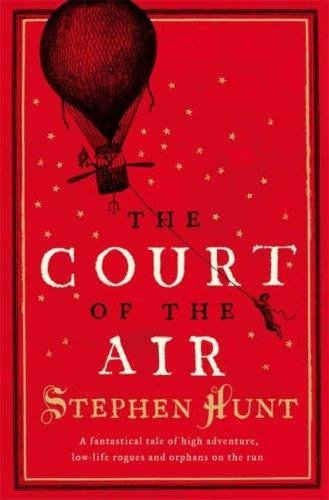
The Court of the Air
Stephen Hunt's The Court of the Air is core secondary-world steampunk fantasy, with airships, revolution and ancient powers.
Core Steampunk Fantasy
The Court of the Air
Stephen Hunt's The Court of the Air is core secondary-world steampunk fantasy, with airships, revolution and ancient powers.
 Core Steampunk Fantasy
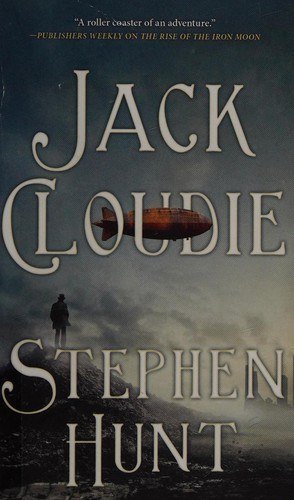
Jack Cloudie
Stephen Hunt's Jack Cloudie is core Jackelian steampunk fantasy, effectively Hornblower with airships and the Royal Aerostatical Navy.
Core Steampunk Fantasy
Jack Cloudie
Stephen Hunt's Jack Cloudie is core Jackelian steampunk fantasy, effectively Hornblower with airships and the Royal Aerostatical Navy.