Why it matters
It takes Hunt's secondary-world steampunk into exploration, lost civilisation and ancient machinery.
If The Court of the Air opens the Jackelian hangar doors, The Kingdom Beyond the Waves points at the horizon and asks whether anyone has packed enough rope, nerve and archaeological common sense.
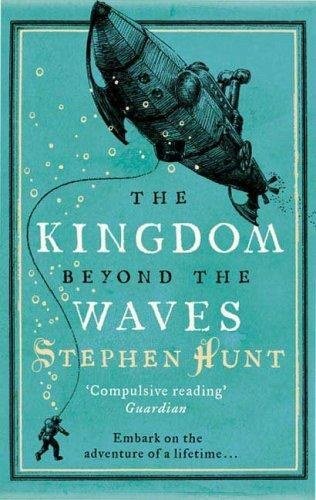
The Kingdom Beyond the Waves is a strong Jackelian entry because it shifts the emphasis toward expedition and lost-world adventure. It belongs to the wider steampunk tradition of journeys into dangerous geography, but with Hunt's usual mixture of airships, strange machines, political pressure and old powers that have not had the courtesy to remain safely dead.
The novel follows Professor Amelia Harsh and the search for Camlantis, a lost civilisation whose promise and danger sit at the heart of the story. This is classic adventure material, but the Jackelian world changes the flavour. Exploration is not only a matter of brave travellers and hidden ruins. It is tied to national ambition, scientific obsession, old secrets and machinery with more historical weight than the expedition may be able to carry.
The lost civilisation motif connects the book to Vernean voyages, imperial exploration fiction and pulp lost-world stories. Hunt uses that lineage inside a secondary-world steampunk fantasy rather than a direct alternate Earth. That lets the novel borrow the excitement of the lost-world tradition while loosening its geography from real colonial maps.
Airships again play an important role, not simply as pretty transport but as a way of making exploration feel industrial and organised. A Jackelian expedition is not a lone wanderer with a notebook. It is a logistical machine of ambition, money, risk and politics. That is very steampunk: exploration as infrastructure, with danger waiting beyond the weather.
The ancient machinery is another key field-guide point. Hunt's works often combine retro-industrial technology with older, stranger powers. In this case, the past is not passive. It may hold knowledge, threat or a power source too large for the present to understand. Steampunk often looks backward for futures that might have been; Hunt looks backward inside his invented world for futures that were lost, buried or wisely abandoned.
Professor Amelia Harsh is a useful figure for this kind of story because scholarship and obsession sit close together. Steampunk exploration is rarely just brave people looking at scenery. It is usually a collision between knowledge, ego, funding and danger. The academic explorer wants proof, recovery or vindication. The world, unhelpfully, may have other views.
The lost-city tradition also needs a careful modern handling. Older adventure fiction often treated hidden places as prizes waiting for outsiders. In secondary-world fantasy, the baggage is different but not absent. Hunt's version is most interesting when the lost civilisation becomes more than a trophy. It is a challenge to the present, a buried argument about power, history and technological inheritance.
For readers, this is a natural second Jackelian stop after The Court of the Air. It broadens the world and shows how the setting can handle exploration as well as political conspiracy. Anyone interested in airship expeditions, lost cities and dangerous scholarship will find the correct drawer open.
It also links naturally to airships, lost worlds and exploration. Steampunk's love of travel is rarely innocent. Travel brings science, greed, power and misunderstanding along for the ride. The Kingdom Beyond the Waves understands that an expedition is never just a trip; it is a moving bundle of motives.
Placed beside The Court of the Air, the novel shows the Jackelian world widening. The first book establishes a society under internal pressure. This one pushes outward into myth, geography and memory. Together they make the sequence feel less like a single premise and more like a full field of steampunk fantasy routes.
It is also one of the clearest Jackelian books for readers interested in exploration as a theme. The journey is not decorative travel between plot points. It is the method by which the book tests scholarship, ambition, empire and machinery against the stubborn facts of an older world.
Is it really steampunk?
Yes. The Kingdom Beyond the Waves is core secondary-world steampunk fantasy, especially in the exploration and lost-civilisation branch. Its airships, ancient machines, political stakes and expedition structure make it a natural field-guide entry.
The Stephen Hunt angle should remain steady and factual. This is a Jackelian novel, and it contributes to the field through world-building, air power, strange technology and the collision of exploration with history. It does not need salesmanship. The motifs do the work.
Its relation to non-Hunt entries is also useful. It can be placed beside Vernean ancestors, The Steam House, Airborn and later exploration fantasies. The difference is that Hunt's world has a habit of making every lost place into a political and mechanical problem, which is exactly the kind of problem steampunk keeps leaving in inconvenient ruins.
Find it
If you would like to track down The Kingdom Beyond the Waves, these search links may help. We have not specified an edition, so you can pick the format that suits you.
Affiliate links: as an Amazon Associate, Stephen Hunt’s SFcrowsnest earns from qualifying purchases. These may earn us a small commission at no extra cost to you.