
Why it matters
It extends the Jackelian field into undersea settings, revolution, ancient powers and machinery below the waves.
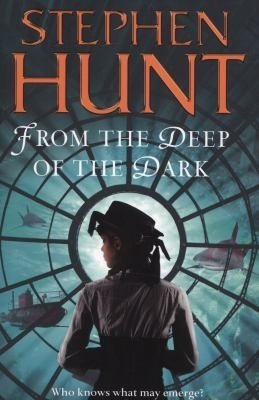
After airships, lost cities and political machinery, From the Deep of the Dark reminds the Jackelian world that the sea has its own secrets, and some of them have been waiting below the polite depth.
Stephen Hunt's From the Deep of the Dark brings the Jackelian sequence into conversation with one of steampunk's oldest ancestral routes: the undersea scientific romance of Jules Verne. The comparison is not exact, but the lineage is useful. From the Nautilus onward, the sea has been one of retrofuturism's great pressure chambers.
The spreadsheet's motifs, subsea world, revolution, ancient powers and Jackelian machinery, capture the book's place neatly. It is not just an underwater excursion. It is another example of Hunt taking a particular adventure environment and loading it with politics, old technology and social tension. The sea becomes a setting where hidden histories can apply pressure from below.
The undersea material matters because steampunk is often sky-drunk. Airships dominate the iconography, and Hunt has certainly used them well. But the ocean offers a different imaginative force: pressure, concealment, depth, isolation and the fear that something ancient is rising through the dark. That makes this novel a useful counterweight to Jack Cloudie and the airship branch.
That counterweight is why "classic Jackelian" is a better phrase here than the banned, over-polished alternative. Hunt is not abandoning the sequence's machinery and politics by going underwater; he is testing them in a different pressure system. The same social and technological instincts appear, but the environment changes the music. The sky gives you manoeuvre. The deep gives you consequence.
The subsea world also lets the novel tap into a different strand of scientific romance. Verne's undersea imagination was about wonder, secrecy and the private machine. Hunt's version belongs to secondary-world fantasy, but the old appeal remains: the sea as a place where ordinary law thins out and hidden powers can survive below notice.
Ancient powers in the deep are especially effective because depth already suggests time. What is buried under the sea feels older, stranger and less accountable to surface politics. Steampunk loves buried technology because it turns archaeology into threat. Here, that threat rises through water rather than dust.
Revolution is another important motif. Hunt's Jackelian books repeatedly return to societies under stress: class systems, political orders, empires, services and hidden powers all subject to upheaval. In From the Deep of the Dark, that stress intersects with subsea mystery and ancient forces, giving the adventure both vertical depth and political heat.
The obvious related entry is Twenty Thousand Leagues Under the Seas. Verne gives the genre the private submarine genius and the ocean as technological theatre. Hunt gives secondary-world steampunk fantasy an undersea branch shaped by the Jackelian taste for old powers and political disorder. The echo is useful without claiming direct equivalence.
The novel also links to Secrets of the Fire Sea, where island mystery and hidden technology are central. Together they mark the watery side of the Jackelian map. This matters for readers navigating a long sequence. They can choose the sky-war route, the lost-world route, the island mystery route or the subsea route, depending on which sort of peril currently feels refreshing.
From the Deep of the Dark matters because it shows secondary-world steampunk extending below the surface. The machinery of the Jackelian world is not confined to airships, cities and laboratories; it can also sink into pressure, secrecy and older powers waiting under the waterline.
Is it really steampunk?
Yes. From the Deep of the Dark is core secondary-world steampunk fantasy, especially in the subsea and lost-technology branch. Its machinery, revolution, ancient powers and Jackelian setting place it firmly in the wider field.
Its specific value lies in expanding steampunk's geography. The field needs more than London streets and airship decks. It needs oceans, islands, buried cities, old mechanisms and pressure zones where society cannot pretend the surface is all there is. This novel provides that undersea pressure.
Readers who enjoy Vernean ancestry, Hunt's Jackelian politics, or subsea adventure should find it a useful route. Those who want the most recognisable Jackelian start should still begin with The Court of the Air, but anyone following the theme of water, secrecy and ancient machinery will eventually come down here.
It also pairs neatly with Secrets of the Fire Sea. One book concentrates island mystery and old machinery; the other moves into deeper maritime and subsea territory. Together they prove the Jackelian world has more than one coastline, and most of them appear to be hiding something expensive.
Find it
If you would like to track down From the Deep of the Dark, these search links may help. We have not specified an edition, so you can pick the format that suits you.
Affiliate links: as an Amazon Associate, Stephen Hunt’s SFcrowsnest earns from qualifying purchases. These may earn us a small commission at no extra cost to you.