
Why it matters
It is the first major Jackelian novel and a natural entry point into Hunt's brand of British steampunk fantasy.
Some fantasy kingdoms have wizards in towers. Stephen Hunt's Jackals has airships, revolutionaries, robots, ancient powers and enough political lunacy to make the civil service reach for a stronger pot of tea.
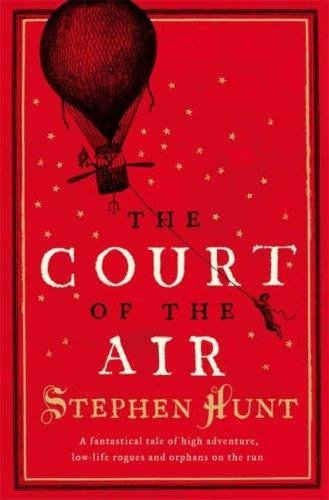
The Court of the Air is one of Stephen Hunt's obvious steampunk-fantasy landmarks, but obvious does not mean simple. Its value lies in how confidently it moves steampunk away from alternate Victorian London and into a fully invented secondary world. The Kingdom of Jackals is not our Britain with brass knobs attached. It is a different political machine, full of air power, class tension, revolutionary pressure, ancient mechanisms and institutions that appear to have been designed during an argument.
The novel follows young protagonists caught inside a much larger conspiracy of powers, factions and old secrets. That shape is classic adventure fantasy, but the texture is Jackelian: clanking machines, radical movements, aristocratic decay, strange sciences, hidden histories and a world where social order looks sturdy until the floor starts making ticking noises. The result is core steampunk fantasy rather than mere gaslamp decoration.
Airships are central to the feel, but not the whole point. In Hunt's work, sky power is tied to war, state reach, exploration, class and national myth. The airship is romance and weapon, workplace and emblem. That makes the book a useful companion to Moorcock's Bastable sequence and later airship fantasies, while still keeping its own secondary-world identity.
The Jackelian setting also gives the novel permission to be politically busy. Revolutions, constitutional absurdities, class divisions and old orders all jostle together. This is one of the reasons the book belongs firmly in the steampunk field: it understands that machines do not exist in empty space. They live inside societies, and societies are often the least reliable mechanism in the room.
That political busyness is not incidental colour. It is one of the book's engines. The Jackelian world is full of institutions that have lasted long enough to become ridiculous and dangerous at the same time. This is a very British kind of steampunk joke: the machine may be exploding, but someone will still insist the correct committee procedure be followed before anyone reaches for the spanner.
The protagonists' youth also matters. Steampunk fantasy often works well when young characters discover that the adult world is not simply complicated but actively deranged. In The Court of the Air, the children are not entering a stable society with a few secret passages. They are entering a system of factions, histories and powers that has been creaking for generations. Adventure, in this sense, is what happens when inheritance fails noisily.
The robots and ancient powers push the book beyond simple retro-industrial fantasy. Hunt's world has layers of prior history and non-human strangeness. That helps prevent the machinery from becoming only aesthetic. The devices and powers are part of a deep, unstable past, which keeps the adventure feeling large and slightly unsafe.
For readers, The Court of the Air is a strong starting point if they want large-scale steampunk fantasy rather than a polite parlour mystery. It is busier than first-wave clockwork Victoriana and more exuberant than the literary industrial branch. It wants sweep, danger and a big stage, with governments, rebels and hidden powers all trying to get their hands on the levers.
It also offers a useful contrast with the same era's urban and YA entries. Compared with Boneshaker, Leviathan or Worldshaker, Hunt's book is less concerned with one striking machine or premise and more concerned with a whole secondary world running on multiple kinds of impossible momentum. That makes it a natural anchor for the Jackelian strand of the guide.
Purists who think steampunk must remain tethered to our nineteenth century may hesitate. That is a narrow view. Secondary-world steampunk is a major branch of the field, and The Court of the Air is one of its useful British examples. It takes the motifs seriously without being trapped by direct alternate history.
Is it really steampunk?
Yes. The Court of the Air is core secondary-world steampunk fantasy. It has airships, strange machines, social unrest, old powers, political systems under strain and a retro-industrial imagination that shapes the world rather than merely decorating it.
The book belongs because it uses steampunk's toolkit at novel scale, especially in its mixture of adventure, class pressure, technological weirdness and institutional madness. It also sets up later Jackelian entries such as The Kingdom Beyond the Waves, The Rise of the Iron Moon and Jack Cloudie.
It sits naturally near airships, revolution, secondary-world steampunk and British adventure fantasy. It is the point where the Jackelian world opens its hangar doors, waves the reader aboard, and quietly mentions that the engines may be older than civilisation.
Find it
If you would like to track down The Court of the Air, these search links may help. We have not specified an edition, so you can pick the format that suits you.
Affiliate links: as an Amazon Associate, Stephen Hunt’s SFcrowsnest earns from qualifying purchases. These may earn us a small commission at no extra cost to you.