
Why it matters
It gave modern YA steampunk one of its most memorable images: mobile cities hunting one another across a ruined world.
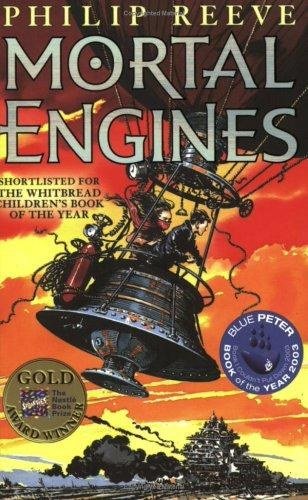
Philip Reeve's Mortal Engines understands one of steampunk's secret wishes and takes it literally: what if London itself had engines, tracks, jaws and absolutely no intention of staying put?
Mortal Engines is one of the clearest modern steampunk landmarks in young adult fiction. Its world is post-apocalyptic rather than Victorian, but its imagination is full of industrial spectacle, scavenged history, city-machines and social hierarchy on wheels. The central conceit, Municipal Darwinism, is wonderfully horrible: great traction cities roam the world, consuming smaller towns for resources. Urban planning has rarely sounded so carnivorous.
The story begins aboard London, now a moving predator rather than a fixed capital. Tom Natsworthy, a young apprentice historian, is thrown into adventure with Hester Shaw, whose personal history cuts through the city's official myths. Reeve uses that chase structure to open out a world of mobile settlements, airships, old technology, ecological ruin and political brutality.
The traction cities are the great field-guide object here. They are visually irresistible and conceptually sharp. A city is already a machine of class, labour, appetite and waste. Reeve simply gives it engines and lets the metaphor become literal. London eats. Smaller towns flee. History is collected, misread and weaponised. The result is one of steampunk's best examples of a single speculative image carrying social meaning.
Although the setting is far future, the aesthetic is scavenger-retro. Old-world fragments, industrial machinery, air travel and antique institutions survive in altered forms. This is why the book fits steampunk rather than ordinary post-apocalyptic SF. It is not obsessed with sleek future technology. It loves patched mechanisms, engines, relics and the absurd continuity of human bureaucracy after disaster.
Reeve also gives the story a moral bite. The romance of huge machines is undercut by the violence they require. London is exciting, but also predatory. Its civic pride is built on consumption. That makes the book a good antidote to purely decorative steampunk. The biggest machine in the story is also the biggest moral problem.
The historians are a clever part of this design. In a world built from scavenged remnants, history becomes both profession and propaganda. Museums, relics and official stories help London understand itself as civilised while it behaves monstrously. Steampunk often loves archives and antiquities, but Mortal Engines asks what happens when a society curates the past in order to justify eating the future.
Hester Shaw gives the novel another kind of edge. She is not a polished adventure heroine, and the story does not treat damage as decorative. Her anger and history cut through the romance of the moving city. In that sense, she does for London what good steampunk criticism should do for the genre: interrupt the spectacle and ask who was hurt to make it possible.
For YA steampunk, Mortal Engines is essential because it trusts young readers with scale and cruelty. It has adventure, pace and wild invention, but also loss, ideology and the unpleasantness of systems that teach children to admire them. Reeve's world is playful in conception and savage in consequence, a combination the field should cherish.
The novel also connects to the wider tradition of mobile environments: Verne's vehicles, The Steam House, walking cities, airships and railway empires. Yet Reeve's traction cities go further by making mobility the basis of civilisation. In this world, settlement itself has become predatory. That is a strong, clean idea, and the book rides it hard.
Is it really steampunk?
Yes, though specifically post-apocalyptic steampunk rather than Victorian steampunk. Mortal Engines uses industrial machinery, airships, scavenged retro technology, class hierarchy and giant mechanical cities to build a steampunk-adjacent future that feels both old and ruined.
Purists who require a nineteenth-century setting may grumble, but the genre has never been only chronology. It is also a set of materials and questions: visible machines, alternate technological development, historical residue, industrial power and the romance and horror of mechanisms. Mortal Engines has all of those, with London chewing the scenery in the most literal possible sense.
Readers should come for the traction cities and stay for the way Reeve punctures their grandeur. The book loves big images, but it does not trust them. That is exactly the balance good steampunk needs: awe, then suspicion, then perhaps a small sprint away from the enormous moving metropolis.
Its YA status should not lead anyone to underrate it. The conceit is bold enough for any adult shelf, and the political clarity is often sharper than more respectable books manage. The great joy of Mortal Engines is that its central image is both ridiculous and devastatingly legible. London on wheels is a joke until it opens its jaws.
The sequels continue that argument across a wider map, but the first book already contains the essential field-guide lesson. A spectacular machine can thrill the reader and indict the society that built it. Reeve makes both things happen at speed, with an engine noise loud enough to drown out civic excuses.
Find it
If you would like to track down Mortal Engines, these search links may help. We have not specified an edition, so you can pick the format that suits you.
Affiliate links: as an Amazon Associate, Stephen Hunt’s SFcrowsnest earns from qualifying purchases. These may earn us a small commission at no extra cost to you.