Why it matters
It expands Hunt's secondary-world steampunk into planetary threat, empire, robots and stranger speculative territory.
The Jackelian world already had airships, revolutions, ancient powers and political absurdity. The Rise of the Iron Moon looks at that list and adds invasion-scale weirdness, because apparently the existing problems were insufficiently celestial.
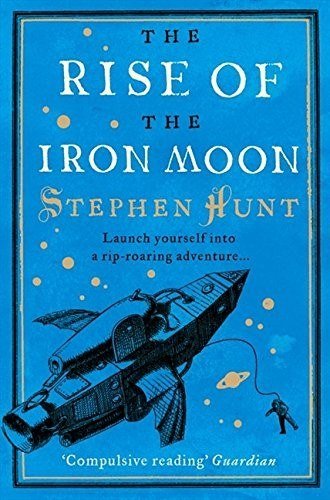
The Rise of the Iron Moon is another Jackelian canon candidate because it shows how elastic Hunt's secondary-world steampunk can be. After the conspiratorial opening of The Court of the Air and the expeditionary lost-world adventure of The Kingdom Beyond the Waves, this entry moves toward invasion and planetary strangeness.
The spreadsheet tags the motifs as alien invasion, Jackelian world, robots and empire. That combination is a good summary of the book's field-guide value. It pushes steampunk fantasy beyond local machinery and national politics into a wider speculative register, while still keeping the Jackelian taste for strange devices, state power and social disorder.
Invasion stories have a long relationship with steampunk's ancestry. Wells's The War of the Worlds is one of the great proto-steampunk scientific romances, and later works repeatedly return to the shock of advanced or alien power arriving in a world that thought itself secure. Hunt's version operates inside his invented world, but the underlying question is familiar: what happens when the existing political and technological order meets a threat outside its categories?
The robot element keeps the mechanical imagination visible. Hunt's machines are not simply tools; they are tied to older histories, social anxieties and the strange depth of the setting. Robots in this kind of steampunk fantasy are never only hardware. They raise questions about labour, sentience, command, inheritance and the uncomfortable possibility that the past built things the present cannot politely manage.
The invasion element also lets Hunt test the Jackelian world's internal conflicts against an external pressure. A society already divided by class, politics and ancient mysteries does not become magically sensible because the sky has produced a larger problem. If anything, crisis reveals which institutions were mostly costume. That is useful steampunk drama because it makes the political machine rattle.
The "iron moon" image has the right pulp-cosmic force for this branch of the guide. It suggests astronomy, machinery and threat at once. Steampunk often looks downward into factories or backward into buried histories. Here the danger rises above the world, turning the sky itself into a mechanism of anxiety.
Empire is again important. The Jackelian world is full of states, institutions and power structures that respond to crisis with varying degrees of wisdom, panic and ceremonial nonsense. That is part of the pleasure. Hunt understands that political systems are dramatic machines. Put them under invasion pressure and every loose gear starts singing.
For readers, The Rise of the Iron Moon is not necessarily the first Jackelian stop. Start with The Court of the Air if you want the world to unfold from the beginning. This entry is more useful once the reader understands the setting's appetite for airships, revolution, class tension and strange old powers.
It also makes a good link to field-guide themes on invasion, planetary weirdness and robots. Steampunk can sometimes feel earthbound, obsessed with cities and empires. This book lets the Jackelian line look upward and outward, while keeping its boots in the same politically unstable mud.
That outward movement is important for a sequence page. The Jackelian books are not simply repeating airship plots. They keep shifting the scale: conspiracy, expedition, invasion, maritime pressure, military adventure. The Rise of the Iron Moon marks the point where the setting proves it can handle planetary weirdness without abandoning its steampunk grammar.
It is also a useful recommendation for readers who like Wellsian invasion ancestry but want it refracted through secondary-world fantasy. The result is not a direct homage to The War of the Worlds, but a related problem: a society that already believes itself complicated discovers that the wider universe has not finished adding complications.
Is it really steampunk?
Yes. The Rise of the Iron Moon is core secondary-world steampunk fantasy, with invasion stakes, robots, empire, strange machinery and the Jackelian mixture of politics, adventure and old powers.
The classification should not pretend it is the same sort of steampunk as The Difference Engine or Soulless. It belongs to the big secondary-world branch, where the technology and social order are invented rather than alternate-historical. That branch is still steampunk when the machinery, politics and retro-industrial imagination shape the world at depth.
Its role is to show how the Jackelian sequence broadens from airships and revolution into invasion and cosmic pressure. That makes it a useful companion to The War of the Worlds, Leviathan and other works where technology, war and the sky become everyone else's problem.
Find it
If you would like to track down The Rise of the Iron Moon, these search links may help. We have not specified an edition, so you can pick the format that suits you.
Affiliate links: as an Amazon Associate, Stephen Hunt’s SFcrowsnest earns from qualifying purchases. These may earn us a small commission at no extra cost to you.