Why it matters
It broadens the Jackelian sequence into mystery, island politics, ancient technology and lost knowledge.
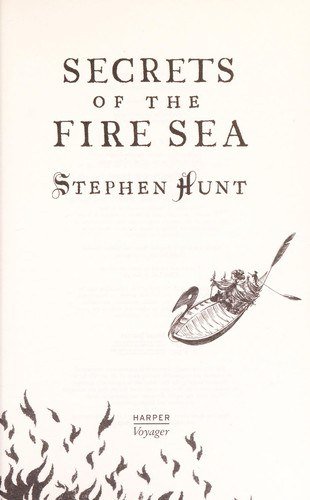
Stephen Hunt's Secrets of the Fire Sea takes the Jackelian appetite for strange places, old powers and political trouble, then parks it on an island where mystery has clearly been breeding without a licence.
Secrets of the Fire Sea is another Jackelian entry that shows how Hunt's secondary-world steampunk can change shape from book to book. After conspiracy, lost-world expedition and invasion-scale weirdness, this one leans into island mystery and buried technological history. That makes it useful because it demonstrates range within the same fictional world.
The island setting matters. Steampunk often loves cities, rails and airships, but islands offer a different pressure: isolation, controlled society, hidden history and the feeling that every dock has been keeping a secret. In a Jackelian context, that isolation becomes a way to explore politics, faith, machinery and old powers without losing the broader world.
Ancient technology is one of the recurring Hunt motifs. The Jackelian world is not a clean technological ladder from primitive to advanced. It is layered with prior civilisations, forgotten mechanisms and powers that complicate the present. That makes the books more than airship fantasy. They are also about inheritance: what a society does with machines and histories it did not fully create.
The mystery structure gives Secrets of the Fire Sea a different route into steampunk. Instead of a simple expedition or war plot, the story invites investigation. This is useful because steampunk worlds are often built from secrets. Hidden machines, hidden histories, hidden institutions and hidden motives all need narrative forms that can uncover them without resorting to a lecture in a corridor.
The setting of Jago, surrounded by the Fire Sea, gives the book a contained pressure that suits mystery. Isolated locations are good for secrets because everyone knows enough to be guilty of something, and leaving is rarely as easy as one would like. Hunt uses that geography to focus the Jackelian world's larger concerns into a tighter, stranger social space.
The ancient-tech strand is especially useful for reading Hunt's lost-technology material. In the Jackelian books, old machines and powers are not decorative relics. They are active inheritances. People fight over them, misread them, fear them and try to bend them into present-day politics. That is very steampunk in spirit, even when the setting is wholly invented.
The book's mystery also gives readers a different way into the sequence. Not everyone wants airship war first. Some readers want locked-room pressure, island strangeness and the slow discovery that the past has installed machinery under the floorboards. Secrets of the Fire Sea gives them that route.
The book links strongly to Jackelian politics. Hunt's invented societies are rarely stable wallpaper. They have factions, laws, beliefs and old tensions that shape the adventure. That is part of the appeal. The machines may be strange, but the politics are often stranger, and more expensive to repair.
This is also a good place to connect the Jackelian books to non-Hunt entries about lost technology and isolated societies. The novel shares some field-guide DNA with The Kingdom Beyond the Waves, but its scale and flavour differ. It is less expeditionary and more investigative, less horizon-chasing and more concerned with what has been hidden in one charged location.
Readers new to Hunt should probably begin with The Court of the Air, but Secrets of the Fire Sea is useful once the Jackelian world is established. It offers another door into the setting: not the grand first entrance, but a side door with suspicious scorch marks.
Is it really steampunk?
Yes. Secrets of the Fire Sea is core secondary-world steampunk fantasy. Its ancient technology, political world-building, mystery structure and Jackelian machinery place it securely inside the field's invented-world branch.
The book belongs because of what it contributes: island mystery, lost technology, politics and the ongoing expansion of the Jackelian setting. It does not need overselling; its place is clear once the island mystery and old machinery come into view.
Readers interested in steampunk mysteries, ancient machinery and secondary-world politics should find it relevant. Those specifically tracking airship war may prefer Jack Cloudie, while those chasing lost-world exploration may go to The Kingdom Beyond the Waves. The pleasure is choosing the right hatch.
As part of the wider Jackelian map, it shows that Hunt's world is not only broad but modular. Different books illuminate different corners: court conspiracy, expedition, invasion, island mystery, airship war and subsea adventure. This one keeps the flame under secrets and lets the pressure build.
Find it
If you would like to track down Secrets of the Fire Sea, these search links may help. We have not specified an edition, so you can pick the format that suits you.
Affiliate links: as an Amazon Associate, Stephen Hunt’s SFcrowsnest earns from qualifying purchases. These may earn us a small commission at no extra cost to you.