Why it matters
It is one of the essential YA steampunk works, pairing mechanical war machines with engineered living technology.
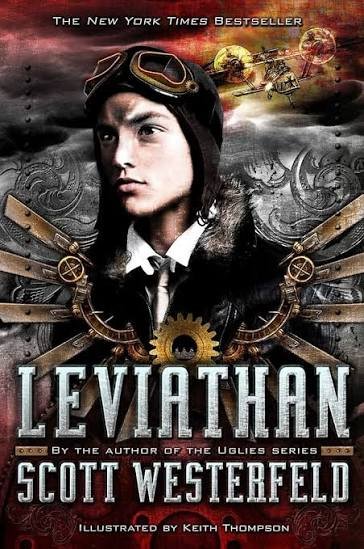
Scott Westerfeld's Leviathan looks at the First World War and asks whether it might be improved, fictionally speaking, by giant walking machines on one side and fabricated beast-airships on the other. History, wisely, was not consulted.
Leviathan opens a major YA alternate-history trilogy in which the First World War is reimagined as a conflict between Clankers, who use mechanical walkers and engines, and Darwinists, who use fabricated living creatures as technology. That split is the book's great field-guide gift. It gives steampunk a clear, elegant opposition: machinery versus biology, steel versus engineered life, pistons versus fabricated ecosystems.
The novel follows Alek, an Austro-Hungarian prince on the run, and Deryn Sharp, a girl disguising herself as a boy to serve in the British Air Service. Their stories bring together court politics, military flight, class, gender performance and the wider machinery of war. The result is accessible, fast and conceptually strong.
The Leviathan itself, a massive living airship, is one of modern YA steampunk's best images. It is not merely an airship with an organic skin. It is a complete biotechnology environment, part whale, part ecosystem, part military vessel. This makes the book stand out from more conventional steam-and-gear adventure. Westerfeld's Darwinist technology asks readers to imagine engineering through life rather than metal.
The Clanker side keeps the steampunk machinery firmly in view. Walkers, engines and war machines give the book its mechanical bite. The conflict between the two technological cultures is not only visual, though the visuals are splendid. It raises questions about what societies value, fear and normalise. One side trusts engines, the other trusts fabricated organisms, and both are perfectly capable of making a mess.
The alternate-WWI setting gives the book a dieselpunk-adjacent shadow while remaining steampunk in texture. It is later than the Victorian sweet spot, but its visible machines, airships, monarchies and retro-engineering keep it close to the field. It belongs to the wider retrofuturist war-machine tradition, with enough biological invention to make the label biopunk-steampunk useful.
The illustrations by Keith Thompson are also part of the book's field-guide impact. They make the rival technologies instantly legible: Clanker metal has weight and angles, Darwinist beasts have sinew and strangeness. Steampunk has always been visual as well as literary, and Leviathan understands that a young reader should be able to feel the machinery of the world at a glance.
Alek and Deryn give the technology split a human shape. He is tied to old dynastic politics and Clanker machinery. She is tied to disguise, service and the Darwinist air world. Their crossing paths lets the novel turn a world-system contrast into character drama, which is why the premise does not remain a diagram.
For readers, Leviathan is an excellent entry point because it has a clean premise, strong protagonists and a world that explains itself through action. It does not require prior steampunk literacy. It teaches the reader its own rules while the engines start and the living airship breathes overhead.
Deryn's disguised service also gives the book a lively gender thread. Steampunk and military adventure often inherit old boys'-own patterns; Westerfeld knowingly bends that inheritance. Deryn is not there to admire the machinery from the sidelines. She is inside it, working it, lying magnificently and earning her place in the sky.
The book is especially good at making technology feel cultural. The Darwinists do not merely use beasts because beasts are colourful. Their whole scientific tradition has developed around fabrication, ecosystems and living tools. The Clankers do not merely use metal because metal is loud. Their machines express hierarchy, engineering confidence and military industry. That cultural depth is why the split works.
The trilogy structure also gives the premise room to travel. Leviathan sets up the technological divide and the central partnership, while later books expand the war and its strange alliances. The first volume is the cleanest entry point, with the full arc carrying the premise into wider war and stranger alliances.
Is it really steampunk?
Yes. Leviathan is core YA steampunk with a strong biopunk twist and an alternate-WWI frame. Its Clanker machines, living airships, retro-military world and air-service adventure make it one of the clearest modern young-reader entries in the field.
The book's importance lies in how cleanly it expands the technology palette. Steampunk does not have to be only brass and steam. It can create a world where biological engineering becomes the rival tradition to machinery. That gives the genre a fresh argument while keeping the appeal of visible, understandable systems.
Placed beside Mortal Engines and Airborn, Leviathan shows how strong YA steampunk was in this period. Reeve gives us predatory cities. Oppel gives us elegant passenger airships. Westerfeld gives us war machines and living vessels. Between them, the young-reader branch of the field looks impressively well supplied with things one should probably not stand beneath.
Find it
If you would like to track down Leviathan, these search links may help. We have not specified an edition, so you can pick the format that suits you.
Affiliate links: as an Amazon Associate, Stephen Hunt’s SFcrowsnest earns from qualifying purchases. These may earn us a small commission at no extra cost to you.