Jackelian world
Mechancia
A civilisation of steam-driven people who are, awkwardly for everyone, arguably more human than the humans.
Science fiction has, on the whole, one story about the machines. The story has variants — Asimov’s Three Laws, Banks’s Culture Minds, Ellison’s I Have No Mouth, Adams’s Marvin, Egan’s Diaspora citizens, Sladek’s Roderick, the entire Cybermen filmography — but under the variants, the same underlying anxiety keeps recurring, which is will they eat us?, in various registers, from horror through comedy through commercial-space-opera reassurance. The question the story is really asking is whether the machines are people, and the reader is generally invited to arrive at not quite and have a nice cup of tea about it.
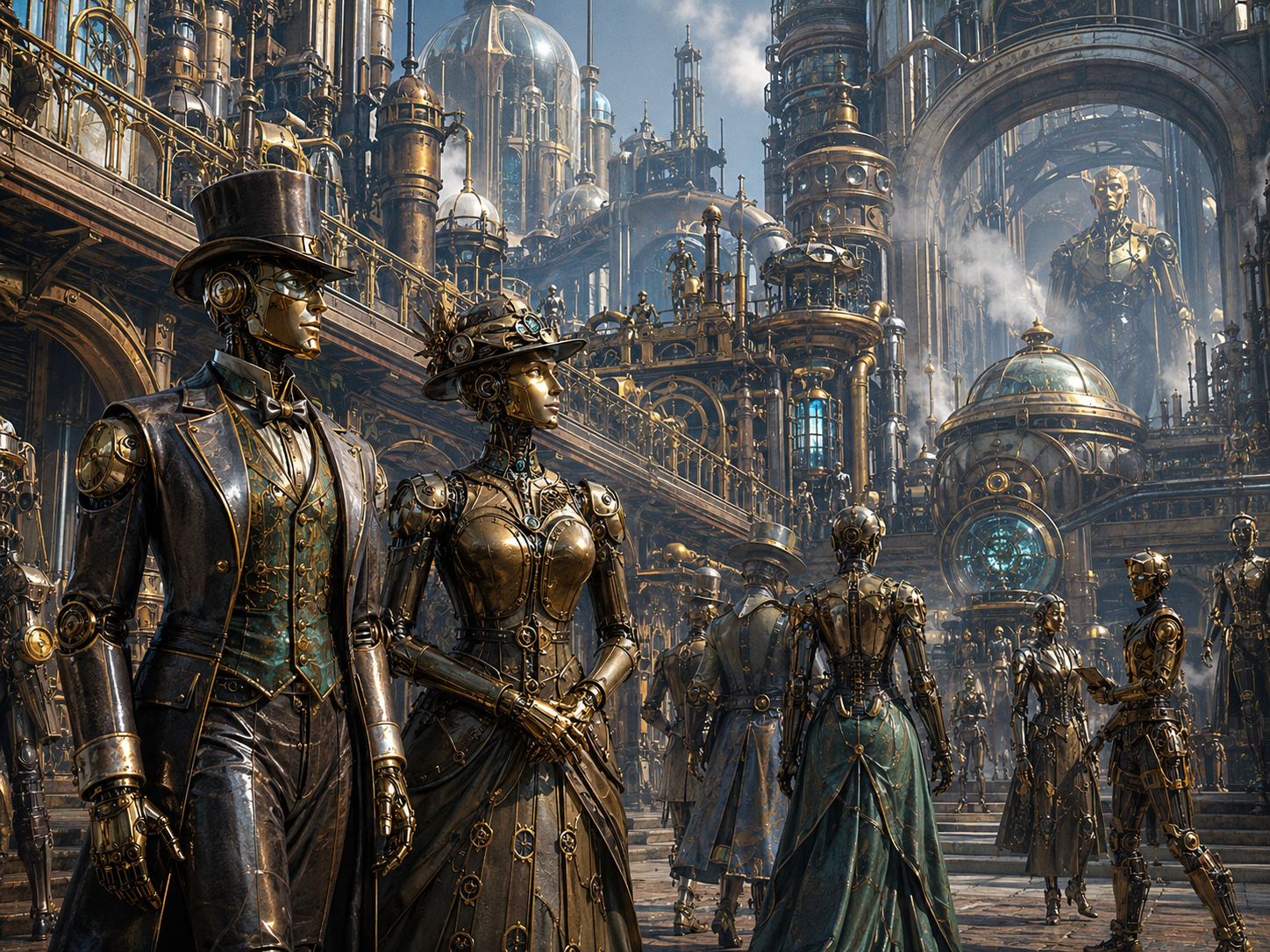
Stephen Hunt’s Jackelian sequence quietly refuses to have the argument at all. In its opening chapters it introduces a civilisation of intelligent, brass-bodied steam-driven citizens who have their own country, their own king, their own religion, their own ambassadors, their own alcohol equivalent, and their own strong preferences about being addressed correctly at diplomatic functions. They are called the steammen. Their nation is called the Steammen Free State by outsiders and Mechancia by themselves, and the polite thing to do is use the second one. They are, as it happens, one of the finest sustained inventions in modern flintlock fantasy — and if you are going to make any sensible claim about which people in the Jackelian world are most fully people, you are going to have to fight your corner past the steammen first.
What Mechancia actually is
Mechancia is a sovereign kingdom in the high country to the west and north of the Kingdom of Jackals, ruled from a mountain capital by an unbroken monarchy going back further than most of the surrounding humans’ religions. Its economy is craft-based, its infrastructure is thermal, its neighbourhoods are laid out for citizens of varying frame size and stride length, and its climate is largely managed by pipe. The steammen do not experience cold in the human way; they experience it as a concern, in the way a shipping company experiences a strike. Their engineering vocabulary for the problem is much richer than English’s.
The kingdom’s dominant political fact is its long alliance with the Kingdom of Jackals. The two nations fought side by side against the old Jackelian aristocracy in the civil war that shaped the modern parliamentary state, and neither side has forgotten. The dominant economic fact is that Mechancia mines celgas — the buoyant lift-gas that keeps the entire Royal Aerostatical Navy in the sky — and licenses it to Jackals on carefully negotiated terms. Every treaty between the two countries has celgas somewhere in its subordinate clauses, and every steamman ambassador knows exactly what those clauses say.
The current monarch is King Steam, which is a title rather than a personal name; the current holder of the title is the latest in a long line, and his predecessors are still available for consultation, in a sense that requires explanation.
The Loas
Steammen do not die the way humans die. When a steamman’s frame wears past the point of repair — and frames do; they are physical, and physical things fatigue — the consciousness within it is not lost. It is transferred, in a rite the steammen take with the utmost seriousness, into the honoured ancestral registry the steammen call the Loas. A Loa is a steamman who has passed out of the world of daily service and into the world of counsel. King Steam consults them. So do the knightly orders. So do private citizens on the eve of significant decisions. The Loas are not metaphors, and they are not analogies for human belief in an afterlife. They are, in the Jackelian world, present, addressable and reliably tetchy. Any human theologian who takes the time to sit with a steamman priest comes away disquieted, because the steammen have the one thing human religions have historically had trouble producing on demand: evidence.
This has consequences. A civilisation whose ancestors continue to be available is a civilisation with a strong sense of continuity, a low tolerance for fashionable ideas, and an intensely developed etiquette. The steammen are courteous in a way that would embarrass a Victorian butler, and they are courteous up, down and across — because at any given point in the conversation, someone within earshot might be a Loa’s descendant, or a Loa’s inheritor, or the chassis a Loa is quietly renting for the afternoon.
Frames, orders, knights
There is no single steamman shape. There are frames, and frames come in kinds: the great knightly chassis of the religious-military orders; the tracker frames of the scouting brotherhoods; small quick bodies for tight work; specialist frames for weather, for depth, for the long patience of watchtower duty. The kingdom’s most respected professions are the knightly orders — steamman knights are simultaneously soldiers, priests and craftsmen — and any child raised in Mechancia grows up with a preferred order the way a human child in a certain kind of English village might grow up with a preferred cricket club. Hunt writes the knights with the utter straightness of tone one would expect from someone who has done the reading in every knightly-order novel written from Malory forward and is not about to make a joke.
He is also, importantly, not sentimental about them. Steamman knightly life has losses. One of the most affecting figures in the whole sequence is Boxiron: a steamman who was once a knight of the highest register and whose frame was destroyed in a manner Mechancia’s rites of restoration could not fully repair. Boxiron now walks in a cheap Middlesteel-built human-shaped body, which for a steamman knight is exactly the kind of quiet humiliation an English readership will recognise from other novelists’ treatments of exile and reduced circumstance. Boxiron does not complain. That is part of what makes him a knight. The reader complains for him.
More human than the humans
Which brings us to the subtitle. The claim that the steammen are, awkwardly for everyone, arguably more human than the humans, is not decoration — it is what the Jackelian sequence spends seven novels quietly demonstrating.
Consider. The humans of Jackals believe in Circlism, a philosophically respectable but distinctly thin doctrine of consciousness returning through cycles, which the average Jackelian citizen professes on a Sunday and does not visibly consult on any other day of the week. The steammen believe in the Loas, whose opinions they can hear and act upon. Which of the two, one is entitled to ask, has a functioning religion?
The humans of Jackals have a monarchy that has been formally diminished for excellent historical reasons, and whose current holder attends ceremonies. The steammen have an unbroken monarchy operating in continuous consultation with its ancestors. Which of the two, one is entitled to ask, has a functioning kingship?
The humans of Jackals have the Special Guard, a corps of magically altered citizens on state licence and under state collar. The steammen have knightly orders whose members serve by vocation. Which of the two, one is entitled to ask, has a functioning ideal of public service?
The humans have industrial modernity’s shortcuts. The steammen have — bluntly — craftsmanship. Hunt does not push the argument, but he does not need to. It arrives on its own, as good arguments do, by attrition.
None of which is to say the steammen are a utopia. They quarrel; they hold grudges the length of centuries; they have historical enmities they do not intend to relinquish; they are not, in the ordinary sense, warm. But they are consistent. The gap between what a steamman says he believes and what a steamman actually does about it is very small. In a fantasy sequence which spends a great deal of its time on a continent full of humans making exactly the opposite trade, that gap is the point being made.
Where you meet them
Coppertracks is your first steamman, and he is your best introduction: a scholar-savant on extended sabbatical among Jackelian society in The Court of the Air, who returns across the sequence. Ironflanks is your steamman in the field, a tracker-order scout on Amelia Harsh’s expedition in The Kingdom Beyond the Waves. Boxiron is your steamman in exile, walking the streets of Middlesteel in the wrong body in Secrets of the Fire Sea and From the Deep of the Dark. King Steam himself makes appearances in The Court of the Air and The Rise of the Iron Moon, and there are worse ways to spend an afternoon than in his throne-room.
Read any of them. Then reconsider what a robot is, and what a citizen is, and whether the two categories were ever as separate as science fiction has spent a hundred years assuming they had to be.
The steammen have already reconsidered. They are simply too polite to make you feel bad about it.