
Why it matters
It pushed steampunk-adjacent industrial fantasy into a darker, stranger, more politically charged urban form.
New Crobuzon is what happens when the industrial city grows teeth, politics, thaumaturgy and a civic attitude best described as "try not to breathe too deeply".
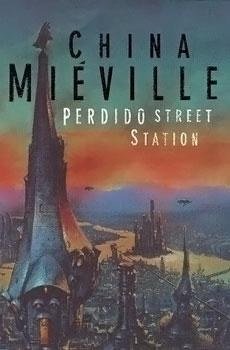
China Mieville's Perdido Street Station is not steampunk in the classic brass-goggles sense, and it is stronger for not trying to be. It belongs to New Weird and industrial fantasy, building a city where science, magic, labour, species, crime, empire and nightmare all share the same air. If much steampunk is fascinated by the nineteenth-century machine, Perdido Street Station is fascinated by the industrial city as organism, prison and fever dream.
The novel centres on Isaac Dan der Grimnebulin, a scientist in New Crobuzon, whose work draws him into consequences far beyond academic ambition. The city around him is the real star: immense, dirty, multi-species, politically violent and socially stratified. It is a place of factories, rails, militias, artists, criminals and impossible biology. One does not visit New Crobuzon so much as acquire it in the lungs.
The important thing is the book's relationship to industrial imagination. Steampunk often aestheticises machinery, polishing the engine until it glows. Mieville does almost the opposite. His machines, sciences and urban systems are sticky with exploitation, state power and bodily transformation. The result is steampunk-adjacent because it shares the industrial and retro-urban obsession, but it refuses the comfort of nostalgia.
The "monstrous sciences" motif is especially important. In this world, knowledge does not sit in neat disciplines. Biology, magic, engineering and politics contaminate one another. That makes the book a strong cousin to industrial fantasy and gaslamp grotesque. Its inventions are not delightful toys. They are part of a society where bodies can be remade, punished, sold or weaponised.
Class and empire are not background seasoning. They shape the city. New Crobuzon is a colonial and capitalist power with police violence, labour tension and social hierarchy built into its streets. This gives the novel a harder political edge than many retrofuturist works. It asks not merely what machines can do, but who gets fed into the system that builds them.
The book's influence on the wider field is partly tonal. After Perdido Street Station, a certain kind of industrial fantasy could be bigger, dirtier and less polite. It helped show that speculative cities did not need to be charming. They could be overwhelming, grotesque and morally compromised, with beauty appearing in cracks rather than on postcards.
The Remade are crucial to this argument. They are punished bodies, altered by the state into living examples of power's creativity and cruelty. Steampunk often enjoys prosthetics, augmentation and mechanical bodies, but Mieville turns bodily modification toward punishment, labour and social control. That is one reason the book sits so usefully near the field while also challenging its habits.
The novel's sciences are similarly uncomfortable. Isaac's work has wonder in it, but knowledge in New Crobuzon is embedded in risk, ambition and social consequence. The laboratory is not outside politics. It is one of the places politics happens. That lesson should be engraved above the door of many steampunk workshops, ideally before the first unethical experiment starts smoking.
Purists should file it as New Weird / Industrial Fantasy rather than core steampunk. That label is not evasive; it is accurate. The novel is too biologically strange, too magically hybrid and too politically feral to sit neatly among Babbage engines and airship adventure. But the adjacency is essential. It expands the field's sense of what industrial fantasy can be when it stops polishing the brass and starts following the smoke.
Is it really steampunk?
No, not strictly. Perdido Street Station is New Weird industrial fantasy with steampunk-adjacent machinery, urban density and social concerns. It belongs near steampunk because it shares the field's fascination with industrial modernity, but transforms that fascination into something stranger and less nostalgic.
Readers coming from steampunk may find the book bracing. It has no interest in giving the city a charming vintage glow. Its engines are embedded in class, punishment and monstrous transformation. That makes it invaluable for anyone who wants the field to include the unpleasant implications of industrial fantasy, not only its decor.
It also connects strongly to later works that use fantastical cities as total environments. If Mortal Engines literalises the mobile city, Perdido Street Station makes the static city feel just as predatory. Both understand that a city is not merely a setting. It is a machine made of people, appetites, laws and waste.
For readers, the book is best approached as a neighbouring giant rather than a tidy genre specimen. It will not supply the comfort of clean brass adventure. It will supply one of the most forceful arguments that industrial fantasy can be politically angry, bodily strange and architecturally immense.
One word short of steampunk purity, perhaps, but several miles deep in industrial consequence.
Find it
If you would like to track down Perdido Street Station, these search links may help. We have not specified an edition, so you can pick the format that suits you.
Affiliate links: as an Amazon Associate, Stephen Hunt’s SFcrowsnest earns from qualifying purchases. These may earn us a small commission at no extra cost to you.