
Why it matters
It gives the field towering war machines, alien modernity and a brutal reversal of empire-age assumptions.
Nothing improves imperial confidence like finding out that someone else has better machines, worse manners and a firm interest in your home counties.
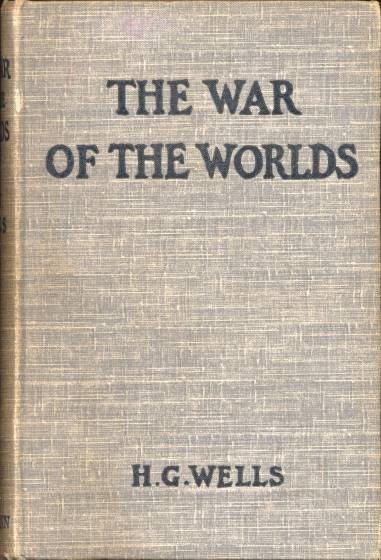
H. G. Wells's The War of the Worlds is one of the great invasion stories and a major ancestor of steampunk's darker mechanical imagination. Its Martians do not arrive as noble visitors or diplomatic puzzles. They arrive inside cylinders, assemble lethal machines and proceed to treat southern England with the chilly efficiency that European empires had often applied elsewhere.
The novel's famous tripods are crucial. They are not steampunk machines in the usual retro-industrial sense, but they are part of the same family of frightening apparatus: towering, mobile, inhuman, and tactically unfair. Later steampunk and dieselpunk-adjacent works would return again and again to walkers, landships, mechanical infantry and giant weapons that make ordinary courage look under-equipped.
Wells's genius is to make the familiar world feel suddenly provincial. Railway lines, artillery, newspapers, military assumptions and suburban routines all buckle under Martian pressure. The invasion is cosmic, but it is also local: commons, roads, villages, crowds and domestic spaces become part of the battlefield. The effect is not only spectacle but humiliation. Britain discovers what it means to be the less advanced power.
That imperial reversal is one reason the book matters to any serious reading of steampunk. The genre is often tempted by the surface pleasures of empire-era style: uniforms, maps, expeditions, grand hotels, polished hardware. Wells throws a brick through that shop window. He asks what happens when empire is not the subject doing the measuring, but the object being measured.
The novel also helps establish a vocabulary of alien technology as terror. The heat-ray and black smoke are not gadgets for admiration. They are tools of extermination. This is an important difference from the cosier corner of retrofuturism. Wells is not asking readers to applaud clever engineering. He is asking them to imagine being on the wrong end of it.
Purists will again call it scientific romance rather than steampunk, and they will be right. Yet the route into steampunk is direct. Works such as Space: 1889 and Scarlet Traces grow from the same Wellsian soil: Victorian or Edwardian worlds confronted by extraterrestrial power, mechanical warfare and the uncomfortable possibility that civilisation is just vulnerability with better stationery.
For readers, the book remains brisk and grim. Its narrator is not an action hero saving civilisation with a ray rifle. Much of the power comes from flight, confusion, rumour and breakdown. Wells understands disaster socially. People do not just fight the Martians. They misread them, report them, flee them, gossip about them and fail to grasp the scale of what has arrived until the familiar order has already come apart.
That attention to social collapse gives the novel a reach beyond its alien premise. The Martian machines are terrifying, but so is the human response: panic, speculation, denial, opportunism and sudden helplessness. Steampunk can use this lesson whenever it introduces a new technology. The arrival of a machine is never only a technical event. It changes crowds, governments, newspapers, soldiers and breakfast tables.
The book's biology is just as important as its engineering. The Martians are not knights in better armour. They are evolved, specialised beings whose machines compensate for frailty and amplify appetite. That makes their technology feel like part of their bodies and culture, not a collection of detachable props. Later invasion stories, especially those with retrofuturist equipment, keep returning to this queasy union of creature and apparatus.
It also gives the field a model for scale. A single village, a single road or a single railway station can register planetary catastrophe if the writer keeps the human angle sharp. Steampunk and adjacent invasion tales often borrow that method, placing cosmic or technological upheaval beside ordinary domestic panic.
Is it really steampunk?
No, not as a modern genre specimen. The War of the Worlds is proto-steampunk and scientific romance, a work later steampunk repeatedly raids for invasion machinery, imperial critique and Martian menace. It sits beside the genre as a parent with alarming opinions and a shed full of tripods.
Its steampunk value lies in how it bruises the fantasy of technological superiority. Many retrofuturist stories ask, "What if the Victorians had built astonishing machines?" Wells adds, "What if somebody else built better ones and came looking for lunch?" The result is not only more honest but much more interesting.
It sits near The Time Machine, The Space Machine, Space: 1889 and other works where nineteenth-century modernity meets a force it cannot politely annex. It is a reminder that the age of machines includes the terror of being out-machined.
Find it
If you would like to track down The War of the Worlds, these search links may help. We have not specified an edition, so you can pick the format that suits you.
Affiliate links: as an Amazon Associate, Stephen Hunt’s SFcrowsnest earns from qualifying purchases. These may earn us a small commission at no extra cost to you.