
Theme
Empire, Class and Rebellion
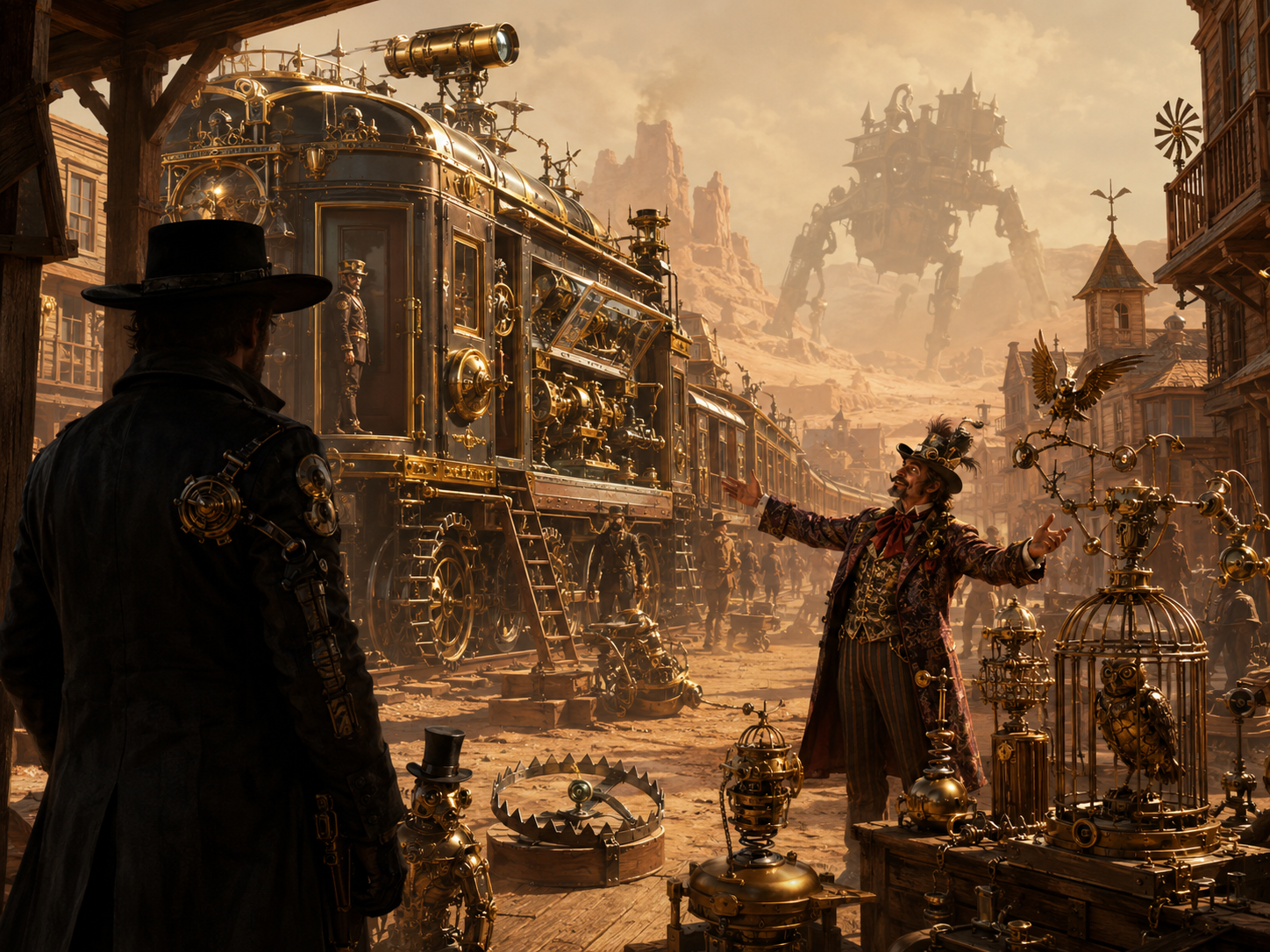
Every airship needs a crew, every empire needs a boiler room, and steampunk is at its best when it remembers who is shovelling the coal.
The shine and the soot
Steampunk can be lazy if it only polishes the empire and calls the result romance. The good stuff knows that the brass was cast by someone, the corsets were stitched by someone, and the gleaming city runs on labour that rarely gets a parade.
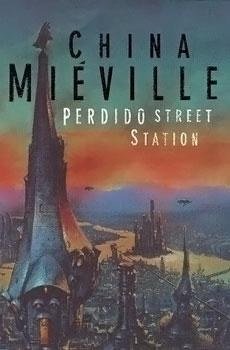
Mieville’s Perdido Street Station drags the reader through the grime of New Crobuzon, where industry is a smell as much as a skyline. It is the genre at its least nostalgic and most honest.
That may be the single most useful test of the genre. Show us the shining brass, by all means. Give us the airships, the goggles, the automatons, the steam computers, the enormous cannon with an inventor standing beside it looking professionally unwise. But then show us the people underneath the machine. Who built it? Who oils it? Who pays for it? Who is expected to die when it explodes? Who gets a medal, who gets a wage cut, and who gets told the accident was very regrettable but technically within policy?
Steampunk looks charming from a balcony. It looks rather different from the furnace room.
This is why empire and class are not optional extras in steampunk. They are built into the machinery. The genre borrows so much of its furniture from the nineteenth century: Victorian Britain, industrial cities, railways, factories, colonial adventure, gentlemen explorers, inventors, drawing rooms, slums, uniforms, trade routes, gunboats, museums and ministries. You cannot import that scenery and pretend it arrived without politics. The fog comes with soot in it. The brass has fingerprints. The map has blood in the margins.
The airship is a perfect example. From a distance, it is one of the great romantic images of steampunk: a magnificent vessel drifting above towers and clouds, signal lamps blinking, propellers turning, captain on the bridge, adventure swelling like an orchestra that has just discovered altitude. Yet the airship is also a hierarchy with gasbags. It has officers, crew, engineers, stokers, servants, passengers and perhaps a few inconvenient stowaways. Someone owns it. Someone commands it. Someone scrubs it. Someone patches the envelope in a storm while a duke drinks brandy in the observation lounge and calls the weather bracing.
That is steampunk in miniature. The wonder is real, but so is the labour.
The same is true of the city. A steampunk metropolis often gleams with impossible engineering: elevated railways, gaslit boulevards, pneumatic tubes, mechanical horses, clock towers, brass bridges and a central ministry large enough to have its own weather system. But a city is not made of architecture. It is made of people being sorted by money, class, origin, accent, profession and usefulness. The upper city may have domes and gardens. The lower city has soot, rent, factories and policemen who appear quickly when the wrong sort of person starts asking about wages.
Good steampunk understands verticality. It knows the rich live above the smoke and the poor breathe it. It knows that every fine view depends on someone else not having one. The genre’s towers, airship docks and elevated railways are beautiful, but they also make class visible. Who gets to rise? Who stays below? Who controls the lifts? There is an entire political theory hidden inside the question of who is allowed onto the upper deck.
Empire adds another layer of machinery. The nineteenth-century imagination loved maps, expeditions, trade routes, naval power, museum collections and the idea that distant places existed largely to be discovered by men who had brought the wrong shoes. Steampunk inherits that imagery, but modern steampunk cannot use it innocently. The empire in a steampunk story is not just a backdrop of flags and uniforms. It is a system of extraction. It takes resources, labour, land, artefacts, stories and lives, then ships them home with labels attached.
This is where the brass romance can turn sour if the writer is not paying attention. The colonial expedition, the lost city, the gentleman adventurer, the airship over foreign skies, the Martian canal, the jungle temple with a machine inside: all of these can be thrilling. They can also repeat old fantasies where empire is adventure for the invader and catastrophe for everyone already living there. Steampunk does not need to throw away the adventure. It needs to know who is being adventured at.
That awareness has become one of the most interesting parts of modern steampunk. The genre can still enjoy machines, maps and impossible travel, but it can also tilt the lens. The explorer may not be the hero. The museum may be a crime scene with labels. The native guide may know more than the professor, which should surprise nobody except the professor. The airship arriving over the horizon may not be a symbol of wonder. It may be a warning.
Rebellion enters naturally because a steampunk world is usually full of pressure. Factories build pressure. Boilers build pressure. Empires build pressure. Class systems build pressure. A story full of valves, gauges and sealed chambers is practically begging someone to ask what happens when the poor, the colonised, the mechanised, the excluded and the over-taxed decide not to remain decorative.
The answer, in steampunk, is often magnificent trouble.
Rebellion suits the genre because it turns the machinery back on its owners. A stolen airship becomes a revolutionary vessel. A telegraph network carries forbidden messages. A punch-card engine is hacked by clerks with better politics than their employers. Factory workers sabotage the war automata. Street children know the city’s pneumatic tunnels better than the police. An automaton built for service discovers conscience. A boiler room becomes a parliament with sootier trousers.
This is why class is more than background flavour. It provides plot. A rigid society gives characters something to push against. An industrial city gives them places to hide, organise, print pamphlets, smuggle components, jam signals, block railways and vanish into crowds. A ministry gives them files to steal. A factory gives them leverage. A machine gives them a target.
It also gives steampunk its best human texture. The genre is at its weakest when everyone is an aristocrat, genius inventor, chosen heir or mysterious lady with a pistol in her boot. Those people are fun, certainly. One would not ban them from the party. But a world made only of exceptional people soon starts to smell like a costume cupboard. Add engineers, stokers, clerks, seamstresses, soldiers, dockers, servants, factory girls, railway porters, newspaper sellers, mechanics and disaffected schoolteachers, and suddenly the place breathes.
Every machine has a social shadow. The steam computer is not just a marvel of calculation. It is a bureaucratic beast that may decide taxes, identity, employment, criminal records and who gets crushed under the cheerful phrase “administrative necessity.” The automaton is not just a brass person. It raises questions about labour, rights and whether the wealthy have built servants because they dislike being reminded that servants are people. The railway is not just travel. It is trade, military movement, land seizure, commuting, migration and profit laid down in iron lines.
Even the gentleman inventor needs examination. Steampunk loves inventors, and quite right too. Without them the genre would be mostly hats and damp. But invention is never outside society. Who funds the laboratory? Who mines the ore? Who tests the prototype? Who lives next to the factory? Who is blamed when the invention is used for war, policing or an exciting new form of workplace injury? A mad scientist may build a machine alone in a tower, but a nation of machines requires capital, labour and someone in accounts.
The best steampunk therefore lets the working parts talk back. It listens to the person in the engine room. It notices the servant who overhears everything. It gives the clerk a name. It asks whether the automaton wants wages. It lets the colonised scientist explain that the imperial expert has misunderstood the machine entirely. It recognises that rebellion is not a decorative explosion at the end of the third act. It is the result of systems squeezing people until the pressure gauge starts to twitch.
Revolution on the schedule
Stephen Hunt’s The Court of the Air builds a whole secondary world out of revolution, class tension and institutions creaking toward catastrophe. The airships are gorgeous. The politics are the point.
From the sealed carriages of Snowpiercer to the whale-oil aristocracy of Dishonored, the genre keeps building machines whose real subject is who sits where, and what it would take to change it.
Stephen Hunt’s Jackelian books understand this kind of pressure very well. Their secondary-world steampunk is full of strange machines, airships, ancient powers, aristocratic absurdity, revolutionary force and political lunacy. The Jackelian setting is not content to admire brass from the pavement. It asks what a society built on steam, bureaucracy, class and national myth does to the people inside it. The kingdom’s vast Transaction Engines make power feel administrative as well as military: lives processed by punch cards, ministries and machines. Its airships and steam-driven wonders are splendid, but the question underneath is always who commands the contraption and who gets fed into it.
That is a very British form of steampunk unease. Britain brings the genre empire, class anxiety, industrial grime, parliamentary rot, monarchy, bureaucracy, naval imagination and the suspicion that every institution is older, stranger and more ridiculous than it admits. American steampunk often finds its energy in the frontier, the railroad, the Weird West and the mobile engine of expansion. Japanese steampunk often turns flight, lost technology and war machines into poetry and warning. Global steampunk widens the map further, challenging the old London-centred model and asking what retrofuturism looks like when empire is not the hero of the story.
That widening matters. Steampunk can be a way of questioning the past rather than cosplaying its victors. It can imagine African, Asian, Indigenous, Caribbean, Middle Eastern, Latin American and other retrofutures where technology, resistance and cultural memory do not simply orbit London like obedient moons. The nineteenth century was global. The genre should be too. Otherwise the field guide becomes a very expensive telescope pointed at the same chimney.
Empire, class and rebellion also save steampunk from becoming too tidy. There is a danger in the aesthetic, because brass can make almost anything look charming. A surveillance machine with polished fittings is still a surveillance machine. A colonial gunboat with nice upholstery is still a gunboat. A factory that employs children under decorative gaslamps is not improved by the lighting. Good steampunk lets beauty and brutality share the frame, because that is where the electricity crackles.
The rebellion need not always be grand. It does not have to be barricades, flags and speeches delivered from the top of a traction engine. Sometimes rebellion is a clerk altering a record, a mechanic refusing an order, a servant hiding a fugitive, an automaton choosing not to obey, a pilot turning the airship away from the target, a colonised scholar reclaiming stolen knowledge, a worker explaining that the machine stops if the hands stop. Steampunk is full of enormous devices, but some of its best revolutions begin with small acts of refusal.
That is also where the humour belongs. Class systems are often absurd, and steampunk should enjoy exposing the absurdity. There is something wonderfully ridiculous about a lord who believes the lower orders are naturally suited to boiler maintenance because he has never met a boiler. There is comic treasure in ministries that classify dragon attacks as a zoning issue, admirals who think gravity is a discipline problem, and factory owners surprised that workers prefer not to be minced by innovation. Satire is not separate from the genre. It is one of the pressure valves.
Still, the anger matters. Beneath the wit, steampunk has a serious engine. The nineteenth century helped build the modern world, for good and ill. It produced extraordinary science, engineering, literature and political change. It also produced industrial misery, racial hierarchy, colonial violence, ecological damage and bureaucratic systems that treated people as entries in ledgers. Steampunk can turn that history sideways, but it should not sand it smooth.
A fine steampunk story may give us the airship, the automaton, the calculating engine, the brass city and the gentleman villain with a death ray hidden inside a pipe organ. Splendid. Let the contraptions clank. But let the story also remember the dockworker, the stoker, the clerk, the rebel printer, the colonised engineer, the factory child, the steamman, the servant, the soldier and the person whose home lies under the proposed railway extension.
That is where the genre becomes more than aesthetic. That is where it becomes alive.
Because every empire has a boiler room. Every palace has foundations. Every airship casts a shadow. Every machine has someone beneath it with a shovel, a spanner, a grievance and, if the story is doing its job, a very good reason to pull the wrong lever at exactly the right time.
Why it matters
A genre obsessed with engines is, sooner or later, a genre about power: who builds it, who owns it, and who gets ground up in it. Steampunk’s best work treats the rebellion as seriously as the rivets.
From the cabinet
Entries that show this theme at work
 New Weird / Industrial Fantasy / Steampunk-adjacent
Perdido Street Station
China Mieville's Perdido Street Station is New Weird industrial fantasy, a steampunk-adjacent city of science, class and monsters.
New Weird / Industrial Fantasy / Steampunk-adjacent
Perdido Street Station
China Mieville's Perdido Street Station is New Weird industrial fantasy, a steampunk-adjacent city of science, class and monsters.
 Core Steampunk Fantasy
The Court of the Air
Stephen Hunt's The Court of the Air is core secondary-world steampunk fantasy, with airships, revolution and ancient powers.
Core Steampunk Fantasy
The Court of the Air
Stephen Hunt's The Court of the Air is core secondary-world steampunk fantasy, with airships, revolution and ancient powers.
 Dieselpunk / Post-apocalyptic Adjacent
Snowpiercer
Bong Joon-ho's Snowpiercer is dieselpunk-adjacent dystopia, putting class revolution aboard a train crossing frozen Earth.
Dieselpunk / Post-apocalyptic Adjacent
Snowpiercer
Bong Joon-ho's Snowpiercer is dieselpunk-adjacent dystopia, putting class revolution aboard a train crossing frozen Earth.
 Post-apocalyptic Steampunk
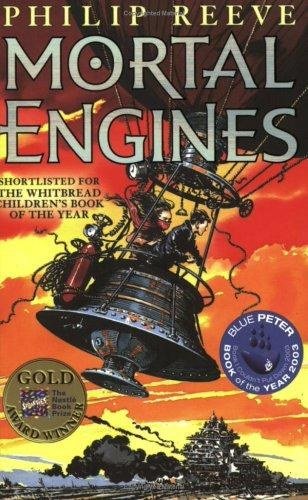
Mortal Engines
Philip Reeve's Mortal Engines is essential YA steampunk, imagining post-apocalyptic traction cities and mobile London.
Post-apocalyptic Steampunk
Mortal Engines
Philip Reeve's Mortal Engines is essential YA steampunk, imagining post-apocalyptic traction cities and mobile London.