
Pillar article
What Is Steampunk?
Steampunk is what happens when the Victorian age gets into the laboratory after midnight, finds the key to the explosives cupboard, and starts improving history with brass fittings.
In short
Steampunk is a retro-futurist genre and aesthetic in which steam-age technology, Victorian or Victorian-inspired societies and alternate histories combine, producing airships, automata, brass machinery and rebellious futures that never were.
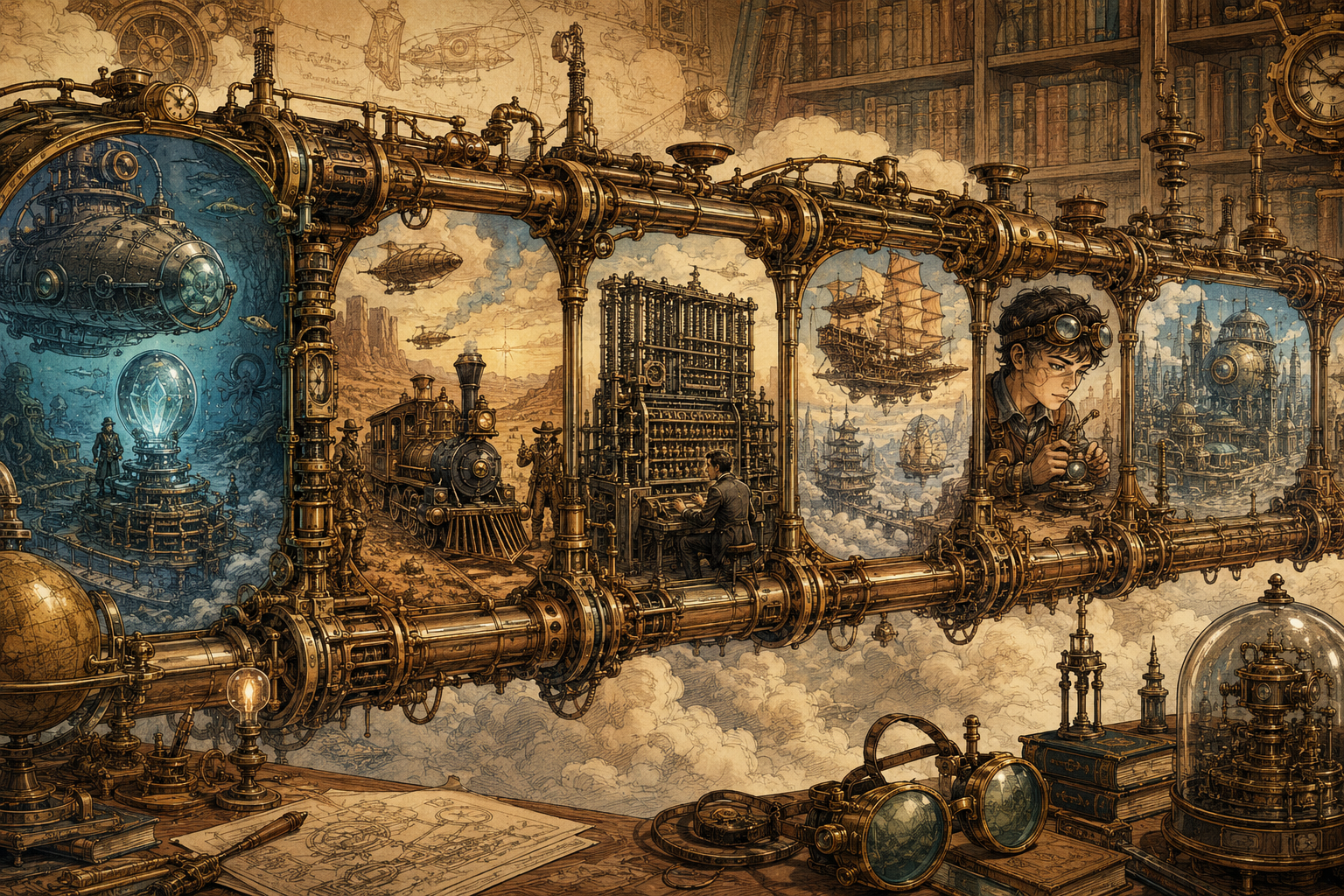
At its simplest, steampunk is a form of science fiction, fantasy and retro-futurism that imagines worlds where steam-age technology did not give way quietly to petrol, plastics, microchips and people saying “app” with a straight face. Instead, the boilers kept roaring. Airships crossed imperial skies. Difference engines clattered in government ministries. Clockwork servants brought tea. Gentlemen scientists invented things that should have been stopped by a stern aunt. Adventuresses climbed out of ballrooms and onto the roofs of speeding trains. Somewhere nearby, a top-hatted villain adjusted a monocle and prepared to conquer Belgium with a mechanical squid.
That is the surface of steampunk: goggles, gears, corsets, rayguns, airships, waistcoats, pocket watches, brass insects, steam-powered computers, elaborate weapons no sensible insurance company would cover, and cities half-choked with fog, soot and ambition. But the genre is not merely fancy dress with boiler pressure. At its best, steampunk is a way of asking: what if the future had arrived early, but through the machines, manners and mistakes of the nineteenth century?
The roots go back long before the word existed. Jules Verne gave the world Captain Nemo and the Nautilus in Twenty Thousand Leagues Under the Seas, and H.G. Wells supplied time machines, Martian tripods and scientific nightmares with excellent posture. Mary Shelley’s Frankenstein lurks further back still, peering through the Gothic laboratory window. These writers were not “steampunk” in the modern sense, because they were not looking back at the nineteenth century from the future. They were writing from inside or near the age of steam, electricity and imperial swagger. They are proto-steampunk: the ancestors, the brass fossils, the old machines found beneath the floorboards.
Modern steampunk is more self-aware. It looks backwards from our own age and rebuilds the Victorian and Edwardian imagination with irony, affection, suspicion and a very large spanner. It may borrow the aesthetics of the past, but it is often wrestling with the present: technology, class, empire, gender, labour, war, pollution and the rich human talent for inventing magnificent devices before wondering whether they are a good idea.
The term “steampunk” itself is usually credited to American writer K.W. Jeter, who used it in a 1987 letter to Locus as a joking riff on “cyberpunk”. Cyberpunk had neon, hackers, corporations and dirty futures. Steampunk, by contrast, had brass, steam, mad inventors and dirty pasts that had somehow become futures. The joke stuck, which is often how genre labels escape from captivity.
The early literary cluster included Jeter, Tim Powers and James P. Blaylock, while William Gibson and Bruce Sterling’s The Difference Engine helped nail the term to the public imagination with an alternate Britain transformed by Charles Babbage’s mechanical computers. From there, steampunk spread like soot on a white glove. It moved into comics, films, anime, tabletop roleplaying games, video games, music, fashion, maker culture and conventions where otherwise respectable adults could discuss dirigible piracy while wearing three watches and a hat with plumbing.
There are several flavours. Some steampunk is close to alternate history: what if the British Empire, the American frontier, Meiji Japan or Belle Époque France had developed different technologies? Some is fantasy wearing a brass waistcoat, with magic and machines arguing over who gets the best lighting. Some is gaslamp adventure, detective fiction with supernatural shadows. Some is dieselpunk-adjacent, slipping into the machinery, warplanes and art deco gloom of the early twentieth century. Some is clockpunk, more Renaissance than Victorian, all springs, automata and murderous little mechanisms. Genre borders are not walls. They are customs posts staffed by pedants.
The popular image of steampunk often centres on Victorian London, which is understandable but limiting. Foggy London is useful because it comes preloaded with factories, class tension, scientific clubs, empire, crime, railways, gaslight, occult societies and suspiciously convenient rooftops. But steampunk does not belong only to Britain, nor should it. Japanese works such as Castle in the Sky and Steamboy helped define the global visual language of airships, impossible engines and skybound adventure. American steampunk has its own Civil War, frontier and industrial flavours. French and Belgian comics bring architecture, surrealism and elegance. Modern global steampunk increasingly asks harder questions about colonialism, whose future was being imagined, and who was being fed into the machinery to make that future gleam.
This matters because steampunk can be lazy if it merely polishes empire and calls the result charming. The better versions know that behind every splendid airship there may be exploited workers, stolen resources and someone in a boardroom pretending the smoke is part of the décor. Good steampunk enjoys the romance of impossible machines while remembering that history was not a theme park with better hats.
On screen, steampunk turns up in many guises. The Wild Wild West helped pioneer the gadget-heavy weird western before the term existed. The League of Extraordinary Gentlemen raided Victorian popular fiction and welded the pieces together. Hayao Miyazaki’s films gave us flying machines that seem to breathe. Steamboy made steam power into spectacle. Games such as Arcanum, Dishonored, Frostpunk and BioShock Infinite explore industrial fantasy, retro-futurism, tyranny and technology with varying levels of soot, guilt and whale oil.
In books, the field is equally broad. There are the founding oddities, the alternate histories, the paranormal comedies, the young adult airship adventures, the weird cities, the brass-goggled detective yarns and the great sprawling secondary worlds. Stephen Hunt’s Jackelian sequence belongs in that last cabinet: British steampunk fantasy with airships, revolution, ancient powers, strange machines, political lunacy and the sense that civilisation is an experiment being conducted by people who misplaced the instructions.
That is one of steampunk’s pleasures. It allows authors and artists to make the past strange again. We are used to thinking of the nineteenth century in sepia: stiff collars, stern portraits, railway timetables, people called Algernon dying of consumption in drawing rooms. Steampunk restores the shock of invention. The telegraph was once uncanny. The railway was once terrifying. Electricity was magic with invoices. Industrialisation changed time, space, labour, war, cities, bodies and dreams. Steampunk exaggerates that transformation until the gears show.
The genre also has a tactile appeal that our own digital age often lacks. A steampunk machine is visible. It has levers, valves, pistons and gauges. You can hear it working. You can imagine repairing it with a hammer, a wrench and language unsuitable for polite society. In an age of invisible algorithms and sealed black rectangles, steampunk offers technology you can kick.
This is why the maker side of steampunk became so important. Fans did not just read or watch it. They built it. They made rayguns from plumbing parts, modified computers into wooden-and-brass contraptions, sewed costumes, formed airship crews, founded conventions, wrote music and turned the aesthetic into a participatory culture. If cyberpunk asked whether technology would eat your soul, steampunk asked whether you could at least rivet a nice casing onto the soul-eating apparatus.
So, what is steampunk?
It is not just Victorian science fiction. It is not just goggles. It is not just airships, although airships do help, in the way dragons help fantasy and trenchcoats help detectives look as if they have unresolved rain issues.
Steampunk is a retro-futurist genre and aesthetic that reimagines the age of steam as a launchpad for impossible technology, alternate history, adventure, satire, romance, rebellion and critique. It is the future that the nineteenth century dreamed, feared and failed to build. It is brass optimism with soot under its fingernails. It is history re-engineered by people who suspect the official version could use more automata.
And somewhere in the distance, naturally, an airship is docking with a clocktower during a thunderstorm. Because if you are going to improve the past, you might as well give it a better skyline.
Common questions
Who coined the word steampunk?
The term is usually credited to writer K.W. Jeter, who used it in the late 1980s to describe the Victorian-set fiction he, Tim Powers and James P. Blaylock were writing.
Is steampunk science fiction or fantasy?
Both, and often at once. It is a retro-futurist mode that can lean toward alternate-history science fiction or toward secondary-world fantasy, depending on the work.
From the cabinet
Related field-guide entries
 Core Steampunk
The Difference Engine
Gibson and Sterling's The Difference Engine is a core steampunk landmark, imagining a Babbage-powered Victorian information revolution.
Core Steampunk
The Difference Engine
Gibson and Sterling's The Difference Engine is a core steampunk landmark, imagining a Babbage-powered Victorian information revolution.
 Proto-Steampunk / Vernean / Scientific Romance
The Time Machine
H. G. Wells's The Time Machine is not brass-bound steampunk, but its machine, social bite and Morlocks haunt the genre.
Proto-Steampunk / Vernean / Scientific Romance
The Time Machine
H. G. Wells's The Time Machine is not brass-bound steampunk, but its machine, social bite and Morlocks haunt the genre.
 New Weird / Industrial Fantasy / Steampunk-adjacent
Perdido Street Station
China Mieville's Perdido Street Station is New Weird industrial fantasy, a steampunk-adjacent city of science, class and monsters.
New Weird / Industrial Fantasy / Steampunk-adjacent
Perdido Street Station
China Mieville's Perdido Street Station is New Weird industrial fantasy, a steampunk-adjacent city of science, class and monsters.
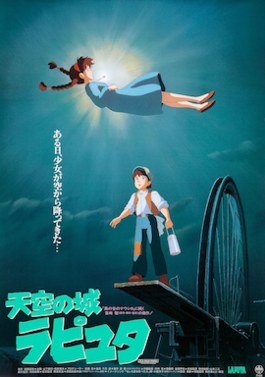 Core Anime Steampunk
Castle in the Sky
Hayao Miyazaki's Castle in the Sky is core anime steampunk, full of air pirates, Laputa, lost technology and skyward adventure.
Core Anime Steampunk
Castle in the Sky
Hayao Miyazaki's Castle in the Sky is core anime steampunk, full of air pirates, Laputa, lost technology and skyward adventure.