
Theme
Airships in Steampunk
Steampunk without airships is still perfectly possible, in the same way tea without biscuits is possible, but one does begin to question the civilisation that allowed it.
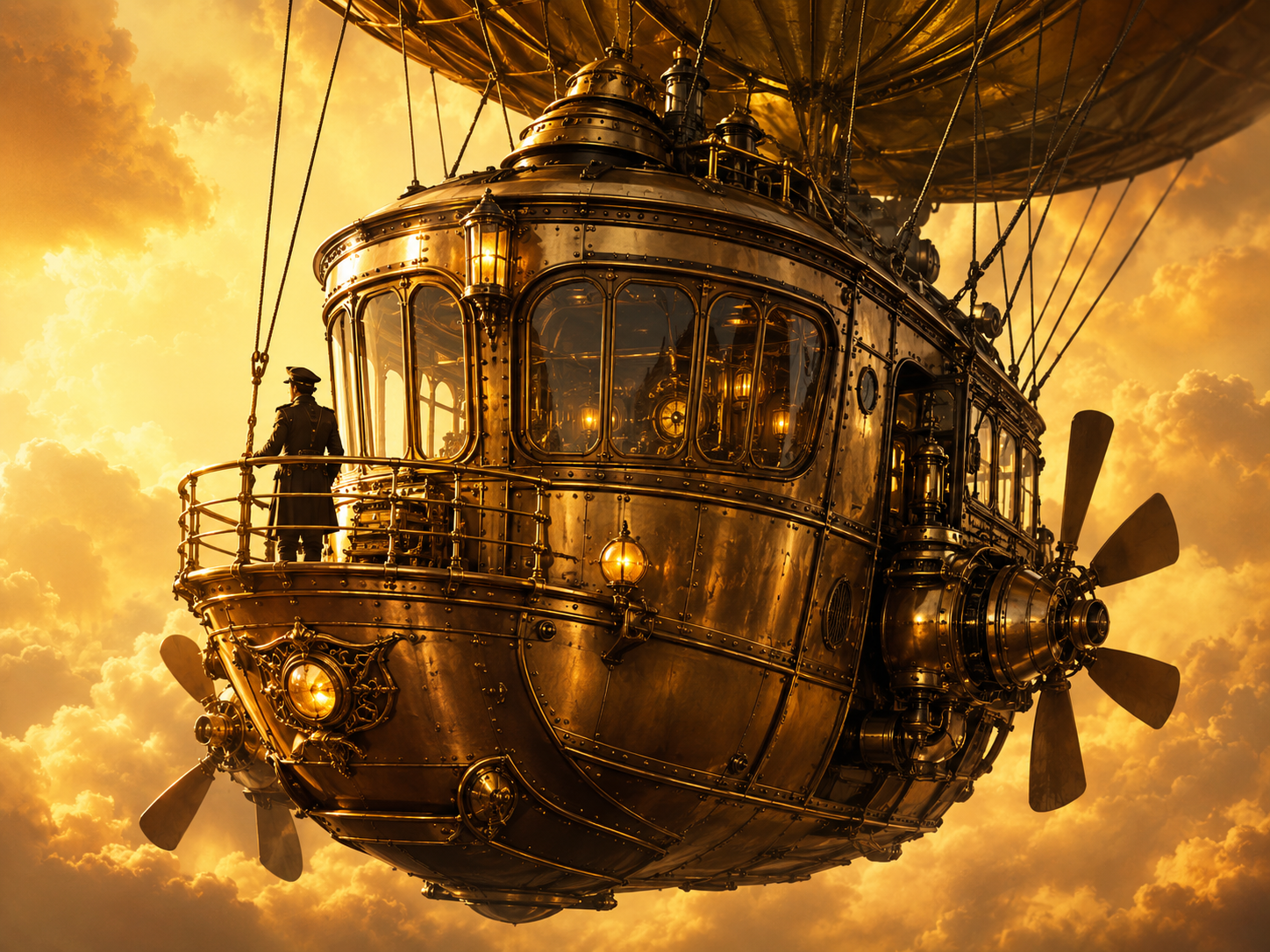
The airship is one of the great sacred machines of steampunk. It floats above the genre like a whale that has read Jules Verne, joined the navy and developed opinions about empire. It is elegant, absurd, vulnerable, majestic, impractical and visually irresistible. It is part transport, part warship, part floating hotel, part symbol and part disaster waiting for weather. In other words, it is perfect.
Why do airships matter so much to steampunk? Because they are the steam-age dream of flight before flight became ordinary. The aeroplane is fast, efficient and modern. The airship is theatrical. It does not simply travel. It proceeds. It looms over cities, casts shadows over palaces, docks with towers, glides across alien skies and gives villains somewhere excellent to monologue. If a train is industrial destiny on rails, the airship is industrial destiny pretending it has transcended rails altogether.
Steampunk loves machinery you can see. Pistons, propellers, cables, girders, canvas, brass, varnished wood, steam vents, pressure gauges, speaking tubes, crew ladders and gantries all do useful aesthetic labour. An airship is not a sealed modern aircraft, anonymous and smooth as a corporate apology. It is a visible contraption. You can imagine people climbing inside it, repairing it, arguing with it, living in it, fighting on it and falling from it while regretting earlier decisions.
The airship also solves a worldbuilding problem. Steampunk wants adventure, and adventure requires movement. Ships made the age of sail global. Trains made the nineteenth century feel accelerated. Airships give steampunk a way to turn the entire sky into an ocean. Suddenly every city has aerial docks. Every empire has fleets. Every explorer can head for the blank spaces on the map without getting their boots wet. Every pirate can become a sky pirate, which is a professional upgrade few pirates would refuse.
This is why the airship so often becomes a naval metaphor. It has captains, crews, rigging, watches, officers, gun decks, navigation, storms, ports, signals, battles, discipline and mutiny. It takes the romance of the sea and hoists it above the rooftops. The result is irresistible to writers, artists and game designers because it gives you all the pleasures of naval fiction without requiring anyone to learn what a mizzenmast is, although some readers will do so anyway and write letters.
Michael Moorcock’s The Warlord of the Air is one of the early literary landmarks here. Its alternate-history world of airships and empire helped shape the pre-steampunk imagination before the term itself had fully clanked into place. The title alone understands the appeal. Air power changes politics. It changes distance. It changes war. It changes who can see whom, and who can drop unpleasantness from above. The airship is never just a vehicle. It is power with a view.
Philip Pullman’s His Dark Materials uses airships as part of a broader gaslamp and parallel-world atmosphere. They belong to a world that is both familiar and estranged: Oxford, snow, theology, daemons, anbaric technology and great vessels crossing northern skies. Pullman’s airships are not there merely to look fetching, though naturally they do. They help establish that this is a world where technological history took a different route, where the familiar has been nudged just far enough sideways to make the reader feel the floor tilt.
Scott Westerfeld’s Leviathan gives the airship one of its strangest and cleverest transformations. In his alternate First World War, the Darwinists grow living war machines, while the Clankers build mechanical ones. The Leviathan itself is a fabricated living airship, part whale, part ecosystem, part military vessel, and entirely unwilling to fit inside any sensible category. It is a reminder that steampunk does not have to mean brass alone. Sometimes the airship is biological, which raises exciting questions about feeding, cleaning and whether the vessel is having opinions about the mission.
Philip Reeve’s Mortal Engines is more famous for traction cities than airships, but its world of scavenged technology, sky travel and post-apocalyptic machinery understands the same vertical romance. Once cities themselves are mobile predators, the sky becomes another zone of escape, trade and danger. In steampunk and its borderlands, air travel is often about freedom, but freedom usually arrives with engine trouble, pirates or moral consequences.
Then there is Stephen Hunt’s Jack Cloudie, which deserves a very firm berth in the aerial canon. It is, in useful shorthand, Hornblower with airships: naval adventure translated into the skies of the Jackelian world. The RAN, the Royal Aerostatical Navy, gives the book its central pleasure: the discipline, hierarchy, danger and adventure of a naval tradition lifted into the air. Instead of broadsides across grey seas, we have aerial manoeuvres, floating vessels, atmospheric hazards and the peculiar terror of war fought where gravity is waiting below with paperwork.
That Hornblower comparison matters. C.S. Forester’s naval fiction works because ships are not just transport. They are pressure cookers: enclosed societies full of rank, duty, fear, skill, courage, cowardice, class, boredom and sudden violence. Put that same structure into an airship and you get a splendid steampunk intensifier. The deck is smaller, the fall is longer, the engines are stranger and the whole business feels as if the Admiralty has been handed balloons and lost all restraint. Jack Cloudie taps exactly that seam: sky-navy adventure where the old naval virtues and absurdities have been aerostatically improved.
Airships also give the Jackelian world something distinctive. The Jackelian books are not simply Victorian London with brass polish. They are secondary-world steampunk fantasy, full of strange nations, ancient powers, revolutionary tensions, odd technologies and institutions that behave as if history has been assembled by competing madmen. The Royal Aerostatical Navy fits beautifully into that machinery. It takes the reader’s familiarity with naval adventure and then changes the element. Sea to sky. Ship to airship. Horizon to cloudbank. The result is both familiar and fresh, which is one of steampunk’s most useful tricks.
In anime, airships become even more important. Hayao Miyazaki may be cinema’s great poet of flying machines, and Castle in the Sky is one of the essential works for understanding why. Its airships, flaptors and flying city of Laputa are not merely cool designs. They are part of a moral universe. Flight can mean freedom, curiosity and wonder. It can also mean military ambition, domination and ancient power being dragged out of the clouds by people who should not be trusted with a bicycle pump.
The pirates in Castle in the Sky understand the joy of aerial adventure. The army understands its strategic possibilities. Pazu understands flight as longing. Sheeta understands the danger of inheritance. Laputa itself hovers above them all, beautiful and terrifying, a floating answer to a question humanity should perhaps stop asking. That is the Miyazaki touch: the machine enchants you, then asks whether you are worthy of it. The answer is usually “not yet, but the clouds are lovely.”
Nadia: The Secret of Blue Water draws heavily on Vernean adventure and gives us submarines, secret technology and global intrigue, but it also participates in the broader retrofuturist aviation tradition. Last Exile goes even further into aerial civilisation, with vanships, battles, aristocratic rituals and a world where flight is both livelihood and war. It is one of the anime series that best understands the sky as a social system. Who gets to fly? Who commands the skies? Who fights? Who repairs? Who falls?
Steamboy is more ground-and-engine obsessed, but its steam-powered spectacle belongs to the same family of industrial ambition. Howl’s Moving Castle is not an airship film, but Miyazaki’s war machines and flying contraptions give its skies a steampunk and diesel-adjacent unease. The sky is beautiful in these works, but rarely innocent. It is always being claimed, crossed, fought over or polluted by someone’s grand design.
Film has often loved airships even when the films themselves wobble. Master of the World, based on Jules Verne’s Robur stories, gives Vincent Price an aerial vessel and therefore automatically earns a seat at the table. Robur is one of steampunk’s spiritual ancestors: the inventor whose flying machine promises dominion and enlightenment while quietly suggesting that the inventor may have mistaken genius for moral authority. This happens a lot in the genre. It is why the laboratory should have a responsible adult.
The Golden Compass gives us gaslamp airships and northern journeys in a parallel world of daemons, theology and armoured bears. The League of Extraordinary Gentlemen, for all its cinematic issues, understands that Victorian super-adventure needs impossible vehicles. The 2011 Three Musketeers film adds airships to swashbuckling history with a straight face that deserves either admiration or a small medical investigation. Mortal Engines brings aircraft and floating technology into a world where entire cities are mobile predators. These films vary wildly in quality, but they all know the same thing: put a large flying machine in the frame and the eye goes straight to it.
Games have also made good use of airship energy. Space: 1889 is not just airships but ether flyers, Martian cloudships and the whole Victorian solar-system fantasy: the British Empire, and other Earth powers, discovering interplanetary travel and immediately becoming everyone else’s problem. It turns the airship into a planetary and imperial device. Why stop at floating over London when you can float over Mars with a map, a rifle and a tragically inflated sense of destiny?
Castle Falkenstein gives us romantic steam-age adventure with airships, dragons, faeries and high society, where a flying vessel feels entirely at home between a duel and a diplomatic incident. Eberron makes airships part of a broader magical-industrial fantasy, alongside lightning rails and dragonmarked houses. In video games, Skies of Arcadia turns airships into joy itself: sky pirates, floating islands and bright adventure. BioShock Infinite takes the sky-city idea into darker American retrofuturism, with Columbia floating above the world as religious spectacle, political fantasy and heavily armed bad idea. Airships: Conquer the Skies does exactly what it says on the riveted tin, letting players design improbable flying war machines and then discover the sky has objections.
Airships also work because they are socially useful. A good airship contains classes, ranks and spaces. There are captains, officers, engineers, gunners, cooks, passengers, spies, stowaways and someone in the engine room who knows the noise it just made is expensive. The ship becomes a miniature society. Put that society under pressure, add weather, enemies, fuel shortages, mutiny, navigation problems or a suspicious crate in the cargo bay, and the plot inflates itself.
They are also politically useful. Airships imply surveillance, trade, empire, policing, war and mobility. Who controls the skies controls communication, commerce and fear. An airship floating over a city is beautiful from a distance and rather less charming if it belongs to the regime. Steampunk, at its best, understands this double nature. The same vessel that carries explorers can carry bombs. The same airship that symbolises freedom for one character may represent occupation for another. Every elegant silhouette has a shadow.
This is why airships are more than genre decoration. They are steampunk’s argument about height. Who gets to rise above the world? Who remains below, mining the coal, building the engines, filling the gasbags, loading the guns, cleaning the decks and paying for the admiral’s trousers? The romance of the airship is real, but so is the labour beneath it. Ignore that and the genre becomes only postcard nostalgia. Remember it and the airship becomes one of the richest symbols in speculative fiction.
The design appeal is undeniable. Airships combine slowness and grandeur. They are big enough to be worlds, fragile enough to be tense, and absurd enough to be lovable. They make weather dramatic. They make docking scenes exciting. They give artists long elegant shapes, glowing windows and dangling gondolas. They let writers put swordfights on top of things where swordfights should not be. They make maps vertical. They allow cities to have aerial harbours, signal towers, mooring masts and customs officers who are surely even worse at altitude.
There is also something deeply steampunk about their impracticality. The modern world mostly chose the aeroplane because it is faster, more efficient and less inclined to become a flaming metaphor. Steampunk looks at that decision and asks, “Yes, but what if the less sensible option had better architecture?” The airship is a vote for grandeur over practicality. It is the transport equivalent of a waistcoat with secret compartments.
Yet the fragility matters. Airships are vulnerable to storms, fire, sabotage, puncture, enemy guns and narrative irony. They float because the world permits them to, briefly. That gives them a melancholy beauty. A train belongs to its track. A ship belongs to the sea. An airship borrows the sky. Perhaps that is why steampunk loves them so much. They feel like futures that could have happened but did not, drifting just above history, close enough to see, too far to board without fiction.
For newcomers, the best airship route through steampunk might begin with Castle in the Sky, then move to The Warlord of the Air, Leviathan, Last Exile, Space: 1889, The Golden Compass, Mortal Engines, Skies of Arcadia and Jack Cloudie. That gives you anime wonder, literary alternate history, biological airships, military sky adventure, Victorian planetary romance, gaslamp fantasy, moving-city spectacle, sky-pirate gaming and the Royal Aerostatical Navy doing Hornblower proud with less seawater and more altitude.
The airship endures because it is the genre’s most graceful contradiction. It is heavy and light. Industrial and dreamlike. Military and romantic. Ridiculous and noble. A symbol of empire, escape, exploration, piracy, class hierarchy, technological arrogance and the human desire to rise above the mud before realising we brought the mud with us in the cargo hold.
Steampunk will always have room for airships. The genre can survive without them, of course. It has automata, steam computers, infernal devices, clockwork limbs, underground cities, mechanical beetles and inventors who should not be allowed near children or funding.
But when the clouds part and a vast airship slides across the sky, engines throbbing, signal lamps blinking, crew at stations, captain on the bridge and some poor soul in the boiler room saying, “That’s new,” the whole genre seems to know where it is.
Up there. In trouble. Magnificent.
From the cabinet
Related field-guide entries
 Core anime steampunk
Last Exile
Last Exile is core anime steampunk, built around airships, courier pilots, militarised skies and retro aviation spectacle.
Core anime steampunk
Last Exile
Last Exile is core anime steampunk, built around airships, courier pilots, militarised skies and retro aviation spectacle.
 YA Core / Biopunk-Steampunk
Leviathan
Scott Westerfeld's Leviathan is essential YA steampunk, setting Clanker machines against Darwinist biotech in alternate WWI.
YA Core / Biopunk-Steampunk
Leviathan
Scott Westerfeld's Leviathan is essential YA steampunk, setting Clanker machines against Darwinist biotech in alternate WWI.
 YA Steampunk-adjacent / Airship Adventure
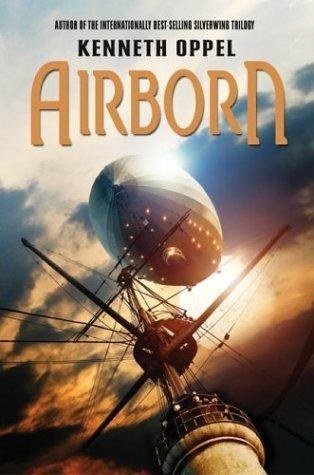
Airborn
Kenneth Oppel's Airborn is a YA steampunk-adjacent airship adventure, full of alternative-world travel and skyfaring romance.
YA Steampunk-adjacent / Airship Adventure
Airborn
Kenneth Oppel's Airborn is a YA steampunk-adjacent airship adventure, full of alternative-world travel and skyfaring romance.
 Core Steampunk Fantasy
The Court of the Air
Stephen Hunt's The Court of the Air is core secondary-world steampunk fantasy, with airships, revolution and ancient powers.
Core Steampunk Fantasy
The Court of the Air
Stephen Hunt's The Court of the Air is core secondary-world steampunk fantasy, with airships, revolution and ancient powers.