
Why it matters
It is one of the crucial pre-label works that gives steampunk its anti-imperial airship imagination.
Before steampunk had fully found its name, Michael Moorcock had already sent Oswald Bastable drifting into an alternate twentieth century where the airships are splendid and the politics are not remotely house-trained.
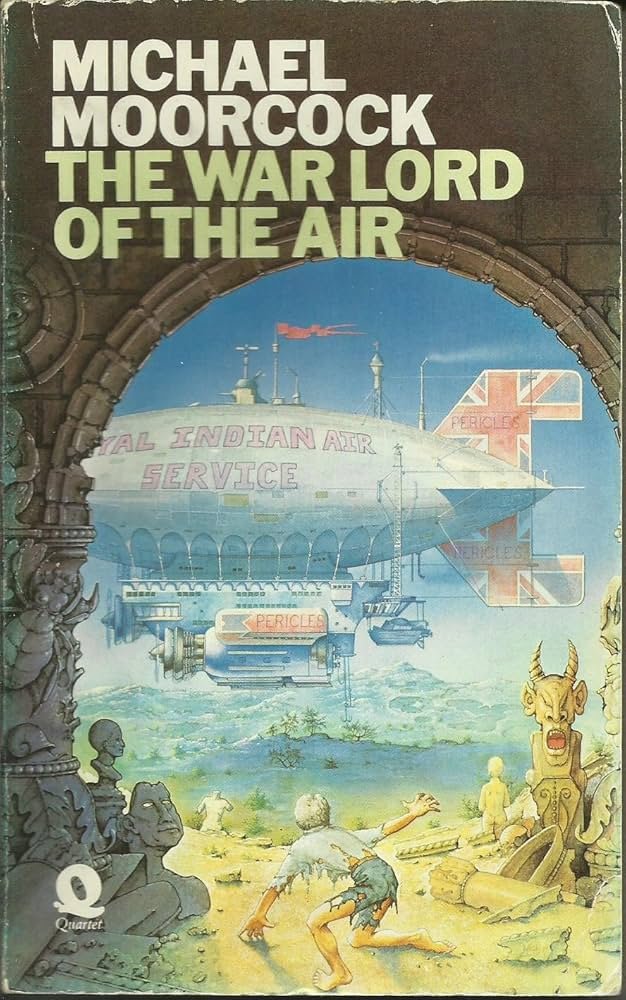
Warlord of the Air is often treated as one of the major roads into steampunk before the term was coined in the late 1980s. It has the machinery, certainly: airships, alternate history, imperial technology and the sheer visual pleasure of power floating overhead. But Moorcock is not simply decorating the past. He is attacking it, rewiring the boy's-own adventure tradition until the shiny adventure machine starts coughing up politics.
The novel introduces Oswald Bastable, a British soldier whose experiences take him into an alternate 1900s. The world he finds is not our own, though it is close enough to make the differences sting. Empires endure. Technologies have developed along different lines. Air power and imperial ambition hang together, sometimes literally.
For steampunk, this is a landmark because it demonstrates how to use the nineteenth and early twentieth-century adventure inheritance without saluting it. Moorcock knows the pleasures of exotic journeys, military danger and grand machines. He also knows the rot underneath: racism, imperial arrogance, class power and the habit of mistaking domination for civilisation. That double vision is one of the things mature steampunk needs if it is going to be more than a dressing-up box.
The airships matter enormously. Later steampunk would adopt them as one of the genre's central images, sometimes as free-floating romance, sometimes as military threat, sometimes as piracy with better upholstery. In Warlord of the Air, they belong to a world system. They are not merely cool transport. They are instruments of reach, control and spectacle.
The book also offers a path from scientific romance to political alternate history. Verne and Wells provide many of the ancestral machines and ideas, but Moorcock helps show how those elements can be re-used with late twentieth-century scepticism. The past is not a playground. It is a dangerous machine that must be opened up, inspected and probably shouted at.
Purists may call it proto-steampunk rather than core steampunk because it predates the label and belongs to Moorcock's own multiverse-adjacent interests. Even so, its importance to the field is hard to overstate. If steampunk has an airship wing, this book is one of the hangar doors.
Readers should expect adventure with argument. Bastable is not merely a tour guide through a clever alternate world. His position forces questions about loyalty, empire and political awakening. The result is still readable as adventure, but the adventure is being undermined from within, like a parade float discovering class consciousness halfway down the route.
This is also why Bastable is such a useful figure for the field. He is shaped by the values of imperial adventure fiction, then placed in situations where those values begin to fail him. That gives the book a human mechanism for critique. The alternate world is not just displayed; it acts on him. He must revise himself, which is much more interesting than simply watching a clever map unfold.
The novel's airships should therefore be read as more than genre furniture. They are seductive, and Moorcock knows they are seductive, but they carry an entire political atmosphere. Later steampunk would sometimes reduce airships to romance with propellers. Warlord of the Air keeps the romance and then asks what it is transporting.
That question is still useful. A reader can admire the silhouette of an airship without forgetting the cargo manifest. Moorcock's achievement is to make wonder answerable to history, so the reader can enjoy the ascent while noticing the empire strapped beneath the envelope.
That tension is why the book still feels alive in the hangar.
Is it really steampunk?
It is one of the strongest proto-steampunk cases in the field. Warlord of the Air has airships, alternate history, imperial technology and a critical relationship to Victorian and Edwardian adventure fiction. It is not modern maker-culture steampunk, but it helped prepare the genre's toolkit and its conscience.
The novel is especially useful because it resists empty nostalgia. There is pleasure in the machines, but also a clear awareness that beautiful machinery can serve ugly systems. That matters for any serious account of steampunk. The best works do not ask us to choose between wonder and critique. They make the two argue until sparks come off the railings.
In the wider guide, this entry connects naturally to The Land Leviathan, The Steel Tsar, The Difference Engine and later secondary-world airship fantasies, including Stephen Hunt's Jackelian books where air power, class tension, revolution and political lunacy frequently share the same crowded sky.
Find it
If you would like to track down Warlord of the Air, these search links may help. We have not specified an edition, so you can pick the format that suits you.
Affiliate links: as an Amazon Associate, Stephen Hunt’s SFcrowsnest earns from qualifying purchases. These may earn us a small commission at no extra cost to you.