
Why it matters
It brings revolutionary Victoriana, parallel-world politics and experimental British comics energy into the pre-steampunk neighbourhood.
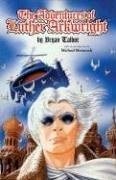
Bryan Talbot's The Adventures of Luther Arkwright makes parallel worlds look less like an escape route and more like a political battleground with several bad governments sharing the same map.
The Adventures of Luther Arkwright began in the late 1970s and became one of the major British adult comics landmarks. Its mixture of parallel worlds, political struggle, occult or psychic overtones, historical variation and dense visual storytelling gives it a place near steampunk's pre-history, though it is never simply a brass-adventure comic.
The comparison to Michael Moorcock matters. Talbot's multiverse, revolutionary energies and alternate histories sit near the kind of speculative freedom Moorcock made available to British genre writers and comics creators. The result is less tidy than conventional alternate history. It feels like history has splintered, and every shard has developed its own uniform.
Victorian and revolutionary imagery give the work its steampunk-adjacent flavour. There are worlds with imperial forms, political factions, militarised spectacle and antique-modern collisions. But the engine is not a single technological divergence. It is multiversal instability, ideology and the possibility that history is a battleground across realities.
Talbot's visual style is part of the importance. The pages are dense, ambitious and serious about comics as a medium for adult speculative narrative. That matters because steampunk and its neighbours have never belonged only to prose. Comics supplied some of the sharpest period remixing, from Tardi's Adele to later works like The League of Extraordinary Gentlemen and Grandville.
Luther himself belongs to the tradition of reality-crossing agents and revolutionary figures rather than the inventor-adventurer line. He is less a man with a gadget than a pressure point in a system of worlds. That makes the work useful beside multiverse fiction, political SF and alternate-history comics.
The comic's difficulty is part of its reputation. It is not a smooth adventure handed to the reader with a cup of tea and a labelled diagram. It is dense, fragmented and formally ambitious, with pages that ask the eye to work. That ambition helped prove British comics could handle adult speculative material without apologising to anyone at the newsagent.
For steampunk, the lesson is not that every alternate world needs a complicated multiverse. The lesson is that history can be treated as unstable material. Talbot's worlds suggest that politics, costume, technology and reality itself are all editable, and that every edit produces consequences. That is a useful idea for anyone building retrofuturist fiction.
The book also reminds comics readers that the pre-steampunk landscape was never tidy. It was already full of rebels, timelines, uniforms and impossible systems.
That untidiness is exactly why it remains useful.
Is it really steampunk?
Not strictly. The Adventures of Luther Arkwright is proto-steampunk-adjacent, multiverse SF and revolutionary alternate history. Its connection comes through Victorian variants, political machinery, period imagery and its influence on later British speculative comics.
Readers expecting straightforward airships and clockwork may find the book stranger, denser and more psychedelic than expected. Readers interested in the British comics route into period speculation should treat it as essential terrain. It is a map of worlds drawn by someone who knows maps can be weapons.
Find it
If you would like to track down The Adventures of Luther Arkwright, these search links may help. We have not specified an edition, so you can pick the format that suits you.
Affiliate links: as an Amazon Associate, Stephen Hunt’s SFcrowsnest earns from qualifying purchases. These may earn us a small commission at no extra cost to you.