
Why it matters
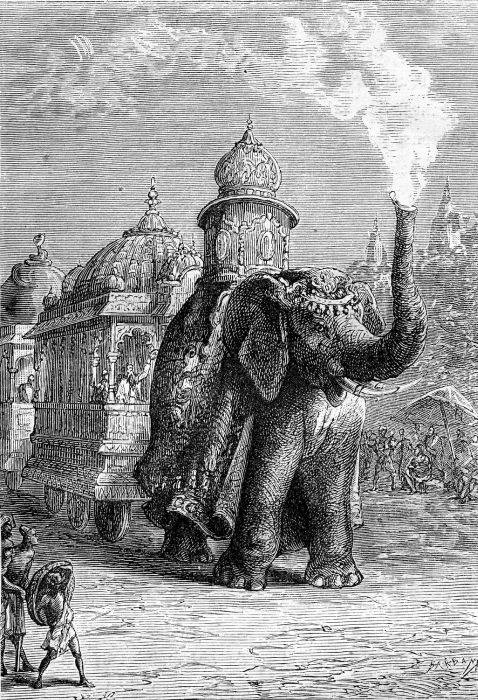
It offers one of Verne's most directly steampunk-looking images: domestic travel by artificial elephant.
There are many ways to tour India in fiction, but Jules Verne, being Jules Verne, eventually arrives at the only sensible answer: build a steam-powered elephant and attach a house to it.
The Steam House is not the most famous Verne novel, but it is one of the easiest to place on a steampunk mood board without much argument from the costume department. Its central contrivance, a steam-powered mechanical elephant pulling mobile living quarters through India, is the sort of invention later steampunk would polish, over-engineer and park beside an airship hangar with a small brass plaque saying "perfectly safe".
The book belongs to Verne's Voyages extraordinaires, and it carries many of the familiar pleasures of that shelf: travel, engineering, geography, technical description and the sense that the world can be made legible through movement. The machine is both vehicle and promise. It lets the travellers cross terrain with independence, comfort and a theatrical disregard for ordinary transport options.
That image is powerful enough to survive even when the surrounding material needs careful handling. The novel is a French adventure set in colonial India, written in the nineteenth century, and modern readers should not expect it to escape the assumptions of its age. That is not a reason to ignore it. It is a reason to read with both eyes open: one eye on the splendid absurdity of the steam elephant, the other on the imperial frame that makes such a journey possible in the story.
In steampunk terms, The Steam House is unusually literal. Here is steam power, Victorian-era travel, exoticised geography, mechanical spectacle and domestic space turned mobile. Many later works would build whole subgenres out of similar pleasures: walking houses, landships, locomotive fortresses, traction cities and parlours that have somehow escaped their foundations.
The machine also reveals something about Verne's place in the genre's ancestry. His inventions are rarely just props. They reorganise social experience. The Nautilus creates a private undersea nation. Fogg's journey turns the globe into a schedule. The steam house transforms travel into a portable domestic empire, which is both delightful and politically loaded. Steampunk often inherits that double charge: the machine as wonder, and the machine as a way of carrying power around.
That portable domesticity is one of the novel's most steampunk-friendly ideas. The machine does not merely move people from one point to another. It lets them carry comfort, hierarchy and routine into motion. Later steampunk loves this trick: the train carriage as salon, the airship as club, the mobile fortress as badly behaved country house. The Steam House helps show how travel technology becomes social architecture.
The artificial elephant also gives the field a reminder that engineering can be theatrical. A plain traction engine would do the job with less fuss. Verne's chosen image, however, makes the machine into a beast, a spectacle and a statement. Steampunk has never been shy about this. A device may be practical, but if it can also look faintly outrageous while crossing the landscape, so much the better.
Purists would be on firmer ground calling it Vernean scientific romance than steampunk proper. Verne is not looking back nostalgically at a steam-age past. He is writing from within a period where steam and empire are current forces. Later steampunk borrows the picture and changes the angle. The elephant becomes not just a marvel but a retrofuturist emblem.
For readers, the attraction is partly novelty. The steam elephant is simply a splendidly odd object, and genre history needs its splendidly odd objects. It is the sort of invention that reminds one how much of steampunk's appeal comes from giving machinery a personality. A train is useful. A mechanical elephant is useful and also possibly judging your hat.
Is it really steampunk?
It is proto-steampunk rather than modern steampunk, but it is closer to the visual heart of the genre than many better-known ancestors. The steam elephant, mobile house and travel-machine premise all sit comfortably in the Vernean wing of the field. The colonial setting, however, requires honest context rather than uncritical celebration.
Anyone building a steampunk reading path should include The Steam House as a deep cut after the more famous Verne landmarks. It is not the first stop for every reader, but it shows how quickly nineteenth-century scientific romance could turn engineering into pageantry. It also shows why later writers have had to revisit these materials with sharper politics and a wider cast of voices.
It connects to machinery as spectacle, imperial travel, mobile homes, artificial beasts and the grand tradition of vehicles that appear to have been designed after lunch by someone with no intention of walking anywhere ever again.
Find it
If you would like to track down The Steam House, these search links may help. We have not specified an edition, so you can pick the format that suits you.
Affiliate links: as an Amazon Associate, Stephen Hunt’s SFcrowsnest earns from qualifying purchases. These may earn us a small commission at no extra cost to you.