
Why it matters
It turns a classic sea-adventure template into animated aetherpunk, full of rigging, ships, maps, cyborg parts and Victorian space romance.
Treasure Planet takes Treasure Island, bolts it to a solar sail, and sends the whole pirate business into space with a commendable disregard for ordinary naval insurance.
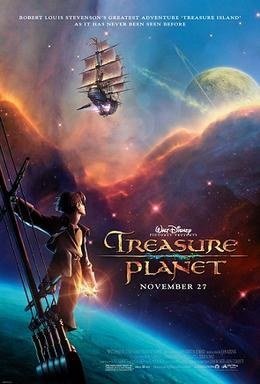
Disney's Treasure Planet reworks Robert Louis Stevenson's Treasure Island as a space adventure, with Jim Hawkins, Long John Silver, a treasure map and a ship that sails between worlds. The trick is that the film keeps the emotional grammar of the pirate story while changing the physics to something cheerfully theatrical. Space behaves just enough like an ocean to keep the rigging busy.
The steampunk-adjacent pleasure is design. Ships have sails, cabins, rails, ropes and old-world fittings, but they move through a glowing cosmic sea. Silver is a cyborg pirate with mechanical limbs and enough charisma to make bad decisions sound temporarily sensible. The result is not Victorian engineering as such, but a hybrid of nautical adventure, retro technology and fantasy space.
That puts the film near aetherpunk: the branch where nineteenth-century or old-adventure imagery reaches beyond the atmosphere without becoming sleek modern science fiction. It belongs beside Space: 1889 and other works that ask what space travel might look like if it inherited masts, uniforms, maps and the cheerful assumption that a boy can learn heroism from a dangerous voyage.
The animation style helps sell the collision. Traditional character work sits beside digital ships and cosmic backgrounds, creating a world where the old pirate romance and newer visual technology pull in the same direction. The film's best images understand that retrofuturism is not a matter of sticking brass on a rocket. It is about making the old adventure language behave naturally in a new impossible setting.
The film also has a stronger emotional spine than its gadgetry alone suggests. Jim and Silver's relationship gives the adventure its bite. Steampunk and retrofantasy often benefit from mentor figures who are useful, charming and morally cracked. Silver is exactly that: affectionate enough to matter, selfish enough to hurt, and mechanically interesting into the bargain.
There is a good reason the film has aged into affection. Its box-office story once overshadowed the film itself, but viewers returning to it tend to notice the generosity of the design and the warmth of the character work. It is a strange, handsome object, and those often do better in memory than they did in the opening weekend scrum.
Purists may object that it is more space fantasy than steampunk. Fair. There are no boilers powering an alternate empire, and the science is largely poetic. But the film's analogue ship design, cyborg pirate, old-adventure structure and aetheric space make it a vivid neighbour to the genre.
It also belongs near Atlantis: The Lost Empire in Disney's early-2000s pulp-adventure pocket. Both films move away from the musical fairy-tale lane and towards machinery, maps, exploration and found worlds. Treasure Planet is the more sky-drunk of the two, while Atlantis keeps its boots closer to expedition pulp.
Is it really steampunk?
It is aetherpunk and steampunk-adjacent, not core steampunk. The solar ships, cyborg body, nautical retrofuturism and pirate machinery place it close to the field, while the setting is space fantasy rather than historical industrial speculation.
It is a fine family entry for readers who want the romance of rigging, maps and dangerous mentors without requiring the vacuum of space to behave itself.
Find it
If you would like to track down Treasure Planet, these search links may help. We have not specified an edition, so you can pick the format that suits you.
Affiliate links: as an Amazon Associate, Stephen Hunt’s SFcrowsnest earns from qualifying purchases. These may earn us a small commission at no extra cost to you.