
Why it matters
It brings Disney animation into pulp retro-adventure territory, with submarines, expedition machinery and ancient crystal technology.
Atlantis: The Lost Empire sends a turn-of-the-century expedition under the sea with enough vehicles, maps and questionable employers to make any sensible linguist check the small print.
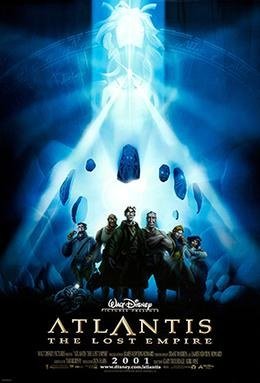
Directed by Gary Trousdale and Kirk Wise, Atlantis: The Lost Empire follows Milo Thatch and a heavily equipped expedition searching for the lost city of Atlantis. The film is not conventional Disney musical territory. It is pulp adventure, lost-world fantasy and technological expedition story, with a design sense that sits comfortably near steampunk.
The opening appeal is Vernean. Submarines, maps, scholars, hired specialists and dangerous travel all point back to scientific romance and early adventure fiction. The film loves equipment: vehicles, diving gear, engines, weapons, drills and machines built for the practical business of getting people somewhere they should perhaps leave alone.
The expedition structure gives it a pleasingly old-fashioned rhythm. A team is assembled, each member has a skill, and the journey becomes a test of motives as much as courage. Steampunk and pulp fantasy both enjoy that arrangement because it makes technology social. Machines are designed, repaired, piloted, misused and stolen by people with competing agendas.
Atlantis itself shifts the film from expedition tech into ancient super-science. The crystal power and lost civilisation are not steam-powered, but they belong to the same family of speculative wonder as Laputa in Castle in the Sky: beautiful, powerful, misunderstood and very attractive to outsiders with poor moral ventilation.
The production design carries a great deal of the genre flavour. Vehicles look heavy, specialised and slightly too ambitious for comfort. The submarine voyage has that Vernean thrill of pressure, darkness and machinery holding back the impossible. Even before Atlantis appears, the film has committed to the pleasure of equipment.
The film's steampunk-adjacent status comes from its surface and structure rather than strict mechanics. The period setting, analogue vehicles, expeditionary apparatus and lost-world plot all fit the borderland. The energy is more pulp than brass, but the two have been borrowing tools from one another for a long time.
It also has a useful anti-imperial edge. The expedition's shift from discovery to extraction is not subtle, but it is important. Lost cities in adventure fiction often exist to be plundered by the plot. Atlantis at least recognises that the people already living there may have strong views about becoming someone else's prize.
Milo is a familiar but effective figure: the scholar whose knowledge is undervalued until the map becomes real. That type runs throughout scientific romance and pulp adventure. The joke, of course, is that once the scholar is proved right, everyone with more weapons suddenly becomes interested in interpretation.
Purists may hesitate because the Atlantean technology is more fantasy crystal than steam engine. That is fair. The film is not core steampunk. It is a family-friendly neighbouring work that shows how expedition technology, undersea travel and ancient machinery can create a similar appetite for wonder and warning.
Is it really steampunk?
It is pulp steampunk-adjacent rather than core steampunk. The submarines, 1910s-style expedition, gadgets and lost-world machinery matter, but the central Atlantean technology is fantasy super-science.
It is a good family entry for viewers who like Vernean journeys, found civilisations and the moment when the employer's smile starts looking expensive.
Find it
If you would like to track down Atlantis: The Lost Empire, these search links may help. We have not specified an edition, so you can pick the format that suits you.
Affiliate links: as an Amazon Associate, Stephen Hunt’s SFcrowsnest earns from qualifying purchases. These may earn us a small commission at no extra cost to you.