
Why it matters
It is one of the great international landmarks of animated steampunk, joining sky piracy, industrial landscapes and ancient machinery with rare emotional clarity.
Hayao Miyazaki's Castle in the Sky is what happens when air pirates, lost technology and the romance of flight all agree to meet above the clouds and cause trouble with excellent manners.
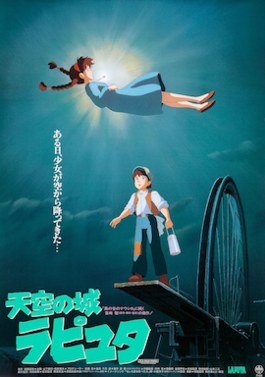
Studio Ghibli's first official feature follows Sheeta and Pazu as they flee soldiers, agents and pirates while searching for Laputa, a legendary floating city. The story draws from adventure fiction, lost-world romance and Miyazaki's abiding love of flight, but the result feels unmistakably like one of steampunk's central anime texts.
The machinery is everywhere, and it has character. Airships, mining equipment, military craft, robots and Laputa's ancient systems all feel designed, maintained and inhabited. The film is not satisfied with sleek magic. It loves rivets, engines, pulleys, boilers, metal fatigue and the sound of a machine being asked to do more than is wise.
Air pirates give the film its comic lift. The Dola gang are scoundrels, family, opportunists and secret romantics, which is exactly the mixture air pirates require. They make the sky feel socially alive rather than merely scenic. Their machines are patched and practical, a working-class counterpoint to the cleaner menace of the military.
The mining town is just as important. Pazu's home gives the film a grounded industrial base before the story rises into the sky. The workers, tunnels and machinery make the adventure feel connected to labour rather than pure fairyland. That grounding is a large part of why the film's wonder works. It starts among people who know what tools are for.
Laputa itself deepens the film beyond adventure spectacle. The floating city is beautiful, but it is also a warning. Ancient technology has outlived the civilisation that built it, and its power attracts the wrong kind of ambition. Steampunk often asks whether machinery liberates or dominates. Castle in the Sky answers: that depends very much on who finds the controls.
Pazu and Sheeta keep the film human. The lost city, robots and air fleets would be impressive on their own, but the emotional centre is trust, courage and refusing to let wonder become possession. Miyazaki's best machines are never separate from moral choice. They reveal character.
The film's place beside Nausicaa, Steamboy, Nadia and Last Exile is obvious. It helped establish a mode of anime retrofuturism where flight, industrial machinery and lost civilisations could carry both exhilaration and political caution. Its influence runs through later animated and game worlds that treat the sky as a working environment.
It also makes a useful argument about scale. The film loves vast machines and magnificent ruins, but it distrusts anyone who wants to own them. That tension keeps it from becoming mere spectacle. Laputa is not a prize cabinet in the clouds. It is a question about whether beauty and power can survive human ambition without becoming a weapon.
Purists need not grumble much here. It may not be Victorian Britain, but steampunk was never obliged to remain trapped in one foggy postcode. Castle in the Sky has the alternate machinery, class texture, imperial danger, skyward romance and analogue beauty to count as core anime steampunk.
Is it really steampunk?
Yes. It is core anime steampunk, with airships, industrial landscapes, ancient technology, sky piracy, military greed and a floating city that turns technological wonder into moral test.
It remains one of the best places to start because it is generous without being soft. Children get adventure. Adults get empire, labour, memory and the suspicion that some machines should not be switched back on.
Find it
If you would like to track down Castle in the Sky, these search links may help. We have not specified an edition, so you can pick the format that suits you.
Affiliate links: as an Amazon Associate, Stephen Hunt’s SFcrowsnest earns from qualifying purchases. These may earn us a small commission at no extra cost to you.