
Why it matters
It is one of the key early steampunk tabletop roleplaying games, taking Victorian adventure, ether flyers, Mars, empire and scientific romance into a playable form.
Space: 1889 takes the Victorian empire into space, which is exactly the sort of idea that makes scientific romance exciting and colonial history reach for the headache powders.
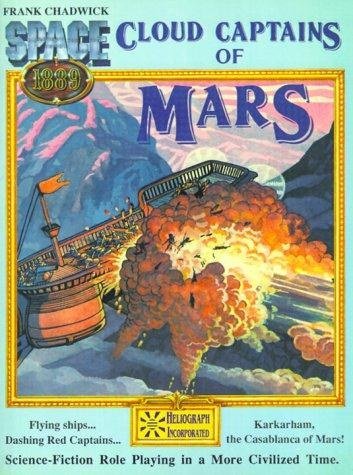
Designed by Frank Chadwick and published by Game Designers' Workshop, Space: 1889 imagines a late nineteenth century where ether travel opens the solar system to exploration, commerce, conflict and imperial expansion. Mars, Venus and other worlds become arenas for adventure shaped by Victorian assumptions and scientific-romance inheritance.
Its place in steampunk history is important because it gave the genre a playable engine early on. Steampunk is not only novels and films. Tabletop games let players inhabit the assumptions, machinery and moral problems of a setting. In Space: 1889, that means ether flyers, colonial expeditions, strange planets and the unsettling comedy of empire believing space was waiting politely to be administered.
The scientific-romance ancestry is clear. Verne, Wells and nineteenth-century planetary fantasy all hover nearby, though the game turns those literary materials into maps, rules, equipment lists and adventures. That transformation matters. A novel can describe a Victorian Mars. A roleplaying game asks who goes there, what they carry and what trouble follows.
The imperial material needs care. Space: 1889 uses Victorian empire as a central premise, and modern readers will naturally notice the colonial assumptions built into that fantasy. That does not remove its steampunk importance. It sharpens the classification. Early steampunk often engaged with imperial adventure by imitation before later works became more openly critical.
The game's imagery of ether flyers is among its strongest contributions. Airships already give steampunk altitude; ether flyers give it planetary reach. They turn brass adventure into space travel without abandoning the nineteenth-century frame. That is the essential trick, and the game performs it with memorable clarity.
Its audience is the reader or player interested in steampunk's gaming roots, especially where scientific romance becomes a toolkit for campaigns. It is foundational not because every later work copies it, but because it proved this material could become an explorable world with rules, factions and practical consequences.
The tabletop form also makes the ethical tension harder to ignore. Players are not just reading about empire in space; they may be asked to act inside it. That can be thrilling, uncomfortable or both, depending on the table. Modern play often benefits from bringing a sharper critical eye to the colonial assumptions that older adventure material treated as scenery.
That tension is part of why Space: 1889 remains important. It contains the romance of impossible travel and the problem of who claims the right to travel, trade and rule. Steampunk has spent decades working through exactly that knot, sometimes elegantly and sometimes with a wrench.
It also sits at a useful point in RPG history. Before steampunk became a broad lifestyle and media label, Space: 1889 offered a complete play environment for scientific-romance adventure. That made the genre practical at the table: equipment, expeditions, maps, politics and all the troublesome assumptions packed beside them.
That practicality still matters.
Is it really steampunk?
Yes. Space: 1889 is core early steampunk RPG material: Victorian science, ether travel, planetary adventure, imperial politics and scientific romance made playable.
It is also a useful reminder that steampunk's pleasures and problems often arrived together. The ether flyer is marvellous. The empire using it is another matter entirely.
Find it
If you would like to track down Space: 1889, these search links may help. We have not specified an edition, so you can pick the format that suits you.
Affiliate links: as an Amazon Associate, Stephen Hunt’s SFcrowsnest earns from qualifying purchases. These may earn us a small commission at no extra cost to you.