
Why it matters
It joins The Time Machine and The War of the Worlds into a Victorian science-adventure shape later steampunk can easily recognise.
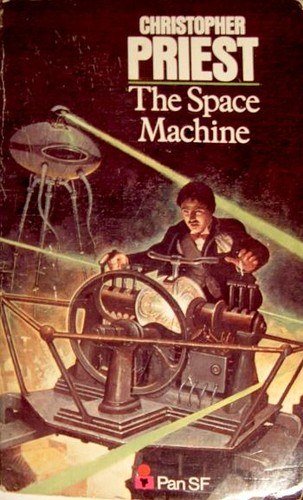
Christopher Priest's The Space Machine has the cheerful audacity to look at H. G. Wells and decide that one foundational scientific romance is good, but two can be made to collide if handled with sufficient nerve.
Published before steampunk had settled into a named genre, The Space Machine is one of those works that feels like it is arranging the tools on the bench for later builders. Its ingredients are openly Wellsian: time travel, Martian adventure, Victorian scientific speculation and the sense that the nineteenth century is only one experimental mishap away from becoming a cosmic incident report.
The novel is often described as a kind of bridge or mash-up between The Time Machine and The War of the Worlds. That is not a minor parlour trick. Wells's two books represent different branches of scientific romance: the machine that opens time, and the invasion that exposes human vulnerability. Priest brings those ancestral lines into conversation, giving the pre-steampunk field a self-conscious return to Victorian SF materials.
For steampunk, that self-consciousness matters. Verne and Wells were writing from within the steam-age future. Priest is looking back. That change of angle is one of the moves that makes later steampunk possible. The nineteenth century becomes not simply a setting but a literary machine that can be restarted, adjusted and made to produce different sparks.
The spreadsheet tags the work with Mars, a Wells mash-up and Victorian science adventure, which is a fair field-guide triad. It is not chiefly about brass decoration or maker-culture whimsy. Its appeal lies in literary engineering: taking the components of early science fiction and reassembling them with modern awareness.
That places The Space Machine near the first-wave steampunk novels even though it is not always given the same attention as Jeter, Powers or Blaylock. It belongs to the pre-coinage cluster of works that revisit Victorian speculative forms before the shelf label arrives. If Morlock Night raids The Time Machine for grotesque adventure, Priest's novel treats Wells as a shared architecture.
Purists might call it scientific romance pastiche, and that is not wrong. But pastiche can be more than imitation. In this context it becomes a method of genre formation. Later steampunk would repeatedly re-enter Victorian fiction, alter one mechanism, and watch the social, scientific and political consequences stagger out.
For readers, the book is likely to appeal if they enjoy the literary ancestry of the field as much as the hardware. It is a work for those who like seeing genre history treated as a set of pressure valves. Priest is not merely borrowing Wells's toys. He is asking what happens when the old machines are wired together.
That makes the novel an important bridge between homage and reinvention. A lesser Wells tribute might simply repaint the tripods and send everyone running across Surrey again. Priest's value lies in the act of connection. By bringing time travel and Martian adventure into the same conceptual space, he shows that early science fiction can be treated as a shared universe of anxieties: class, invasion, exploration, empire and the dangerous confidence of experiment.
The result is also a reminder that steampunk did not emerge only from costume, craft or visual taste. It grew from reading habits. Writers returned to Victorian and Edwardian scientific romance because those books had left usable machinery behind: ideas with handles, settings with pressure still in the pipes, and unresolved questions waiting for another generation to make them troublesome again.
The book is therefore useful even for readers who later prefer busier, brassier steampunk. It shows the literary workshop before the subculture arrives. The parts are on the bench: Wells, Mars, time, class anxiety, invasion fear and the seductive thought that old scientific romances might still have unused doors.
For the careful reader, those doors still creak rather nicely, and some of them open onto very red skies.
Is it really steampunk?
It is proto-steampunk and Wellsian scientific romance rather than core steampunk. Its importance comes from its retrospective use of Victorian SF materials before the genre label became common. It has the time machine, Mars, speculative machinery and nineteenth-century adventure frame, but not the later costume and culture of steampunk.
The value of The Space Machine is that it shows how steampunk begins to become conscious of its own ancestry. Verne and Wells provide origins. Moorcock provides political alternate history. Priest helps demonstrate that returning to early SF can be an act of invention, not merely homage.
In the wider guide, this entry should sit beside The Time Machine, The War of the Worlds, Morlock Night and The Difference Engine. It is a useful stop for readers tracing how Victorian scientific romance became raw material for modern retrofuturism.
Find it
If you would like to track down The Space Machine, these search links may help. We have not specified an edition, so you can pick the format that suits you.
Affiliate links: as an Amazon Associate, Stephen Hunt’s SFcrowsnest earns from qualifying purchases. These may earn us a small commission at no extra cost to you.