
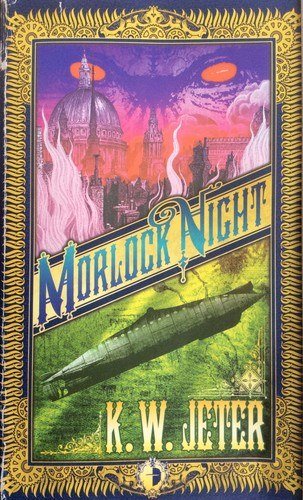
Why it matters
It is one of the works most often grouped with the earliest named steampunk fiction, taking Victorian scientific romance and bending it into unruly retro-adventure.
If H. G. Wells left the door to the future politely ajar, K. W. Jeter took one look at it and asked what would happen if the Morlocks came through carrying trouble in both hands.
Morlock Night is an important title partly because of what it does on the page and partly because of where it sits in the family album. Jeter would later jokingly propose "steampunk" as a label for the kind of Victorian fantastika he and fellow writers such as Tim Powers and James P. Blaylock were producing. This earlier novel already has the necessary mischief: it raids Wells, brings future monsters into the Victorian past, and refuses to treat literary inheritance as something to be handled with white gloves.
The premise springs from The Time Machine. Wells's Morlocks, those future underworld descendants of the labouring classes, become not merely a warning from tomorrow but an invading force with designs on the nineteenth century. That is a very steampunk move before steampunk has properly put its nameplate on the door. The past is not sealed. The future is leaking backwards. History, having ignored the maintenance schedule, is now making a noise in the pipes.
Jeter also throws Arthurian material into the machinery, which gives the book its particular oddness. The result is not smooth. It is not trying to be smooth. The charm of early steampunk often lies in its willingness to bolt together Victorian fiction, occult adventure, historical jokes and pulp velocity until the whole thing lurches forward under its own power. Morlock Night is a good example of that energetic awkwardness.
Its importance is less about polish than nerve. The novel treats a canonical scientific romance as a usable engine, not a museum exhibit. Wells's future is taken seriously enough to be dangerous, but not so reverently that no one may touch it. Later steampunk would perform this same operation again and again: lift a nineteenth-century device, character, institution or nightmare, then ask what new trouble it can cause.
The book's motifs are central to the genre's borderlands. Time travel becomes invasion. Social anxiety becomes monster fiction. The heroic past of Arthurian myth is dragged into the mechanised and literary past of Victorian London. That collision is precisely the sort of antique junk-shop cosmology steampunk can make productive when it keeps the wheels turning.
Purists who prefer later, tidier steampunk may find Morlock Night raw. That is fair. It is not the full brass orchestra of the 1990s and 2000s. It is more like hearing someone in the next room inventing the instrument, occasionally dropping a spanner and shouting with delight. As a reading experience, it matters because it shows the genre before it became self-conscious about its wardrobe.
It also helps make sense of Jeter's later Infernal Devices. Both books enjoy warped Victoriana, strange devices and the sense that respectable history is hiding a back alley full of alarming mechanisms. Morlock Night is the more direct literary sequel-game, while Infernal Devices would become the stronger clockwork grotesque. Together they show why Jeter's name belongs near the start of any serious steampunk map.
There is another reason the book matters: it helps establish that steampunk can be parasitic in the best literary sense. It feeds on existing nineteenth-century texts, not to drain them dry, but to make them move differently. Wells wrote a social nightmare about class and evolution. Jeter turns that nightmare into a returning threat, then adds mythic and adventure machinery until the old anxiety starts clanking in a new register.
That move would become one of steampunk's favourite tricks. Later works would revisit Verne, Wells, Stoker, Conan Doyle, Babbage, Lovelace, imperial adventure fiction and Gothic melodrama. Morlock Night is not the most elegant example, but it is an early and revealing one. It shows the genre learning that the Victorian canon is not a glass case. It is a toolbox, and some of the tools are sharp enough to remove a finger.
Is it really steampunk?
Yes, with the caveat that it is first-wave steampunk rather than the later visual subculture's more codified version. Morlock Night uses Victorian setting, Wellsian machinery, retro-literary remixing and pulp adventure in the way that helped establish the field. It is not merely adjacent. It is part of the early engine room.
The novel is also useful because it shows steampunk's debt to cheek. Much of the genre depends on asking impolite questions of respectable old books. What if Wells's future invaded the past? What if the monsters were not safely contained by narrative distance? What if Victorian fiction had a trapdoor under the carpet? Jeter's answers are not cautious, and that is part of the fun.
Readers should come to it as a canon landmark rather than a perfectly balanced modern novel. Its pleasures are scruffy, pulpy and historically important. Sometimes the rough early machine teaches you more than the polished showroom model.
It is especially useful for readers tracing the line from scientific romance to pulp retrofuturism. The Time Machine provides the origin wound. Morlock Night worries at it. By the time later steampunk arrives, the operation has become almost a method: find a historical anxiety, reanimate it, and see which gentleman faints first.
Find it
If you would like to track down Morlock Night, these search links may help. We have not specified an edition, so you can pick the format that suits you.
Affiliate links: as an Amazon Associate, Stephen Hunt’s SFcrowsnest earns from qualifying purchases. These may earn us a small commission at no extra cost to you.