
Why it matters
It is one of the defining game examples of steampunk-adjacent JRPG design, making magitek, airships, mechanised empire and rebellion central rather than decorative.
Final Fantasy VI is the one where fantasy finally admits that swords, opera, airships and industrialised magic all belong in the same catastrophe.
Released by Square in 1994, Final Fantasy VI is often treated as the moment the series' machine-and-magic instincts became impossible to miss. Earlier Final Fantasy games had airships, crystals and hints of lost technology, but this one places industrialised magic at the heart of the world. The Gestahlian Empire extracts power from Espers and turns it into magitek, a word that does a great deal of genre labour in very few syllables.
Magitek is the key. It is not simply magic with a metal casing. It is extraction, weaponisation and empire. That gives the game's machinery political weight. Steampunk becomes much more interesting when invention is not neutral, and Final Fantasy VI understands that a factory, a laboratory and a palace can all be parts of the same machine.
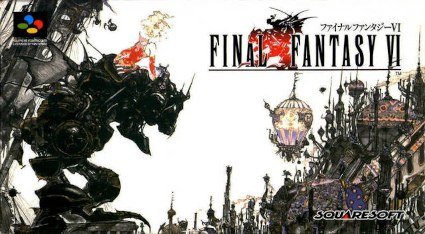
The visual language is also crucial. Airships, walkers, imperial uniforms, factories, mining towns and mechanical armour sit beside castles, monsters, opera houses and prophecy. The game does not treat those ingredients as contradictions. It lets them rub against each other until sparks appear. That friction is one reason it still feels so rich. The world has one boot in high fantasy and the other in industrial nightmare.
Its empire is one of the strongest steampunk signals. Many core works in the field circle around power: who controls invention, who suffers under progress, who gets to call exploitation civilisation. Final Fantasy VI brings that argument into melodrama, adventure and battle systems. The empire's technology is impressive, but the game never lets us forget what it costs.
The airships matter too, because they continue the series' old promise of flight while making it grander and stranger. In the original Final Fantasy, the airship was liberation across a map. Here it is part of a larger technological culture. Air travel belongs to a world of engineers, gamblers, nobles, soldiers and rebels, all trying to stay airborne while history breaks beneath them.
The opera sequence is not steampunk in itself, but it shows the game's confidence. Final Fantasy VI understands spectacle: mechanical, theatrical, emotional and musical. That matters because steampunk is often a spectacular mode. It thrives on stagecraft, costume, timing and large entrances. This game has all of those, plus a healthy respect for melodrama.
It also helped shape later expectations for Japanese game steampunk. Works such as Skies of Arcadia, Sakura Wars and many later RPGs would keep returning to airships, empires, machinery and fantasy energy systems. Final Fantasy VI sits near the centre of that lineage, not because it invented every ingredient, but because it cooked them together with rare confidence.
Is it really steampunk?
Yes. Final Fantasy VI is core JRPG steampunk, or at least core magitek industrial fantasy with enough airships, empire, machinery and social consequence to earn the label.
It suits players who like their fantasy with factories, rebellion and the occasional reminder that progress can have a very ugly uniform.
Find it
If you would like to track down Final Fantasy VI, these search links may help. We have not specified an edition, so you can pick the format that suits you.
Affiliate links: as an Amazon Associate, Stephen Hunt’s SFcrowsnest earns from qualifying purchases. These may earn us a small commission at no extra cost to you.