
Why it matters
It is one of the great airship fantasy games, turning sky piracy, floating worlds, exploration and ship-to-ship battles into a buoyant steampunk-adjacent JRPG adventure.
Skies of Arcadia is what happens when the airship stops being transport and becomes an entire way of life, complete with pirates, floating islands and heroic optimism at altitude.
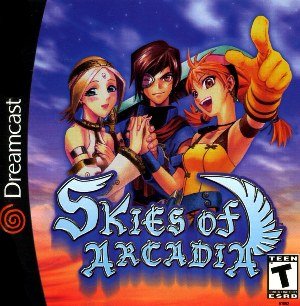
Released by Sega for the Dreamcast in 2000, Skies of Arcadia follows Vyse and his fellow sky pirates through a world of floating islands, empires, discoveries and airship battles. It is not grimy industrial steampunk. It is the bright, wind-filled branch of the field: adventurous, romantic and absolutely convinced that the horizon is there to be chased.
The airship is everything here. In many steampunk works, airships are impressive props or prestige vehicles. In Skies of Arcadia, they are geography, culture, combat system and emotional promise. The world is built around flight. Nations, routes, battles and discoveries all depend on the sky as a navigable space. That makes the game one of the strongest examples of airship fantasy in video games.
Its relationship to Castle in the Sky is obvious and useful. Both works treat flight as wonder rather than mere transportation. Floating ruins, skyborne adventure and imperial ambition all circulate through the same imaginative weather. Skies of Arcadia is more openly swashbuckling and game-shaped, but it shares that sense that the world becomes more morally and visually exciting once one lifts off the ground.
The sky pirate motif gives the game its heart. Pirates in steampunk-adjacent works often embody freedom, improvisation and resistance to empire. Vyse and company belong to that tradition. They are not cynical criminals; they are bright-eyed adventurers with a ship, a code and a dangerous habit of getting involved. This is rebellion with a masthead.
The game's airship battles also matter. They make the vessel not just a menu option but a participant. Ship-to-ship combat gives mechanical fantasy a heroic scale. The player is not only swinging a sword in a dungeon. The player is commanding a craft through the sky, which is exactly the sort of escalation airship stories crave.
Its placement at the turn of the millennium is fitting. Earlier games such as Final Fantasy VI had made airships and magitek central to fantasy machinery. Skies of Arcadia took the airship impulse and built the whole adventure around it. Later animated works such as Last Exile would explore airship culture with a different mood, but the shared appetite for sky worlds is unmistakable.
It also shows that steampunk-adjacent games do not have to be dark to matter. The genre's machinery can be oppressive, polluted or militarised, but it can also be liberating. Skies of Arcadia is powered by optimism, exploration and the pleasure of having a ship whose destination is always more interesting than staying put.
Is it really steampunk?
Yes, in the airship fantasy branch. Skies of Arcadia is not Victorian industrial steampunk, but its sky pirates, floating worlds, airship battles and retro-adventure machinery make it core to the broader field.
It suits players who want blue skies, grand voyages and machinery that feels like freedom rather than factory discipline.
Find it
If you would like to track down Skies of Arcadia, these search links may help. We have not specified an edition, so you can pick the format that suits you.
Affiliate links: as an Amazon Associate, Stephen Hunt’s SFcrowsnest earns from qualifying purchases. These may earn us a small commission at no extra cost to you.