
Why it matters
It helped establish motifs that later Japanese fantasy games would expand into full steampunk or magitek territory, especially the airship as both vehicle and promise.
The original Final Fantasy is not steampunk, but it does contain an airship, crystals, ancient machinery and the useful lesson that fantasy worlds improve by having something improbable to fly.
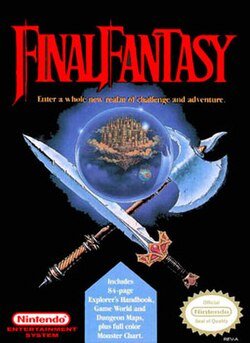
Released by Square in 1987, Final Fantasy is the first entry in one of video gaming's largest roleplaying series. Its core identity is heroic fantasy: elemental crystals, chosen warriors, monsters, towns, dungeons and world-saving in the grand tradition of parties who never travel light. Yet even here, before the series becomes famous for elaborate technology and magitek spectacle, the seeds are visible.
The airship is the important object. In early console roleplaying games, an airship is never just transport. It is liberation. It changes the map, rearranges the player's sense of scale and turns fantasy geography into something navigable from above. Steampunk loves airships for similar reasons: they are adventure, status, machinery and horizon in one vehicle. Final Fantasy did not invent that pleasure, but it helped make it a recurring JRPG expectation.
The game's relationship to steampunk is therefore genealogical rather than direct. No one should confuse the 1987 Final Fantasy with Final Fantasy VI, where magitek and industrial empire become central. The first game is much closer to mythic fantasy. Still, its mixture of ancient civilisations, lost technology, elemental power and aircraft points toward the series' later habit of blending swords, machines and cosmic engineering with no apology at all.
That blend matters for Japanese steampunk-adjacent media. Works such as Nausicaa of the Valley of the Wind and Castle in the Sky had already shown how flying machines, ruins and environmental imagination could reshape adventure fantasy. Final Fantasy brought some of that machine-and-myth energy into console RPG form. The tone is not Miyazaki's, but the motif family is recognisable: sky travel, old powers, dangerous technology and worlds where the ancient past may be technically ahead of the present.
The crystals also deserve a mention. In steampunk proper, power sources are often material and industrial: steam, coal, aether, electricity, ghost rock, clockwork springs. JRPGs frequently use crystals or magical energies instead, giving technology a mystical foundation. That becomes crucial to later magitek fiction. The machine does not have to run on coal to be part of the same imaginative argument. It can run on fantasy's version of a bad idea.
Final Fantasy is best treated as context. It is not a core steampunk work, and claiming it as one would make the label wobble. But it is part of the background through which later game steampunk travelled: airship travel, magic technology, ancient machines and heroic fantasy that has no fear of mixing steel with spellcraft.
It also reminds us that genres are not only built by obvious examples. Sometimes they are built by reusable pleasures. The first time a player takes an airship over a world map, a future appetite is quietly being trained.
Is it really steampunk?
No, not in itself. Final Fantasy is fantasy first. Its relevance is steampunk-adjacent, especially through the airship, lost technology and magic-power motifs that later JRPGs would make far more mechanical.
It suits readers tracing how airship fantasy and magitek taste entered game culture before later titles turned the machinery up.
Find it
If you would like to track down Final Fantasy, these search links may help. We have not specified an edition, so you can pick the format that suits you.
Affiliate links: as an Amazon Associate, Stephen Hunt’s SFcrowsnest earns from qualifying purchases. These may earn us a small commission at no extra cost to you.