
Why it matters
It gives YA steampunk another strong mobile-society image, linking machinery, hierarchy and rebellion.
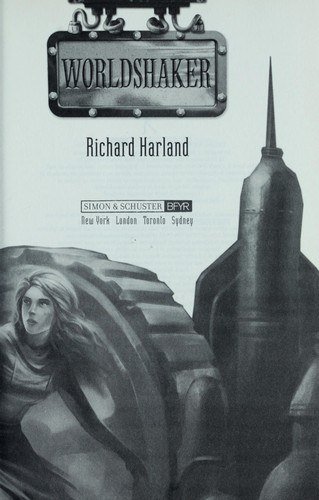
Richard Harland's Worldshaker puts society aboard a gigantic moving juggernaut, because sometimes the class system is apparently not oppressive enough unless it also has engines.
Worldshaker is a young adult steampunk novel built around a vast mobile juggernaut, a moving society whose decks and depths reflect class hierarchy. That immediately places it near Mortal Engines, but the emphasis differs. Reeve's cities are predators in a post-apocalyptic ecology. Harland's juggernaut is a social machine, with privilege above and exploitation below.
The story follows Col, a privileged young man whose assumptions are challenged when he encounters Riff, one of the oppressed Filthies. The structure is direct but effective: a character raised inside the official story meets someone who reveals the cost of that story. Steampunk loves this pattern because the genre is full of beautiful surfaces hiding brutal mechanisms.
The juggernaut setting gives the novel its field-guide hook. A mobile city is always more than scenery. It is a machine of movement, labour, class and ideology. Every deck implies a hierarchy. Every engine implies workers. Every polished upper level implies something below that has not been invited to dinner. Worldshaker takes that arrangement and makes rebellion the necessary response.
Its YA status helps sharpen rather than soften the social argument. Young adult fiction often excels at showing inherited systems through characters who are just old enough to see the cracks. Col's awakening is not subtle, but subtlety is not always the point. The book wants the reader to understand how a closed society teaches comfort to ignore suffering.
The Australian origin is also useful. Steampunk is international, and Worldshaker helps mark that wider geography. It participates in global YA steampunk rather than only the British or American branches. That matters for a canon that should not pretend the field has one national boiler room.
The juggernaut image also gives the novel a theatrical clarity that suits YA. Readers can see the metaphor immediately, which is not a flaw. A vast moving hierarchy is a strong teaching machine. The upper levels have comfort, ceremony and ignorance. The lower levels have labour, suffering and knowledge. The plot comes from forcing those decks to recognise each other.
Riff's role is crucial because she is not simply there to educate Col for his moral improvement. She brings anger, knowledge and a claim on the story. The rebellion plot works best when the oppressed are not scenery for the privileged hero's conscience, but agents in their own right. That is the standard class-rebellion steampunk has to meet.
The comparison with Leviathan is helpful too. Both are YA works from 2009, both use large-scale speculative machinery, and both place young protagonists inside systems of war, class or ideology. Together with Mortal Engines and Airborn, they show how strong the young-reader side of steampunk had become by the end of the decade.
For readers, Worldshaker works best as a socially clear adventure. It may not have the conceptual wildness of Mortal Engines or the biotechnological elegance of Leviathan, but its image of a stratified moving world is strong. It knows exactly what it wants its machine to mean.
That clarity makes it a good educational entry in the canon. If The Light Ages explores class through literary industrial fantasy, Worldshaker makes class spatial and mechanical. The reader does not need a lecture to understand the world. They only need to ask who lives above, who works below, and who designed the stairs.
The book also belongs in conversation with rebellion narratives across steampunk. Retro-industrial worlds often look stable because their machinery is large and loud, but that stability is usually theatre. Put pressure on the lower decks and the whole grand contraption starts to sound less like civilisation and more like a badly maintained lie.
That makes Worldshaker especially useful for younger readers encountering class critique through speculative adventure. The machine is exciting, but the social arrangement is indefensible. The book's job is to make both facts visible at once.
Is it really steampunk?
Yes. Worldshaker is YA steampunk, with a giant mobile machine-society, retro-industrial setting, class hierarchy and rebellion. It belongs in the field's young-reader branch and connects strongly to other mobile-city and class-conscious entries.
The novel's importance lies in making social structure physically legible. Steampunk often talks about class; Worldshaker builds the class system into the architecture. Up and down are not just directions. They are politics. That is a useful lesson for any retro-industrial fantasy hoping to do more than admire brass fittings.
It also creates a neat thematic bridge from Mortal Engines to The Light Ages. One literalises predatory urbanism. The other explores magical industrial class. Worldshaker sits between them as a moving hierarchy waiting to be shaken, which is a title doing honest work.
Find it
If you would like to track down Worldshaker, these search links may help. We have not specified an edition, so you can pick the format that suits you.
Affiliate links: as an Amazon Associate, Stephen Hunt’s SFcrowsnest earns from qualifying purchases. These may earn us a small commission at no extra cost to you.