
Why it matters
It pushes steampunk's pre-label machinery toward global conflict, imperial breakdown and mechanised catastrophe.
After Warlord of the Air, one might hope Oswald Bastable had earned a quiet sit-down and perhaps a restorative sandwich. Michael Moorcock instead gives him a darker alternate history and the machinery of war.
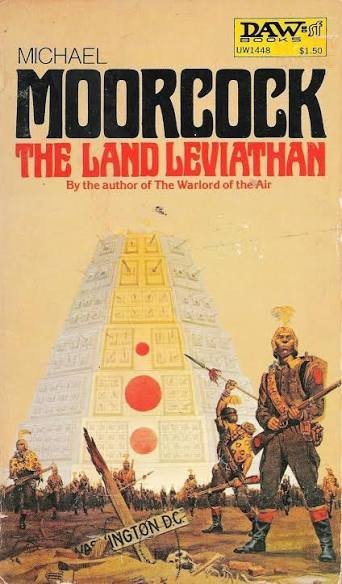
The Land Leviathan is the second of Moorcock's Oswald Bastable books and a key companion to Warlord of the Air. If the earlier novel helped establish airship alternate history as a major route into steampunk, this one deepens the sense that altered technology and imperial politics do not simply produce picturesque adventure. They produce wreckage.
The title itself carries the right kind of weight. A land leviathan suggests industrial scale, biblical menace and a war machine with no interest in a gentlemanly duel. The spreadsheet tags the book with alternate empire, world war and giant machines, which catches its field-guide value neatly. This is steampunk ancestry leaning away from parlour contraptions and toward the monstrous apparatus of history.
Moorcock's Bastable sequence is important because it treats the adventure hero as unstable evidence. Bastable moves through alternate worlds where the familiar landmarks of imperial confidence are rearranged, exaggerated or exposed. He is not simply having ripping adventures. He is being forced to confront the political implications of the stories that raised him.
For steampunk, The Land Leviathan helps expand the genre's mechanical vocabulary. Airships may be glamorous, but land warfare brings a different mood: mass movement, heavy industry, mechanised killing, and the awful possibility that technological ingenuity is very good at making disaster efficient. Later dieselpunk-adjacent and industrial fantasy works would draw heavily from this darker side of retrofuturism.
The novel also strengthens the link between alternate history and moral pressure. It is easy to imagine alternate worlds as clever map games: move a border, change a monarch, add a machine. Moorcock is more severe. The question is not only "what changed?" but "who suffers because of it?" That question gives the Bastable books their continuing value for the field.
Purists may again hesitate over the label. The Land Leviathan predates the public naming of steampunk, and it is not part of the later aesthetic movement. But classification should not flatten ancestry. It is a proto-steampunk work, a core precursor, and a warning that the genre's machines have always had shadows.
For readers, the book is likely to appeal if they want less whimsy and more bite. This is not the corner of the field where a clockwork valet serves tea while a duchess loads a ray pistol. It is closer to the place where industrial modernity realises it can put tracks, armour and ideology on the same terrible chassis.
The Bastable sequence also helps separate nostalgia from historical imagination. Nostalgia wants the past to be a better-dressed holiday. Moorcock is after something rougher. His altered histories use adventure furniture, but they are concerned with violence, ideology and the excuses powerful nations make for themselves. That is a sturdier foundation for serious steampunk than any number of brass knobs glued to a moral vacuum.
The land-machine imagery is especially valuable because steampunk is so often sky-drunk. Airships dominate the horizon, but ground power has its own terror: weight, momentum, occupation, the crushing confidence of industrial force. The Land Leviathan reminds the genre that mechanised modernity does not always float above the world. Sometimes it rolls over it.
That makes it an essential corrective within the Bastable line. The first book gives readers altitude, alternate imperial glamour and political unease. This one drags the machinery down into heavier weather, where progress looks less like flight and more like impact.
It is not pretty, but it is necessary ballast for the canon, especially when the shinier machines start behaving as if history is only a backdrop.
Is it really steampunk?
It is proto-steampunk with a strong claim to precursor status. The Land Leviathan uses alternate history, imperial critique and large-scale machinery in ways that later steampunk would recognise, though it belongs to Moorcock's own political and literary project rather than to the genre as a settled label.
The book is useful because it refuses to let the machinery remain charming. Steampunk can sometimes polish war into adventure until it squeaks. Moorcock's approach is harsher. Machines are part of systems, and systems are part of politics. A land leviathan is not merely a grand object. It is an argument in steel.
It should be read alongside Warlord of the Air, The Steel Tsar, The War of the Worlds and later works about mechanised conflict. It also forms a bridge toward dieselpunk-adjacent material, where the romance of machinery gives way to the age of mass war and ideological ruin.
Find it
If you would like to track down The Land Leviathan, these search links may help. We have not specified an edition, so you can pick the format that suits you.
Affiliate links: as an Amazon Associate, Stephen Hunt’s SFcrowsnest earns from qualifying purchases. These may earn us a small commission at no extra cost to you.