
Why it matters
It completes one of the key pre-label sequences that taught steampunk how to use airships, empire and anti-imperial unease without losing the adventure charge.
By the time Oswald Bastable reaches The Steel Tsar, the airship romance has acquired enough political bruising to need a separate luggage allowance.
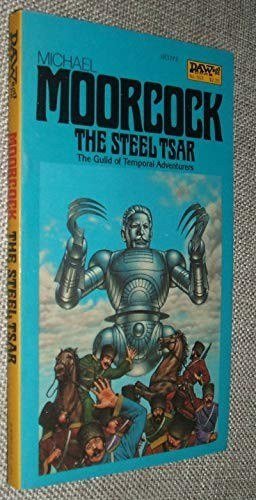
The Steel Tsar is the third of Michael Moorcock's Oswald Bastable books, following Warlord of the Air and The Land Leviathan. The sequence is central to steampunk's ancestry because it gets so many later ingredients airborne before the label is commonly in place: alternate history, airship power, imperial critique, political dislocation and a hero whose inherited certainties keep being shoved into stranger weather.
The spreadsheet tags this entry with airship empire, alternate Russia and imperial collapse. That is a useful way into the book. Moorcock's interest is not just in making history different. He wants altered history to expose the violence and fantasy inside imperial adventure fiction. Bastable's travels through alternate worlds become a kind of ideological education, though one delivered with more gunfire and dirigibles than most evening classes provide.
As with the earlier Bastable books, the machinery matters because it belongs to systems. Airships are beautiful in silhouette, but Moorcock seldom lets beauty remain innocent. They are bound up with military reach, imperial power and the seductive dream that superior technology can make politics obey. Later steampunk would sometimes keep the airship and misplace the critique. The Steel Tsar is a useful reminder to pack both.
The novel also sits near the boundary between steampunk and broader alternate-history SF. It is not a cosy Victorian toybox. It is not especially interested in brass as decor. Its claim on the field comes through the way it turns historical machinery, political machinery and actual machinery into one apparatus. That is often where the best steampunk lives: not in the gadget alone, but in the social order the gadget reveals.
Bastable himself remains important as a perspective character because he comes with assumptions that the books can test. He is not a blank traveller. He carries the baggage of empire, military training and adventure tradition. When the world changes around him, the interesting question is not simply what the map looks like now, but what happens to a man whose values were built for a map that no longer exists.
For readers approaching the sequence from modern steampunk, The Steel Tsar may feel more politically barbed than visually ornamental. That is a strength. It belongs to a strand of the genre that treats retrofuturism as argument rather than escape. The alternate world is a laboratory for power, not a holiday resort with better hats.
It also closes a progression. Warlord of the Air gives the field one of its great airship-political templates. The Land Leviathan drags industrial machinery into heavier conflict. The Steel Tsar completes the triptych with another face of imperial fantasy and collapse. Together they form a canon thread that every later serious airship adventure has to answer, even if it answers by humming loudly and pretending not to hear.
The book's "deep cut" status in the spreadsheet is right, but deep cuts can be the places where a canon shows its spine. The Steel Tsar may not be the first recommendation for a casual reader who wants to know what steampunk looks like. It is, however, important for anyone asking what steampunk argues with. Moorcock's alternate worlds argue with imperial romance, heroic certainty and the notion that technological superiority confers moral authority.
That argument would echo through later retrofuturist fiction, especially the works that place air power, class conflict and colonial violence in the same frame. An airship is never just an airship once you ask who paid for it, who crews it, who commands it and who has to look up at its shadow. The Bastable books trained the field to ask those questions before the brass polish had dried.
Is it really steampunk?
It is proto-steampunk and a core precursor rather than modern steampunk in the later subcultural sense. Its alternate history, airship technology and anti-imperial pressure make it a close ancestor. It is best understood as part of the machinery that made steampunk possible, particularly the political and military side of the field.
The book's value lies in its refusal to separate spectacle from responsibility. Moorcock knows the appeal of grand machines and exotic rearranged histories, but he also knows that such pleasures can carry imperial habits in their hold. That tension keeps the Bastable books sharper than many later works that borrow the look and leave the politics in lost property.
This is a deep cut but not an optional one. Readers who want only the most accessible route may start with Warlord of the Air. Readers tracing the canon's development should follow Bastable through to this point, where the air has grown colder and the machinery more severe.
It also offers a useful bridge to later secondary-world steampunk and airship fantasy, including Stephen Hunt's Jackelian books. Those later works move into invented settings, but many of the tensions remain familiar: war, class, revolution, state violence, impossible machines and the question of whether any society can build wonders without also building new ways to misbehave.
Find it
If you would like to track down The Steel Tsar, these search links may help. We have not specified an edition, so you can pick the format that suits you.
Affiliate links: as an Amazon Associate, Stephen Hunt’s SFcrowsnest earns from qualifying purchases. These may earn us a small commission at no extra cost to you.