Why it matters
It shows the steampunk borderlands engaging with apocalypse, empire, India and adventure in a neo-Victorian frame.
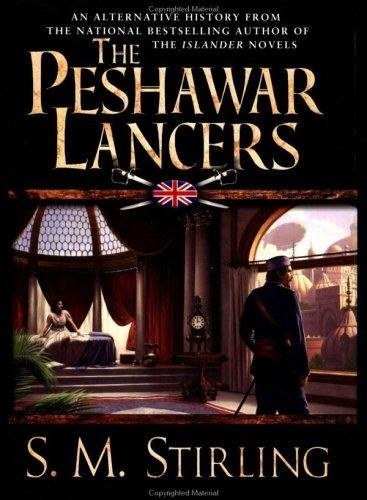
S. M. Stirling's The Peshawar Lancers imagines the British Empire surviving catastrophe by relocating its centre of gravity, which is one of those alternate-history premises that arrives wearing a splendid uniform and carrying a very large ethical suitcase.
The Peshawar Lancers is a deep-cut adjacent work rather than a clean core steampunk novel. Its central divergence is catastrophic: a nineteenth-century disaster devastates much of the northern hemisphere, pushing the British imperial order into an altered future with India as a major centre of power. The result is not the usual Victorian London with shinier machines. It is a post-catastrophe imperial world rebuilt around different geography, hierarchy and memory.
That makes the book useful because steampunk often has to decide how honestly it will handle empire. Stirling's premise puts imperial continuity at the centre of the story. The world is neo-Victorian not because everyone likes waistcoats, but because institutions, military culture and social forms have survived and mutated. This is a strong alternate-history engine, even when readers may argue fiercely about what the book does with it.
The spreadsheet's motifs, neo-Victorian empire, apocalypse aftermath and imperial India, place it in the right zone. The book's relationship to steampunk is mostly through retro-historical world-building, military adventure, alternate technology and nineteenth-century imperial inheritance. It is closer to alternate history than gadget romance, and that label should be respected.
The India setting is central and demands care. Too much old adventure fiction treated India as scenery for imperial self-confidence, and modern readers should not repeat that without scrutiny. The Peshawar Lancers belongs here partly because it shows how steampunk-adjacent fiction can use imperial materials, and partly because it reminds us to ask who is being centred, who is being exoticised, and whose version of history the adventure requires.
In this sense, the book can be compared with Moorcock's Bastable sequence, though the temperaments differ. Moorcock uses alternate empire to critique imperial romance from within. Stirling builds a detailed alternate imperial order after disaster. Both belong to the map, but they do different work and should not be blurred together.
The adventure elements connect the novel to Space: 1889, military alternate history and colonial-era speculative fiction. Yet the apocalypse gives it a different flavour. This is not merely the empire expanding into a new frontier. It is a civilisation surviving a blow and becoming stranger because of it. That survival fantasy is compelling, but it is also politically loaded.
The novel also shows how alternate history can preserve historical attitudes in altered form. Catastrophe does not automatically make people wiser, fairer or less attached to hierarchy. In many alternate histories, disaster becomes an excuse for old systems to harden. That is part of what makes this kind of book interesting and uncomfortable. The reader is not just asking what changed, but what stubbornly refused to change.
Its military romance should therefore be read with two minds. On one hand, cavalry, uniforms, intrigue and frontier danger are potent adventure ingredients. On the other, they arrive carrying the history of imperial fantasy. The thrill can be acknowledged while keeping the context visible. That is not scolding the book out of the canon; it is reading the canon with both eyes open.
For readers, the book is likely to be most interesting if they enjoy alternate-history systems: altered institutions, military orders, succession, geography, religion, and the long consequences of a single catastrophe. Readers seeking brass gadgets may find it less immediately steampunk than the spreadsheet category suggests. Readers tracking neo-Victorian adventure will find it relevant.
Is it really steampunk?
Not strictly. The Peshawar Lancers is alternate history and steampunk-adjacent, with a neo-Victorian imperial frame and some shared adventure DNA. It belongs as a borderland work rather than as a pure example of steam-driven retrofuturism.
The novel's usefulness lies in the questions it raises. What happens when Victorian institutions survive into a different world? How does catastrophe preserve, distort or intensify imperial forms? Can adventure fiction use these materials without becoming their servant? The book does not settle every argument, but it points to where the arguments live.
Readers approaching from Stephen Hunt's Jackelian books may notice shared interest in military orders, political arrangements, social hierarchy and strange alternate worlds. The Jackelian line is more overtly secondary-world steampunk fantasy. Stirling's novel is a more direct alternate-history construction with heavier imperial baggage.
The book's presence in this batch is useful beside Mortal Engines and The Light Ages. All three imagine societies shaped by catastrophe, power or altered energy, but each does so through a different lens: mobile predation, imperial survival and magical industry. Together they show how flexible steampunk adjacency can be once the guide stops demanding the same boiler in every basement.
Find it
If you would like to track down The Peshawar Lancers, these search links may help. We have not specified an edition, so you can pick the format that suits you.
Affiliate links: as an Amazon Associate, Stephen Hunt’s SFcrowsnest earns from qualifying purchases. These may earn us a small commission at no extra cost to you.