Why it matters
It is a modern television example of the gaslamp-superhuman borderland, using Victorian outcasts, strange powers, secret science and social panic to approach steampunk-adjacent territory.
The Nevers gives Victorian London a population of altered people, proving that society can receive superpowers and still somehow make the paperwork worse.
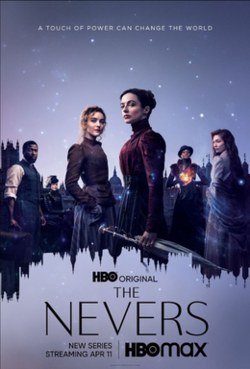
Created by Joss Whedon, The Nevers is set in Victorian London after certain people, many of them women, develop unusual powers known as Turns. The series follows the Touched as they face fear, exploitation, institutional control and threats that gradually reveal a larger science-fiction framework.
The steampunk connection is not primarily mechanical. This is gaslamp superhuman drama, closer to a Victorian X-Men notion than to full steam-age alternate history. Yet the setting, costumes, inventions, social outcasts, secret science and institutional menace all place it near the genre's television borderlands.
Its strongest idea is social rather than technological. Powers arrive in a world already full of hierarchy, sexism, class anxiety and imperial confidence. The result is not liberation. It is panic, surveillance and opportunism. That makes the show useful beside steampunk because both often examine what happens when disruptive power enters an unequal society.
The series also uses invention and strange science as part of its texture. Machines and laboratories do not define the whole world, but they reinforce the sense that Victorian modernity has been knocked sideways. In a gaslamp setting, even a small technological disturbance can make the familiar city feel unstable.
Its production history and creator context are complicated, and the show never had the clean cultural landing that some modern genre series enjoy. Even so, the concept remains relevant: a Victorian city facing altered bodies, hidden causes and social fear. That is potent borderland material, even when the execution divides viewers.
The Nevers sits near Carnival Row and Sanctuary. All three use genre outsiders to ask what polite society does with people it finds inconvenient. The answer, as usual, involves institutions behaving as though compassion were rationed.
The series is also worth noting for its superhuman twist on the gaslamp ensemble. Instead of one inventor, detective or adventurer, it builds a community of altered people whose abilities upset existing categories. That gives the show a broader social frame than a simple secret-science caper. Powers become public anxiety, and public anxiety becomes policy.
Its relationship with steampunk is strongest when the inventions and powers sit beside class and gender pressure. Victorian spectacle alone would not be enough. The interesting part is how the setting turns difference into a problem to be managed, studied, feared or exploited. That is very much in the gaslamp borderlands.
The show is not a clean fit for everyone. Its later science-fiction turns shift the emphasis away from pure period fantasy, while its production history complicates its reception. Even so, the initial proposition remains a striking gaslamp one: altered people, social panic and secret histories moving through a city that already knows how to exclude.
It is most useful as a comparison point rather than a cornerstone. Put it beside Carnival Row and Sanctuary and the pattern becomes clearer: modern television repeatedly uses the Victorian or gaslamp city to stage arguments about bodies, rights and institutional fear.
That pattern is worth keeping, even when the individual show is uneven.
Is it really steampunk?
Adjacent. The Nevers is gaslamp superhuman science fantasy, not core steampunk. Its relevance comes from Victorian setting, altered bodies, secret science, social control and outcast communities.
It belongs near the field's modern television edge, where the machinery is partly social and the abnormal body becomes the argument.
Find it
If you would like to track down The Nevers, these search links may help. We have not specified an edition, so you can pick the format that suits you.
Affiliate links: as an Amazon Associate, Stephen Hunt’s SFcrowsnest earns from qualifying purchases. These may earn us a small commission at no extra cost to you.