
Why it matters
It is not steampunk, but its love of early forensic methods, invention, historical guest figures and Victorian science makes it a long-running gaslamp neighbour.
Murdoch Mysteries gives Victorian-era Toronto a detective who keeps inventing things, which must be useful for crime solving and exhausting for everyone trying to keep the office tidy.
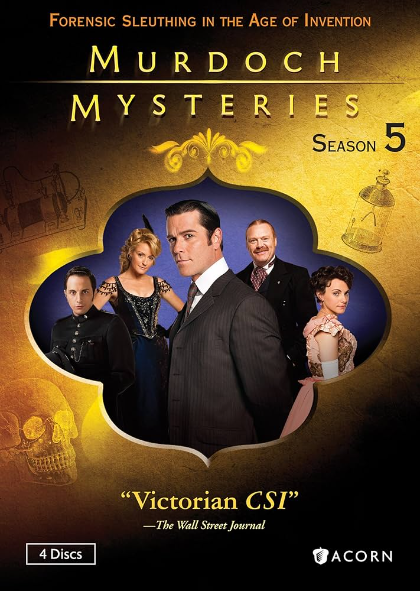
Based on characters from Maureen Jennings' novels, the television series follows Detective William Murdoch as he solves crimes in late nineteenth-century and early twentieth-century Toronto. Developed for television by Cal Coons and Alexandra Zarowny, it has become a durable procedural with a period setting, a fondness for scientific method and a steady appetite for historical invention.
The steampunk connection is adjacent rather than central. Murdoch is not building an alternate steam empire, and the show is not about a world transformed by speculative technology. Its pleasure lies in seeing modern forensic ideas appear in an earlier setting, often through devices, experiments and methods that make colleagues blink politely.
That makes it a close cousin to gaslamp detection. Like Sherlock Holmes stories, it treats reason, observation and science as theatrical forces in a period world. Murdoch's inventions can feel faintly steampunk because they turn future habits into Victorian contraptions. The difference is that the show usually keeps one foot in plausible procedural history rather than leaping fully into retrofuturist fantasy.
The Canadian setting matters. Much popular gaslamp and steampunk material defaults to London, as if no other city had fog, crime or ambitious hats. Murdoch Mysteries gives Toronto its own period detective imagination, with local institutions, politics and social habits shaping the cases. That widens the map without requiring an airship to point at it.
Its long run also means the show has become a comfort machine for viewers who enjoy the blend of history, invention and murder solved before bedtime. The tone is often genial despite the body count, and that makes its science feel less like industrial dread than curious problem-solving with respectable collars.
Murdoch Mysteries is valuable because it shows how far gaslamp adjacency can stretch without becoming steampunk proper. The ingredients overlap: period setting, invention, scientific optimism, detective logic and social change. The engine, however, is procedural mystery.
The show's historical guest figures and playful anticipations of modern technology give it extra borderland appeal. It enjoys the joke of a character inventing, naming or nearly inventing something viewers already recognise. That is not steampunk world-building, but it scratches a similar itch: the pleasure of seeing the modern world arrive early and slightly awkwardly.
It also has a gentle confidence unusual in louder genre pieces. Murdoch does not need to fight a giant brass spider to make his science interesting. A careful experiment, a new device or a forensic hunch can provide enough period charm. Sometimes the most convincing machine in the room is a detective's patient brain.
The series is also useful for readers who prefer repeated, lived-in period worlds to one grand speculative premise. Its inventions arrive through practice rather than prophecy. That modest rhythm makes the show feel adjacent to steampunk without ever needing to dress itself as steampunk for the evening.
It is a quiet border case, but a persistent one, and persistence counts when a detective keeps finding new uses for wires, lenses and suspicion.
Is it really steampunk?
No. Murdoch Mysteries is gaslamp-adjacent detective television. Its relevance comes from Victorian forensics, inventions, scientific detection and period crime rather than alternate industrial world-building.
It suits readers who like the sensible side of the borderlands: fewer rampaging automata, more laboratory work, and a detective who probably has a labelled drawer for everything.
Find it
If you would like to track down Murdoch Mysteries, these search links may help. We have not specified an edition, so you can pick the format that suits you.
Affiliate links: as an Amazon Associate, Stephen Hunt’s SFcrowsnest earns from qualifying purchases. These may earn us a small commission at no extra cost to you.