Why it matters
It is not steampunk, but its hidden institutions, strange beings, Victorian backstory and science-fantasy lineage place it near gaslamp and League-style monster adventure.
Sanctuary builds a refuge for abnormals, secrets and old scientific sins, because apparently monster management also requires institutional planning.
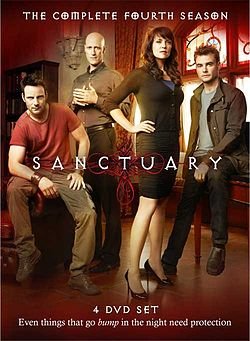
Created by Damian Kindler, Sanctuary began as a web series before becoming a television series. It follows Dr Helen Magnus, played by Amanda Tapping, and her work with abnormals, creatures and hidden scientific legacies. The format mixes contemporary fantasy, monster-of-the-week adventure, secret history and old experiments that have aged about as well as one might fear.
Its steampunk fit is indirect, but the border is clear. Much of the action is modern or near-modern, so this is not a period steampunk series. The relevance comes from the Victorian backstory, the secret-science atmosphere, the sense of hidden societies and the interest in exceptional bodies as products of research, evolution, myth or alarming curiosity.
The connection to The League of Extraordinary Gentlemen is tonal rather than identical. Both are interested in extraordinary beings, secret histories and the possibility that the respectable world has a deeply strange underside. Sanctuary turns that idea into an institution, less literary mash-up and more creature welfare crossed with hazardous research.
Helen Magnus gives the series its strongest gaslamp thread. A long-lived scientist with roots in the Victorian era, she brings the old world into the present. That continuity matters because steampunk-adjacent fiction often imagines the nineteenth century not as finished history, but as a machine still running under the floorboards.
The show also belongs near artifact and warehouse fantasies. Like Warehouse 13, it treats history as something that leaves dangerous leftovers. Objects, bodies and discoveries persist. The past is not a museum. It is a storage problem with teeth, paperwork and occasional tentacles.
The useful angle is its role as a modern descendant rather than a core example. Sanctuary shows how gaslamp monster science can move into contemporary television while keeping Victorian shadows, secret experiments and abnormal bodies in circulation. The brass is less obvious, but the inheritance is there.
The digital-production background also gives the series a place in television history. It began online before moving to a more conventional broadcast life, which suits a show about hidden spaces and unusual forms rather neatly. That production story is not steampunk, but it does make Sanctuary one of the more interesting genre-television experiments of its moment.
Its audience is the viewer who enjoys archives, monsters, secret histories and science with a slightly guilty conscience. There is less polished brass than in core steampunk, but plenty of curiosity, old trouble and institutional unease. The creatures are not decorative. They ask what science does with the lives it discovers.
The show's creature ethics give it a little more bite than a simple monster catalogue. The question is not only how to contain the strange, but whether containment becomes another kind of harm. That concern sits well beside steampunk's suspicion of enlightened institutions that are not quite as enlightened as their stationery suggests.
It also gives Amanda Tapping a commanding central role in a genre space often crowded with reckless men and their inventions. Magnus is not merely a keeper of secrets. She is a survivor of them, and that gives the series a welcome sense of age.
Is it really steampunk?
No. Sanctuary is monster-adjacent science fantasy with gaslamp roots. Its relevance comes from secret science, Victorian backstory, hidden institutions and abnormal bodies rather than steam-age alternate technology.
It belongs near the shelves where steampunk meets occult science and creature cataloguing. Someone has to keep the monsters safe, and apparently that someone also needs a research budget.
Find it
If you would like to track down Sanctuary, these search links may help. We have not specified an edition, so you can pick the format that suits you.
Affiliate links: as an Amazon Associate, Stephen Hunt’s SFcrowsnest earns from qualifying purchases. These may earn us a small commission at no extra cost to you.