Why it matters
It helped show that steampunk romance could handle world-building, post-imperial trauma, action and desire in the same engine room.
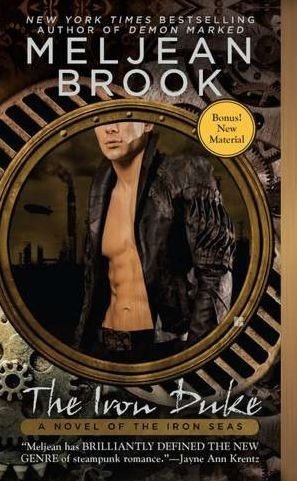
Meljean Brook's The Iron Duke is what happens when steampunk romance looks at empire, bodily control, airships and adventure, then decides the courtship will have to proceed through several layers of political wreckage.
The Iron Duke opens Brook's Iron Seas sequence and is one of the major romance-steampunk crossover titles of the Maker & Masquerade Age. It is not merely a romance novel in goggles, nor a steampunk adventure with kissing added as a polite afterthought. Its appeal comes from the way relationship, history and speculative technology are braided into the same dangerous social world.
The setting imagines a Europe emerging from occupation by the Horde, whose control involved nanotechnology and bodily domination. That gives the book a more unsettling technological premise than the usual friendly clockwork device. Nanotech in a steampunk context is deliberately strange: it is invisible, invasive and modern-feeling, placed inside a world of airships, imperial aftermath and adventure romance.
The hero, Rhys Trahaearn, the Iron Duke, is a celebrated figure whose public heroism carries complicated private and political weight. The heroine, Mina Wentworth, works as an inspector and moves through a society still marked by conquest, prejudice and trauma. That social pressure matters. Romance here is not floating above the world; it is negotiating the world, which is much more interesting.
The book's importance lies in genre crossing. By 2010, steampunk was no longer a narrow literary label. It had moved into romance, paranormal comedy, YA adventure, weird west fiction and series entertainment. The Iron Duke shows the romance branch taking the machinery seriously enough to build a political and bodily history around it.
The airships provide the visible steampunk pleasure, while the nanotech provides the deeper speculative unease. That combination is useful because it stops the book becoming merely decorative. The technology has touched bodies, identities and social order. It is not only transport or weaponry. It is history embedded in flesh, which is quite a bit harder to polish for the cover.
Readers who come from Soulless will recognise the genre-blending openness of the period, but Brook's register is different. Carriger leans toward comedy of manners and paranormal society. Brook leans toward adventure romance, trauma, danger and heat. Both belong in the guide because both show how steampunk could become emotionally and commercially flexible.
The book also complicates the empire-adventure inheritance. Many older adventure forms use empire as scenery or engine. The Iron Duke works in the aftermath of domination and resistance, asking how people live after occupation and how public legends sit beside private damage. It is still a romance adventure, but the background is not weightless.
That background is one of the reasons the romance works as steampunk rather than costume play. Mina and Rhys are not simply negotiating attraction; they are negotiating status, power, public myth and a world in which bodies have been technologically violated. The result gives the relationship a pressure that comes from the setting itself. Desire is not insulated from history, and history is not polite enough to wait outside the bedroom door.
Brook's Iron Seas world also offers a useful alternative to the familiar British Victorian template. Its post-Horde setting, altered technologies and global adventure routes make the field feel less like a single national wardrobe. The book still uses airships, titles and retro-adventure pleasures, but the deeper premise is one of occupation, liberation and social aftermath. That makes it a richer crossover than a bare list of motifs would suggest.
The nanotech element deserves special attention in the guide because it is almost anti-steampunk at first glance. Steampunk tends to love visible mechanisms: gears, pistons, boilers, brass gauges. Nanotechnology is invisible, intimate and invasive. By putting it in this world, Brook creates a productive tension between the genre's tactile style and a technology that cannot be admired safely from across the room.
Is it really steampunk?
Yes. The Iron Duke is romance steampunk, with airships, alternate history, speculative technology, empire aftermath and adventure structure. Its nanotech element is not traditional brass-and-steam machinery, but it deepens the retrofuturist world rather than pulling it out of the field.
Purists who prefer machinery to romance are missing the point. Steampunk's modern expansion depended on hybrids, and romance is one of the places where the genre learned to handle bodies, attraction, social pressure and emotional stakes with real force. Ignoring that branch would be pretending the airship never had cabins.
For readers, this is a good crossover entry: more intense than a cosy gaslamp romp, more relationship-driven than military adventure, and more technologically invasive than many romance-steampunk peers. It deserves a place beside Soulless, Phoenix Rising and other works that made the field hospitable to broader audiences without abandoning speculative world-building.
It is also a reminder that romance is not automatically soft in the structural sense. Romantic plots are excellent machines for testing trust, consent, reputation and vulnerability. In a steampunk world scarred by imperial technology, those questions become part of the genre's machinery too.
Find it
If you would like to track down The Iron Duke, these search links may help. We have not specified an edition, so you can pick the format that suits you.
Affiliate links: as an Amazon Associate, Stephen Hunt’s SFcrowsnest earns from qualifying purchases. These may earn us a small commission at no extra cost to you.