
Why it matters
It gives modern steampunk a brisk detective-adventure entry point, mixing investigation, gadgets, airships and horror flourishes.
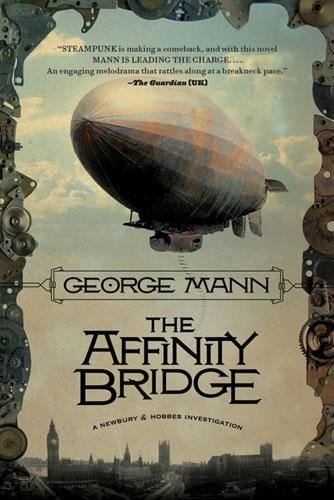
George Mann's The Affinity Bridge has the good manners to bring together Victorian detection, airship disaster, sinister science and zombies, because apparently one genre lane was not causing enough traffic.
The Affinity Bridge introduces Sir Maurice Newbury and Veronica Hobbes, investigators operating in a Victorian world of strange science, imperial secrets and occult-adjacent trouble. It belongs squarely to the modern maker-era steampunk wave: readable, genre-blending, visually clear and happy to place familiar detective structures beside clockwork and airship spectacle.
The detective frame is important. Steampunk often uses mystery because the genre is full of hidden mechanisms, secret societies and technologies with concealed purposes. A detective story gives the reader a reason to open the casing. In The Affinity Bridge, investigation becomes the way to move through a world where public order is already being warped by private experiments and state interests.
The airship element supplies one of the classic images, while the zombie material brings horror into the mix. This is not unusual for modern steampunk, which often behaves like a grand interchange for adjacent forms: mystery, horror, adventure, gaslamp fantasy, science fiction and pulp. Mann's skill is in making the combination approachable. The book is a good entry point because it knows its genre pleasures and serves them cleanly.
Newbury and Hobbes themselves are central to the appeal. The pairing creates a Holmesian echo without simply repeating Holmes and Watson. Veronica Hobbes is not only a sidekick-shaped note-taker; she is part of the investigative engine. This matters in a field that can otherwise get stuck admiring gentlemen with apparatus.
The novel's London is recognisable as steampunk stage-space: monarchy, ministries, clubs, strange devices, shadowy threats and the sense that technological progress has been allowed into the parlour without wiping its boots. It is not trying to build a full systemic alternate history like The Difference Engine. It is building an energetic series world.
That series-world quality matters. Detective steampunk thrives on recurrence: familiar investigators, new cases, new devices, old secrets returning with suspicious timing. The reader comes back partly for the world and partly for the rhythm of investigation. Mann's Newbury and Hobbes books help show how steampunk could function as an ongoing genre format rather than a one-off literary experiment.
The zombie strand also points to modern steampunk's willingness to raid horror. Zombies in this setting are not a betrayal of steampunk but part of its hybrid appetite. Once the genre accepts strange science, imperial laboratories and secret experiments, the undead are never that far from the railway timetable. The trick is making the horror feel built into the world rather than sprinkled on for cover art.
The Affinity Bridge is useful because it marks the detective branch of modern steampunk. Readers who like case-based structure, recurring protagonists and a steady supply of weird incidents can start here more easily than with denser or more eccentric canon works.
The book also shows how the Maker & Masquerade Age packaged steampunk for a broader audience. The motifs are legible at once: airships, gadgets, Victorian manners, danger and the undead. That clarity can be dismissed as formulaic, but formula is not always a vice. Used well, it becomes a doorway.
Is it really steampunk?
Yes. The Affinity Bridge is core modern detective steampunk. It has a Victorian-style setting, speculative technology, airship adventure, investigative structure and horror-adventure crossover elements. It may be lighter than the literary-industrial branch, but it is very much in the field.
The novel's best field-guide label is "good entry point". It gives readers a manageable taste of the mode without requiring them to understand the entire canon. The trade-off is that it works within familiar genre furniture rather than demolishing the house. Sometimes that is exactly what a reader wants.
Its limits are also part of its usefulness. Not every guide entry needs to be a revolution in form. Some works are valuable because they demonstrate a reliable branch: detective partnership, Victorian adventure, gadgets, monsters and recurring danger. The Affinity Bridge helps readers find that branch without requiring a machete.
The book also shows how steampunk can use familiar forms as stabilisers. Once the reader understands the detective pattern, the stranger elements can arrive without collapsing the structure. Airships, zombies and strange science may be unruly, but the case gives them a track to run on.
That track is why the novel remains easy to place in a reading path. It can sit after gaslamp mysteries, before heavier conspiracy works, or beside pulp series fiction. It is a hinge entry, modest in ambition compared with some landmarks, but useful because it helps the field move between shelves.
It connects naturally to Pax Britannia, Soulless, Anno Dracula and other works where investigation, monsters and Victoriana overlap. It also links back to older gaslamp and detective traditions, where the city is always hiding a mechanism, a corpse or a civil servant with unhelpful news.
Find it
If you would like to track down The Affinity Bridge, these search links may help. We have not specified an edition, so you can pick the format that suits you.
Affiliate links: as an Amazon Associate, Stephen Hunt’s SFcrowsnest earns from qualifying purchases. These may earn us a small commission at no extra cost to you.