
Why it matters
It made paranormal steampunk lively, funny and widely accessible, blending gaslamp fantasy, romance, manners and dirigible-era style.
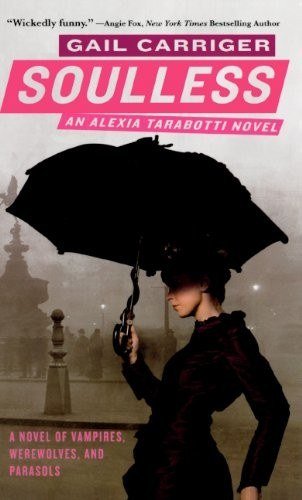
Gail Carriger's Soulless begins with a heroine, a vampire, a parasol and the firm implication that supernatural society would be much improved by better manners and less biting.
Soulless launches the Parasol Protectorate series and is one of the modern popular entry points into paranormal steampunk. Its heroine, Alexia Tarabotti, is soulless in the literal supernatural sense, which makes her an unusual presence in a Victorian society where vampires and werewolves are already part of public life. The premise lets Carriger treat social rules and supernatural rules as equally ridiculous and equally binding.
The comedy of manners is central. This is not steampunk as grim machinery or grand alternate history. It is steampunk as social dance, verbal sparring, etiquette, romance, danger and supernatural bureaucracy. That mixture gives the book its charm. The joke is not simply that vampires exist. It is that vampires exist and still have to navigate reputation, rank, clubs and dinner invitations.
The gaslamp component is strong. Vampires and werewolves place the book near Anno Dracula, but Carriger's tone is lighter and more romantic. Her supernatural society is not only a horror intrusion. It is part of the social order, with rules, factions and absurdities. The result is paranormal fantasy in historical dress, with steampunk accessories and enough dirigible atmosphere to earn its place.
The parasol matters, of course, because steampunk loves objects that are both stylish and weaponisable. Alexia's world understands that fashion can be equipment and that manners can be tactical. This is one of the pleasures of the series: the social surface is not empty decoration. It becomes part of how characters move, fight, flirt and survive.
The steampunk machinery is not as central as in Leviathan or The Difference Engine, but it contributes to the setting's texture. Airships, gadgets and scientific oddities share space with supernatural politics. That hybrid form is a hallmark of the Maker & Masquerade Age, when steampunk overlapped strongly with romance, urban fantasy, cosplay-friendly style and comic adventure.
Alexia's soullessness is more than a quirk. It lets Carriger treat identity as a social and supernatural category at once. She is unusual not only because of temperament but because the rules of the world classify her as a problem. That makes the comedy sharper. Society can tolerate vampires and werewolves, apparently, but a woman who interrupts the system's assumptions is another matter entirely.
The romance element also belongs here rather than being waved away. Modern steampunk grew partly because it could combine adventure, style and emotional genres without apology. Soulless helped make space for readers who wanted banter, attraction, etiquette and supernatural bureaucracy alongside dirigibles and devices. That fusion is a real part of the field's popular history.
For readers, Soulless is a friendly door. It is witty, fast and clear about its pleasures. Someone who finds the political density of Perdido Street Station or the system-building of The Difference Engine a bit much may find Carriger's approach more inviting. That accessibility is part of its canon role.
The book also broadens the field's emotional range. Steampunk can be funny, romantic and socially sharp without giving up speculative interest. Carriger's comedy works because it understands the rules it is teasing. Victorian manners, supernatural status and gender expectations all become mechanisms, and Alexia is very good at jamming them.
It is also a reminder that world-building can happen through etiquette. Who may call on whom, who may bite whom, who may marry whom and who may be seen with a parasol in a crisis are all structural questions in Carriger's world. The social machine is comic, but it is still a machine.
That is why the book's humour lands as more than decoration. Carriger treats manners as pressure systems. A raised eyebrow, a breach of protocol or a supernatural faux pas can move the plot as surely as a gear. In this corner of the field, conversation is a mechanism with teeth.
Is it really steampunk?
Yes, though best labelled paranormal steampunk or gaslamp fantasy. Soulless is not machinery-first steampunk, but its alternate Victorian society, dirigible-era style, speculative science and supernatural social order make it a genuine modern branch of the field.
Purists may prefer to call it gaslamp paranormal romance. That is not wrong, but it should not exclude it from the steampunk map. The genre's modern expansion includes exactly this kind of hybrid: manners, monsters, gadgets, romance and world-building in one well-dressed parcel.
This is a popular entry point and a useful counterbalance to darker works. It shows how steampunk can smile without becoming bland, and how a parasol in the right hands can be as serious a piece of equipment as any ray gun or boiler.
Find it
If you would like to track down Soulless, these search links may help. We have not specified an edition, so you can pick the format that suits you.
Affiliate links: as an Amazon Associate, Stephen Hunt’s SFcrowsnest earns from qualifying purchases. These may earn us a small commission at no extra cost to you.