
Why it matters
It is one of the great visual ancestors of screen steampunk, turning Verne's illustrated imagination into moving retrofuturist spectacle.
Karel Zeman's The Fabulous World of Jules Verne looks as if a nineteenth-century engraving has been given motion, mischief and a workshop full of impossible machines.
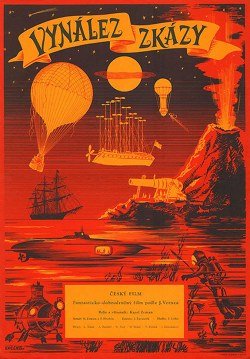
Known in Czech as Vynalez zkazy and often associated in English with The Fabulous World of Jules Verne, Karel Zeman's 1958 film is a landmark of Vernean cinema. Its great achievement is visual: it makes the film frame resemble the engraved illustrations of nineteenth-century adventure books, then animates that world with machines, sea voyages, laboratories and theatrical invention.
The result is proto-steampunk of the highest order. It predates the modern label, but so much of steampunk's later visual vocabulary is present in spirit: etched machinery, gentleman science, strange vehicles, maritime danger, antique futurism and a sense that technology has stepped directly out of an illustrated edition.
Zeman's method combines live action, animation, models and trick photography. That handmade mixture is part of the charm. Modern digital smoothness would be the wrong language for this material. The film works because it looks constructed, printed, staged and dreamt all at once.
The Verne connection is more than subject matter. Zeman understands Verne as a visual world, not simply a plot source. The film captures the sensation of reading old scientific romance and watching diagrams become destiny. Machines in this mode are never merely useful. They are promises, threats and page illustrations that have developed ambition.
It also belongs beside Melies. Both filmmakers use cinema as a machine for impossible journeys, but Zeman's work is more explicitly tied to the engraved book tradition. If Melies gives us theatrical moon fantasy, Zeman gives us illustrated retro-technology in motion.
For steampunk, the importance is obvious. Many later works try to look like antique futures. The Fabulous World of Jules Verne actually feels like one, with the texture of print and the energy of film. It is not just an ancestor; it is a visual lesson.
The film's alternate English title, Invention for Destruction, points to one of its deeper concerns. Vernean machinery is wondrous, but invention can be captured by violence and ambition. That gives the spectacle an edge. The machines are delightful, but delight is not the same as innocence.
That balance keeps the film from becoming a mere cabinet of pretty contraptions. Zeman knows the romance of invention, but he also knows that any marvellous device will soon attract uniforms, financiers and men with alarming eyebrows. The joke is gentle; the warning is not.
Zeman's work also expands the map beyond the usual French, British and American routes. Czechoslovak cinema brought its own craft traditions and visual imagination to Verne, proving that retrofuturism was already international long before steampunk fandom gave itself a name badge.
As a recommendation, it suits viewers who care about design history as much as plot. The film's story matters, but the real reason to watch is the sensation of stepping into an old illustrated adventure and finding the machinery already moving.
Is it really steampunk?
Not in the modern genre sense, but it is one of the strongest proto-steampunk films. Its Vernean machinery, engraving aesthetic, retrofuturist design and handmade spectacle make it essential to the field's visual history.
Viewers interested in steampunk art direction should treat it as required viewing. It explains, better than many manifestos, why old illustrations and impossible machines still have such power.
Find it
If you would like to track down The Fabulous World of Jules Verne, these search links may help. We have not specified an edition, so you can pick the format that suits you.
Affiliate links: as an Amazon Associate, Stephen Hunt’s SFcrowsnest earns from qualifying purchases. These may earn us a small commission at no extra cost to you.