
Why it matters
It is one of cinema's great ancestors of retro-scientific spectacle, moon-voyage fantasy and impossible machinery.
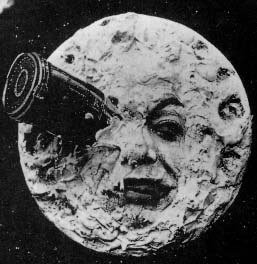
Georges Melies' A Trip to the Moon fires a capsule into the lunar eye and proves, very early in cinema's life, that science fiction was going to be imaginative, theatrical and somewhat rude to astronomy.
A Trip to the Moon is a short French film by Georges Melies, drawing on the moon-voyage tradition associated with Jules Verne, H. G. Wells and stage spectacle. It is not steampunk, because steampunk as a mode did not yet exist and the film is not interested in Victorian alternate history. It is, however, one of the great proto-ancestors.
The film's famous image of the rocket lodged in the Man in the Moon's eye has become one of science fiction cinema's foundational icons. That word is justified here; the image genuinely earned it. It captures what early speculative cinema could do: turn a scientific fantasy into a theatrical gag, a visual shock and a dream of travel all at once.
The machinery is charmingly impossible. This is not hard engineering. It is stage magic with a cannon, astronomers in robes and the confidence of a magician who knows that plausibility is less important than timing. Steampunk would later return to this kind of impossible machine again and again, polishing it with brass and giving it better upholstery.
Its connection to Verne matters because steampunk repeatedly draws from scientific romance. From the Earth to the Moon supplies the cannon-shot fantasy of lunar travel; Melies transforms that tradition into cinema. The result is a bridge between nineteenth-century speculative fiction and twentieth-century visual fantasy.
The theatricality is the point. Sets, painted backdrops, costumes and trick effects make the film feel like a moving stage illusion. Modern viewers may smile at the simplicity, but the film is not primitive in imagination. It is exuberant. It treats cinema as a machine for making impossibilities visible.
For the steampunk field, the lesson is clear: retrofuturism has always been part engineering dream, part performance. The machine does not need to work in a real laboratory if it works on the audience's sense of wonder. Melies understood that before most people had worked out what film could be.
The film also reminds us that science-fiction cinema began with delight, not with technical solemnity. Its astronomers are closer to stage magicians than modern astronauts, and that is exactly why they matter. They show invention as theatre, which is one of steampunk's recurring temptations.
Its handmade quality has aged into strength. The painted sets, tableau staging and trick effects are not obstacles to appreciation. They are the point of contact with an older visual imagination, one where impossible journeys were built from carpentry, costume and nerve.
For readers tracing the field's visual ancestors, A Trip to the Moon belongs beside Verne illustrations and Zeman's engraving-like cinema. It gives the map a lunar starting flare: antique, comic, impossible and still bright.
Is it really steampunk?
No. A Trip to the Moon is proto-science-fiction cinema and theatrical scientific romance. It belongs near steampunk because of its antique moon voyage, impossible machinery, Vernean ancestry and handmade retro-spectacle.
Readers and viewers tracing steampunk's origins should treat it as essential ancestry. It is short, strange, funny and historically enormous, which is a useful reminder that a small film can cast a very long lunar shadow.
Find it
If you would like to track down A Trip to the Moon, these search links may help. We have not specified an edition, so you can pick the format that suits you.
Affiliate links: as an Amazon Associate, Stephen Hunt’s SFcrowsnest earns from qualifying purchases. These may earn us a small commission at no extra cost to you.