
Why it matters
It is one of the defining early works linking steampunk to occult London, literary history, time travel and dark historical comedy.
Some novels use time travel to visit history. The Anubis Gates uses it to fall down a historical coal chute and land among magicians, beggars, body thieves and poets behaving badly.
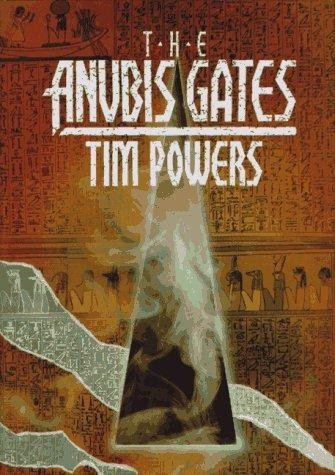
Tim Powers's The Anubis Gates is a canon landmark because it proves that steampunk's early life was never only about machinery. Here the engine is occult, literary and temporal. A modern scholar, Brendan Doyle, is drawn into early nineteenth-century London through time travel and soon finds himself trapped in a city of Egyptian sorcery, criminal underworlds, grotesque transformations and historical figures who cannot be trusted to stay safely in footnotes.
The novel belongs firmly beside Jeter and Blaylock in the first-wave conversation, but it brings a different flavour. Where Jeter leans into clockwork weirdness and Wellsian mischief, Powers mixes scholarship, magic and urban danger. The result is often classified as steampunk, gaslamp fantasy or historical fantasy, depending on which shelf is feeling bold that day. All three labels have a claim.
Its London is central to its power. This is not merely postcard Victoriana, and in fact the main historical action sits before the high Victorian period. The city is dirty, theatrical, predatory and full of secret routes. Powers understands that gaslit or pre-gaslit historical fantasy works best when the city feels like a machine nobody fully controls. Streets, taverns, theatres, prisons and river edges become moving parts.
The Egyptian occult strand gives the book another important field-guide connection. Steampunk and gaslamp fantasy have often borrowed from nineteenth-century Egyptomania and occult fashion, sometimes lazily, sometimes with proper unease. Powers uses the material to create a sense of deep magical history pressing against modern time. The past is not background. It is active, ritualised and rather cross.
One of the novel's great pleasures is its refusal to behave like a tidy tour. Doyle's expertise does not protect him nearly as much as he or the reader might hope. Knowing history is not the same as surviving it. That is a useful lesson for steampunk, which often sends clever modern or semi-modern perspectives into older worlds. Knowledge can help, but London has boots, knives and weather.
The book also matters because it bridges literary games with pulp momentum. Romantic poets, hidden histories and occult systems sit beside chases, bodily peril and nasty surprises. This is part of why the novel still feels lively. It has enough brains to stock a university office and enough menace to make that office lock its door.
Purists who define steampunk through industrial machinery may hesitate. That is understandable but too narrow. Early steampunk was a cluster of retro-historical fantasies, not a finished rulebook. The Anubis Gates belongs because it shares the same project: revisiting the nineteenth-century imagination with speculative tools, black humour and a willingness to scuff the respectable carpet.
Its time-travel mechanism also does something valuable for the field. It makes historical knowledge unstable. Doyle knows enough to think he has an advantage, but the past in Powers's hands is not a museum labelled for visitor convenience. It is hostile, improvised and full of people who are not interested in being studied. That is a useful corrective to the fantasy of historical mastery that sometimes clings to retrofiction.
The body-horror and identity elements add further bite. Gaslamp fantasy often enjoys masks, aliases and hidden selves, but Powers pushes that into stranger territory. Bodies can become traps, names can become liabilities, and the scholar's tidy sense of self may not survive the trip. That gives the novel a more disturbing edge than a simple magical caper.
Is it really steampunk?
Yes, though gaslamp fantasy is just as accurate. The Anubis Gates is core first-wave steampunk if the field is understood broadly: historical setting, speculative intrusion, literary remixing, secret histories and a strong relationship to the Jeter-Powers-Blaylock cluster. It is not gear-heavy, but it is absolutely part of the canon.
Its influence is felt in later works where occult London becomes a playground and a trap: secret societies, magical conspiracies, impossible alleys, historical figures with more plot significance than is decent. It also helps keep the genre from becoming mechanically monotonous. Not every door in the field has to open with a steam valve. Some require a spell, a stolen identity and a serious error of judgement.
For readers, this is one of the easiest early landmarks to recommend. It has pace, wit, invention and enough unpleasantness to stop the historical tourism becoming sugary. It is a book for anyone who wants steampunk's cousinhood with gaslamp fantasy in one lively, dangerous package.
In field-guide terms, it is also a useful antidote to the idea that steampunk must always be about industry. Here the speculative pressure comes from ritual, history, language, identity and the city itself. The machinery is narrative and occult rather than mechanical, but the effect is recognisably part of the same retro-historical experiment.
Find it
If you would like to track down The Anubis Gates, these search links may help. We have not specified an edition, so you can pick the format that suits you.
Affiliate links: as an Amazon Associate, Stephen Hunt’s SFcrowsnest earns from qualifying purchases. These may earn us a small commission at no extra cost to you.