
Why it matters
It is a major gaslamp-adjacent landmark, showing how Victorian literary history can be rebuilt as a shared, politically nasty playground.
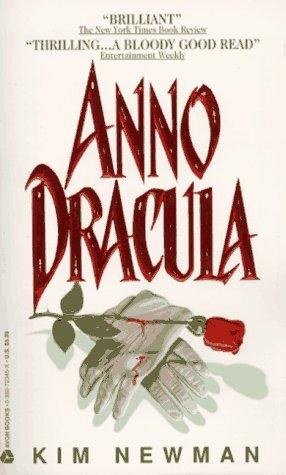
Kim Newman's Anno Dracula asks a beautifully unpleasant question: what if Dracula won, married into power, and Victorian society adjusted itself around the fangs with rather more speed than dignity?
Anno Dracula is not core steampunk in the machinery-first sense, but it belongs very close to the field. It is an alternate Victorian history built from literary inheritance, genre wit and social satire. Dracula has survived the events of Stoker's novel and become Prince Consort to Queen Victoria. Vampirism has spread through public life. The result is a London where the supernatural has not replaced politics so much as joined it for dinner.
The novel's significance lies in how confidently it treats Victorian fiction as a common arena. Characters, references and genre traditions collide in a way that anticipates later crossover works such as The League of Extraordinary Gentlemen. Newman is not simply making a list of cameos. He is asking how a society changes when one Gothic premise becomes state reality.
That makes it important because steampunk and gaslamp fantasy share a habit of remixing the nineteenth century's literature, anxieties and institutions. Where steampunk often introduces speculative machinery, Anno Dracula introduces speculative power through vampirism. The effect is parallel: an altered technology of the body and state reshapes class, fashion, policing, celebrity and violence.
The book also has a sharp sense of social accommodation. One of its nastiest ideas is that many people would adapt to vampire rule with impressive speed if status, survival or advantage required it. That is good gaslamp politics. The supernatural is not outside society. It becomes another ladder, another threat, another way to decide who counts.
Its London is theatrical, bloody and thick with genre memory. The Whitechapel murder atmosphere, Stokerian aftermath and imperial power structures combine into a city where Gothic horror has become public administration. This places the novel near steampunk's darker urban branch, where the past is not charming but crowded, violent and morally compromised.
Purists should call it gaslamp fantasy or steampunk-adjacent rather than core steampunk. The central transformation is vampiric and literary, not mechanical or industrial. But adjacency is not a demotion. The field needs border works that show neighbouring methods: occult politics, Gothic alternate history, shared literary universes and historical satire.
For readers who enjoy steampunk's habit of recruiting old books into new conspiracies, Anno Dracula is essential. It demonstrates how far one can go by changing the outcome of a canonical Victorian text and then following the consequences with a straight face and sharp teeth. The fun comes from recognition, but the bite comes from systems.
The literary-crossover element is worth treating carefully. A weak crossover is just a guest list. Newman's method is stronger because the shared world has consequences. Dracula's victory alters public life. Vampires become citizens, threats, celebrities, social climbers and political facts. The references are pleasurable, but the changed society is the real engine.
This gives Anno Dracula a useful kinship with steampunk even without central machinery. Like The Difference Engine, it begins with a major alteration and follows the ripples. Like The Anubis Gates, it treats literary history as active material. Like later gaslamp works, it understands that monsters become more interesting when they have paperwork, allies and positions within the social order.
Is it really steampunk?
Not quite. Anno Dracula is best filed as gaslamp fantasy and steampunk-adjacent alternate history. It shares steampunk's Victorian remixing, literary crossover instincts and political reconstruction, but it lacks the genre's central technological or industrial engine. It is a neighbour with excellent credentials and terrible table manners.
Its importance to the field lies in showing that the nineteenth century can be altered through myth as power. Vampires here function almost like a new ruling technology: they change bodies, time, hierarchy and statecraft. That makes the book useful for anyone interested in how speculative changes ripple through society, even when the change arrives in a cape rather than a boiler.
In the wider guide, Anno Dracula should sit near The Anubis Gates, The League of Extraordinary Gentlemen, Dracula and other works where Victorian fiction becomes a live ecosystem. It is a reminder that steampunk's borderlands are full of useful monsters, and some of them have already joined the government.
Readers looking for steam engines may need to adjust their expectations. Readers looking for the broader Victorian speculative laboratory will find plenty to examine. The novel shows how a Gothic premise can behave like an alternate technology, changing the rules by which power is acquired, displayed and protected.
That is why it earns a place here: not as boiler-room steampunk, but as proof that Victorian remix fiction can alter society with fangs as effectively as another writer might alter it with engines, laws and ledgers.
Find it
If you would like to track down Anno Dracula, these search links may help. We have not specified an edition, so you can pick the format that suits you.
Affiliate links: as an Amazon Associate, Stephen Hunt’s SFcrowsnest earns from qualifying purchases. These may earn us a small commission at no extra cost to you.