
Why it matters
It gives modern steampunk adjacency a strange architectural landmark, where airships, social systems and bureaucracy climb floor by floor.
The Tower of Babel in Senlin Ascends is less a building than a vertical civilisation with too many rules, too many rooms and absolutely no interest in making a honeymoon easy.
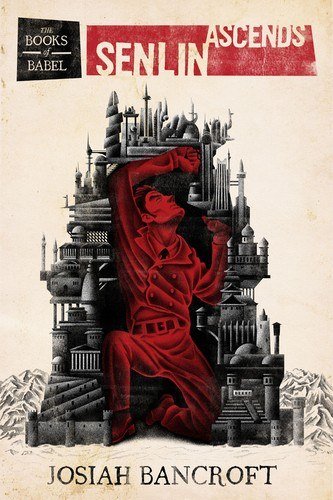
Josiah Bancroft's Senlin Ascends begins with Thomas Senlin, a schoolteacher, arriving at the Tower of Babel with his wife Marya. The tower promises marvels. It promptly behaves like a tourist attraction designed by a committee of pickpockets, clerks and philosophers who dislike tourists. Marya disappears, and Senlin begins climbing.
The book is usually filed as fantasy, but its steampunk adjacency is easy to see. There are airships, industrial systems, social satire, strange transport, theatrical spaces and a fascination with how built environments shape human behaviour. It is not a Victorian alternate history. It is a tower-world with the manners of a bureaucracy and the ethics of a casino.
The tower is the central machine. Each level, or ringdom, has its own culture, rules and traps. That makes the book especially interesting beside steampunk city fiction. Mortal Engines literalises predatory urbanism by putting cities on tracks. Perdido Street Station turns the city into a dense industrial organism. Senlin Ascends stacks society upward, then asks what happens to ordinary decency when every floor has its own little appetite.
Thomas Senlin is also a useful protagonist because he is not the usual swaggering adventurer. He begins as a bookish, rule-respecting man who has mistaken guidebooks for reality, which is a mistake reality enjoys correcting. His education is not simply in danger but in systems: commerce, performance, coercion, false politeness and the many ways civilisation can wear a helpful sign while hiding a trapdoor.
Airships give the series one of its clearer links to steampunk imagery, but the novel's stronger connection is structural. Steampunk often cares about networks: railways, factories, bureaucracies, empires, trade routes, machines and institutions. Bancroft's tower is a vertical network of power. People are processed by it, sold by it, entertained by it and occasionally flung from it.
The satire keeps the marvel honest. The Tower is full of wonders, but it is also full of systems that turn awe into revenue and confusion into leverage. That is where the book brushes close to steampunk's sharper side. Machinery is not only pistons and propellers; it can also be paperwork, ticketing, status, gatekeeping and a helpful attendant who has already decided what you are worth.
Purists may object because the tower is not a steam-age world in the strict sense. That is reasonable. The book is best understood as adjacent fantasy, not core steampunk. But it belongs near the field because it shares the fascination with social machinery. Here the gears are not always visible, but the grinding is hard to miss.
Is it really steampunk?
Not quite. Senlin Ascends is steampunk-adjacent tower fantasy, with airships and mechanical atmosphere but a broader allegorical architecture. Its strongest fit is with industrial fantasy, social satire and the city-as-machine tradition rather than brass-bound Victorian retrofuturism.
Readers who like Mortal Engines, Perdido Street Station or the more bureaucratic corners of weird fantasy should pay attention. Readers wanting pure steam engines may need to accept that the most dangerous machine here is the tower itself, plus all the people who have learned to profit from its staircases.
Find it
If you would like to track down Senlin Ascends, these search links may help. We have not specified an edition, so you can pick the format that suits you.
Affiliate links: as an Amazon Associate, Stephen Hunt’s SFcrowsnest earns from qualifying purchases. These may earn us a small commission at no extra cost to you.