Why it matters
It is a major adjacent work for readers interested in Weird West steampunk, industrial myth and the violent machinery of expansion.
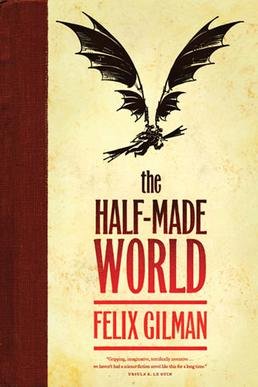
Felix Gilman's The Half-Made World imagines a frontier where railway empires and gun spirits are fighting over reality itself, which is exactly the sort of land dispute that suggests the surveyors have had a difficult morning.
The Half-Made World is not conventional steampunk, but it sits powerfully in the neighbouring territory of Weird West industrial fantasy. Its world is literally unfinished, a frontier where competing powers shape geography, politics and myth. The Line represents railway-industrial order, bureaucracy and expansion. The Gun represents violent individualism and demonic weapon-myth. Between them, the world is being made and unmade.
That conflict gives the book its field-guide value. Steampunk often thinks about machines as inventions. Gilman thinks about machinery as ideology. The railway is not just transport. It is a world-system, an empire of tracks, timetables, war and administration. The Gun is not just a weapon. It is personal violence elevated into supernatural contract. Together they turn the frontier into a battlefield of modern myths.
The Weird West label is important. This is not a polite Western with goggles. It is a mythic, strange and political reworking of frontier imagery. Readers coming from Boneshaker will recognise the American-Western adjacency, but Gilman's work is more abstract and allegorical. Priest gives us a poisoned city. Gilman gives us forces that are trying to decide what civilisation will mean.
The novel follows characters caught between these powers, including a doctor drawn into the conflict and figures shaped by war, trauma and allegiance. The human scale matters because the setting's big mythic conflict could otherwise become a diagram. Gilman gives the ideologies bodies to act through and damage to leave behind.
The doctor figure is useful because medicine and repair are almost impossible tasks in a world built around expansion and violence. Where the Line and the Gun both offer brutal certainties, the wounded human body offers evidence of cost. That gives the novel a moral and emotional counterweight to its grand mythic machinery.
The half-made premise is also one of the most elegant metaphors in modern weird-western fantasy. A frontier is often presented as empty space waiting for civilisation. Gilman makes that lie visible by making the world unfinished, contested and shaped by powers that are anything but neutral. The question is not simply who will settle the world, but who gets to define reality while doing it.
In steampunk terms, the Line is a magnificent horror. Railways are technological marvels, but they also bring military logistics, extraction, timetables, borders and the flattening of local difference. Gilman understands the railway as a creature of system. It is not just a train. It is an argument on tracks.
For steampunk readers, the railway empire is the closest mechanical kin. Railways are among the great nineteenth-century machines: not only engines, but networks of capital, land seizure, labour, scheduling and state power. The Half-Made World understands this at a mythic level. The Line is industrial modernity with a military soul and no interest in asking permission.
The Gun spirits make the book stranger than ordinary industrial fantasy. They embody another fantasy of power: the lone weapon, the chosen killer, the seductive violence of frontier myth. By making that force supernatural, Gilman exposes how mythic the supposedly practical gunfighter story always was.
This is a useful borderland entry because it expands the sense of what industrial fantasy can do. Not every relevant work has airships, automatons or Victorian London. Some have railways, revolvers, unfinished maps and powers that behave like political philosophies with teeth.
Is it really steampunk?
It is steampunk-adjacent rather than core steampunk. The Half-Made World is Weird West industrial fantasy, with railway empire, frontier myth, supernatural guns and industrial expansion standing in for the field's usual brass-and-steam apparatus.
Its connection to steampunk lies in its treatment of technology as social force. The railway is not scenery. It is power, order, violence and empire. That makes the book highly relevant to the field's more serious industrial and weird-western branches.
Readers who enjoy Boneshaker, Deadlands, Perdido Street Station or politically charged fantasy frontiers should pay attention. This is not a cosy adventure. It is a book about a world still being manufactured, and about the terrible question of whose machines, weapons and stories will finish the job.
It helps readers find the darker Weird West route through steampunk adjacency. The book has fewer brass parlours and more mythic violence, but its concern with industrial expansion, machinery and social force makes it one of the field's most interesting neighbours.
It is also a useful reminder that railways are never just background. In speculative fiction, a railway can be a promise, a threat, a government, an army and a theology of straight lines. Gilman understands every one of those uses.
Find it
If you would like to track down The Half-Made World, these search links may help. We have not specified an edition, so you can pick the format that suits you.
Affiliate links: as an Amazon Associate, Stephen Hunt’s SFcrowsnest earns from qualifying purchases. These may earn us a small commission at no extra cost to you.