
Why it matters
It brought alternate Oxford, airships, alethiometers and philosophical fantasy into a form that sits close to steampunk without being ruled by machinery.
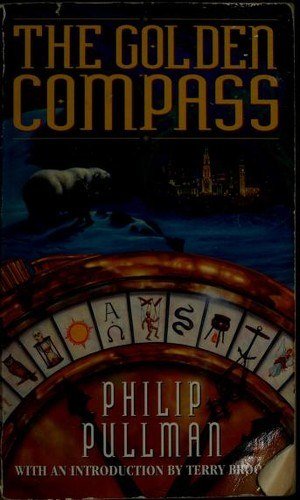
Philip Pullman's Northern Lights, published in the United States as The Golden Compass, begins in an Oxford that feels familiar until one's soul is sitting nearby in animal form and the adults are clearly up to something institutional.
Northern Lights is not core steampunk, but it is one of the great adjacent landmarks. Its world has airships, scholarly institutions, Arctic exploration, strange instruments and an alternate-historical texture that makes it feel near the gaslamp wing of the field. Yet Pullman's real engine is metaphysical rather than mechanical: daemons, Dust, authority, childhood, knowledge and the spiritual politics of power.
The novel introduces Lyra Belacqua, a child of ferocious curiosity and inspired dishonesty, whose Oxford is connected to a wider world of scholars, explorers, armoured bears, witches and religious authority. The alethiometer, a truth-reading instrument, is one of the book's most field-guide-friendly objects: part device, part symbol, part invitation to learn a language of hidden meaning. It is not a steam engine, but it behaves like a proper speculative object. It changes what people can know.
The airships matter too, though Pullman does not make them the whole show. In steampunk, airships often become romance, military power or free-floating spectacle. In Northern Lights, they are part of a broader alternate-world atmosphere. They help establish that this is not our Oxford, not our Arctic, not our modernity. The world has developed along a different imaginative route, and the technology is one strand of that difference.
The daemons push the book decisively toward fantasy. Every human's soul manifests externally as an animal companion, a conceit so strong that it reorganises social and emotional life. That is why a narrow steampunk label would be misleading. The novel's deepest questions are about consciousness, innocence, authority and the structures that claim to protect children while doing terrible things to them.
Even so, the steampunk adjacency is real. The setting has institutions with old stone and darker secrets, scientific theology, instruments of knowledge, exploratory journeys and a world whose technologies feel tactile rather than digital. It shares the field's fascination with alternative modernities: ways the world might have become different if science, religion, empire and metaphysics had tangled in another pattern.
The novel is valuable because it expands the reader's sense of gaslamp fantasy. Not every adjacent work needs London fog and occult clubs. Pullman's Oxford and Arctic give us another route: scholarly fantasy, moral adventure and invented cosmology with enough airships and instruments to sit comfortably near the brass railings.
Its institutions are just as important as its objects. Jordan College, the Magisterium and the networks of scholars and explorers create a world where knowledge is governed, guarded and punished. That has strong steampunk relevance even without boilers in the foreground. Many of the field's best works are about who controls knowledge: Babbage engines, alethiometers, secret laboratories, forbidden archives and official versions of history.
The Arctic journey also ties the novel to older adventure and scientific-romance traditions. Exploration in Pullman's book is not innocent scenery-hunting. It is bound to child abduction, theological panic, imperial routes and the dangerous glamour of discovery. That gives the story a harder edge than its most marketable images might suggest. The armoured bears are splendid, certainly, but the institutions behind the journey are not cuddly.
Purists can object if someone calls it steampunk without qualification. They would be right. But adjacent works often do important work in canon lists. They show what the genre touches, borrows from and overlaps with. Northern Lights demonstrates that retrofuturist texture can support a much larger philosophical story without becoming the story's master.
Is it really steampunk?
No, not strictly. Northern Lights / The Golden Compass is gaslamp-adjacent alternate-world fantasy with steampunk-friendly elements: airships, instruments, scholarly institutions and exploratory technology. Its core is metaphysical fantasy rather than industrial retrofuturism.
Readers coming from steampunk should pay attention to how Pullman handles objects. The alethiometer is designed, learned, interpreted and fought over. It has rules and mystery. Steampunk can learn from that. A device does not have to belch smoke to be compelling; it needs a place in the world's knowledge, power and desire.
The book also matters because it became a gateway for many readers into alternate-world fantasy with a material, historical feel. Its success helped normalise the idea that young readers could handle complex invented worlds, moral argument and anti-authoritarian bite. That overlaps strongly with later YA steampunk and adventure fiction, from Mortal Engines to Airborn and beyond.
For field-guide readers, the best approach is to admire the steampunk-friendly textures without mislabelling the book's soul. Pullman is not writing a machine romance. He is writing a moral and metaphysical adventure in a world where instruments, airships and old buildings help carry the argument. That adjacency is exactly what makes the entry useful.
Find it
If you would like to track down Northern Lights / The Golden Compass, these search links may help. We have not specified an edition, so you can pick the format that suits you.
Affiliate links: as an Amazon Associate, Stephen Hunt’s SFcrowsnest earns from qualifying purchases. These may earn us a small commission at no extra cost to you.