
Why it matters
It shows the 2000 AD route into gothic machine spectacle, anti-authoritarian satire and the later visual language Kevin O'Neill would bring to period remixing.
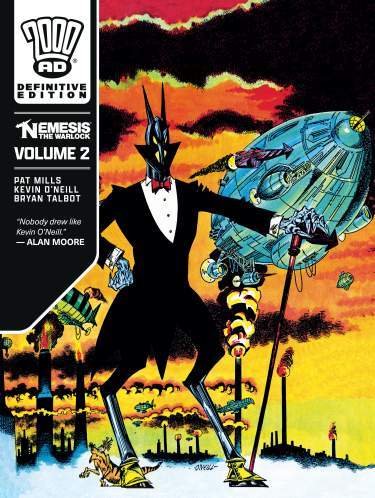
Nemesis the Warlock: The Gothic Empire is what happens when British comics look at empire, religion, machinery and persecution, then decide the sensible response is an alien anti-hero with horns and no patience for human supremacy.
Nemesis the Warlock is one of the great strange machines of British comics. Created by Pat Mills and Kevin O'Neill for 2000 AD, it pits the alien Nemesis against the fanatical human empire of Torquemada. The Gothic Empire arc belongs to that wider saga of religious tyranny, grotesque machinery and anti-humanist inversion.
This is not steampunk in the usual historical sense. It is far-future gothic SF with medieval, imperial and baroque visual ingredients. Yet the adjacency is real. The machines are ornate, oppressive and theatrical. The empire has the look of a civilisation that weaponised architecture, doctrine and bad taste at the same meeting.
Kevin O'Neill's art is one of the main reasons the work matters here. His line has a gift for making machines look alive in the worst possible way. Later, with Alan Moore, he would help define the visual world of The League of Extraordinary Gentlemen. In Nemesis, one can already see that appetite for grotesque hardware, moral ugliness and comic-book design turned up to cathedral volume.
Pat Mills' politics also give the series bite. The human empire is not the natural hero of the story. It is violent, bigoted, authoritarian and absurd. That anti-imperial reversal connects the work to a strand of steampunk and gaslamp fiction that looks at empire-era imagery and asks why anyone trusted the uniforms in the first place.
The Gothic Empire material is therefore useful as a borderland entry. It shares with steampunk a taste for elaborate systems, retro-inflected design and political machinery. It also belongs to British comics' great tradition of laughing at authority while drawing it as something both ridiculous and genuinely terrifying.
The grotesque comedy is crucial. Without it, the material might become only grim. Mills and O'Neill understand that tyranny is often absurd as well as brutal, and that satire can make horror sharper by refusing to kneel before it. The result is not tasteful. It is better than tasteful: it is angry, inventive and impossible to mistake for neutral scenery.
The connection to later steampunk comics is visual as much as thematic. Once one has seen O'Neill's machinery and architecture, it is easier to understand why his later Victorian remix work felt so dangerous. He does not draw old worlds as museum displays. He draws them as systems that may bite.
That bite is why the arc belongs near the border. It proves that ornate retro-design can be satirical, furious and politically awake.
Is it really steampunk?
No. Nemesis the Warlock: The Gothic Empire is gothic science fiction and British comics satire, not steam-age retrofuturism. It is steampunk-adjacent through its baroque machines, imperial grotesquerie and visual influence on later period-remix comics.
Readers interested in The League of Extraordinary Gentlemen, Luther Arkwright or the British comics route into speculative anti-authoritarianism should pay attention. It is not a polite entry, but polite entries rarely have this much useful venom in the boiler.
Find it
If you would like to track down Nemesis the Warlock: The Gothic Empire, these search links may help. We have not specified an edition, so you can pick the format that suits you.
Affiliate links: as an Amazon Associate, Stephen Hunt’s SFcrowsnest earns from qualifying purchases. These may earn us a small commission at no extra cost to you.