
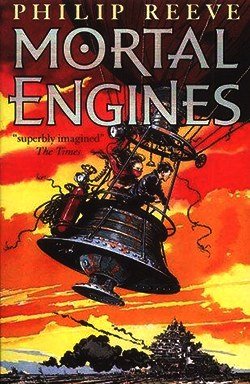
Why it matters
It brings Philip Reeve's traction-city world to screen, making mobile London and post-apocalyptic scavenger imperialism visible at blockbuster scale.
The Mortal Engines film puts London on wheels, which is a drastic but memorable answer to urban planning.
Directed by Christian Rivers and based on Philip Reeve's novel, the film imagines a far future where mobile cities consume smaller settlements in a system called Municipal Darwinism. London becomes a predatory machine-city, part civic identity and part mechanical appetite.
The steampunk fit is strong because the premise fuses city, machine and empire. This is not one vehicle in a world. It is the world reorganised around moving cities, engines, tracks, scavenging and social hierarchy. The industrial metaphor is wonderfully blunt: capitalism, empire and urban hunger have become literal architecture.
The film's greatest asset is visual. The sight of London moving across the landscape is absurd, grand and immediately legible. It captures the central image of Reeve's world, even when the adaptation struggles to carry the novel's full character and political texture.
The film is both useful and limited. It introduces the setting to viewers who may never have read the books, but it compresses and simplifies a great deal. The result is often more spectacle than satire, though the spectacle is not nothing. A city eating another city makes its point even when the dialogue takes a tea break.
It connects naturally to Snowpiercer, 9 and other post-apocalyptic machine-worlds. All imagine survival after catastrophe through systems that become morally deformed. Mortal Engines is the most extravagantly mobile of the lot: urban policy rebuilt as a chase scene.
The film's production design does a great deal of heavy lifting. London is not just a moving backdrop. It is stacked, smoky, hungry and socially layered, with civic pride welded to predation. That is the core idea of traction-city steampunk, and the film understands its immediate visual power.
Hester Shaw and Tom Natsworthy give the story its human route through the machinery, though the film has less room than the novel to complicate them. Even so, the contrast between personal loss and city-scale violence is useful. Steampunk often works best when the grand machine has a human wound caught in its gears.
The adaptation also shows the difficulty of translating YA world-building into a single film. Reeve's setting has jokes, cruelties, histories and social absurdities that need breathing room. The film captures the huge moving image more easily than the satire beneath it, which makes it an introduction rather than the full journey.
Purists of the novel may prefer the book, and understandably. But the film still has value because it puts one of YA steampunk's central images into mainstream visual circulation. Mobile London is now part of the genre's visual vocabulary.
It also matters because the film made traction-city imagery legible to viewers outside the book's readership. A premise that sounds ridiculous in summary becomes instantly comprehensible when the city rolls into view. That is a genuine achievement, even when the adaptation around it creaks.
The best way to treat the film is as a visual gateway. It does not carry all the political bite or slow world-building of the novels, but it gives the eye enough to understand why traction cities became such memorable steampunk images in the first place.
Is it really steampunk?
Yes. It is post-apocalyptic steampunk, built around traction cities, scavenged technology, mobile empire, retro machinery and industrial hierarchy.
It is best treated as a visual entry point to Reeve's richer world. If the film leaves you wanting more bite, the novel is waiting with sharper teeth.
Find it
If you would like to track down Mortal Engines, these search links may help. We have not specified an edition, so you can pick the format that suits you.
Affiliate links: as an Amazon Associate, Stephen Hunt’s SFcrowsnest earns from qualifying purchases. These may earn us a small commission at no extra cost to you.