Why it matters
It is a major adjacent work for retro-industrial dystopia, using a perpetual train as both machine and social order.
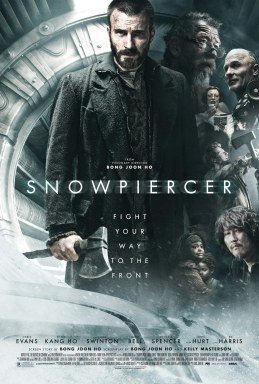
Bong Joon-ho's Snowpiercer turns the last of humanity into passengers on a train, proving that the end of the world still cannot stop class from reserving the better carriage.
Based on the French graphic novel Le Transperceneige, the film imagines a frozen Earth where survivors live aboard a train that endlessly circles the planet. The train is world, economy, prison and myth. Its carriages organise class so literally that revolution becomes a matter of walking forward.
The dieselpunk adjacency lies in the machine-world structure. Snowpiercer is not steampunk, but it shares the retro-industrial fascination with systems made visible. The train is not only transport. It is society engineered as a sequence of compartments, each with a function and a moral smell.
The class politics are blunt and effective. The poor are trapped in the tail, the privileged live nearer the front, and the engine becomes both god and infrastructure. Steampunk's political branch often asks how machinery supports hierarchy. Snowpiercer answers with a corridor, a guard and a protein block one would rather not inspect.
Its post-apocalyptic setting connects it to Mortal Engines and Frostpunk. All three imagine survival after catastrophe through engineered systems that become social nightmares. The difference is compression. Mortal Engines has cities; Snowpiercer has a train. There is nowhere for the metaphor to hide.
The film's design gives each carriage a different mood: prison, factory, schoolroom, aquarium, nightclub, temple of privilege. That compartmental rhythm makes the social argument legible without slowing the film into a lecture.
Bong's gift is tonal control. Snowpiercer can be brutal, absurd, funny and horrific within the space of a few carriages, which is useful when the entire civilisation has been reduced to a linear argument. The film knows that class systems are not only cruel. They are also ridiculous, theatrical and protected by people who have mistaken comfort for destiny.
The engine mythology is especially relevant. Every machine-world needs a sacred centre, and here it is the engine, treated as technological god, political excuse and practical necessity. That fusion of engineering and belief places the film close to industrial dystopia, even without steam aesthetics.
The train's forward movement is the bleak joke. Everyone is told the system must keep going because stopping means death, but keeping going also preserves the cruelty that defines the system. That is a powerful industrial-dystopia pattern: survival and oppression welded together until reform seems mechanically impossible.
Purists will keep it in the dieselpunk and industrial-dystopia neighbourhood rather than core steampunk. That is sensible. Yet it is important for the wider field because it shows machinery as total environment, a built system that determines who eats, who freezes and who gets to call the arrangement natural.
It also has a useful relationship to train romance. Steampunk and dieselpunk often love trains as symbols of motion, industry and adventure. Snowpiercer curdles that romance. The train still moves, still contains marvels and still suggests technological achievement, but every carriage asks who paid for that achievement and who is locked out of it.
That makes the film a strong counterweight to more decorative retrofuturism. It is not interested in a handsome machine for its own sake. It is interested in a handsome machine that has become law, religion and prison.
Is it really steampunk?
No. It is post-apocalyptic dieselpunk-adjacent dystopia. Its relevance comes from the train-world machine, class structure, retro-industrial design and survival system.
It is essential adjacent viewing for anyone interested in machinery as society. The engine runs, the hierarchy runs with it, and neither seems keen on being questioned.
Find it
If you would like to track down Snowpiercer, these search links may help. We have not specified an edition, so you can pick the format that suits you.
Affiliate links: as an Amazon Associate, Stephen Hunt’s SFcrowsnest earns from qualifying purchases. These may earn us a small commission at no extra cost to you.