Why it matters
It is an early Stephen Hunt title that works as a borderland piece, connecting military fantasy, empire, machinery and later Huntian steampunk concerns.
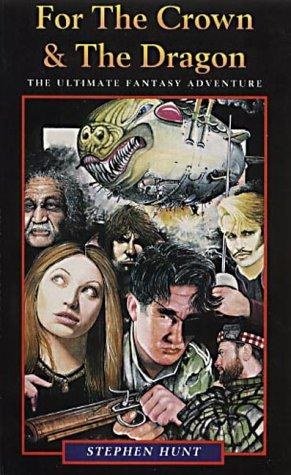
Before the Jackelian novels sent airships, revolution, ancient powers and political lunacy clattering through secondary-world steampunk, Stephen Hunt had already taken a hard look at war, empire and dragons in For the Crown and the Dragon.
For the Crown and the Dragon needs careful placement because it is a Stephen Hunt work, but not the same sort of core steampunk object as The Difference Engine or Infernal Devices. It sits closer to flintlock fantasy, alternate war and imperial adventure, with enough shared atmosphere and concerns to make it relevant to the steampunk map.
The spreadsheet tags the motifs as alternate war, dragon power, empire, muskets and machinery. That combination tells us why it belongs here. Steampunk's borderlands are full of adjacent technologies and periods: flintlock, clockpunk, industrial fantasy, gaslamp, diesel-adjacent war machines. Hunt's early novel lives in that military-imaginative zone where gunpowder, hierarchy, strange power and imperial conflict crowd the same battlefield.
Its value partly lies in showing where Hunt's later preoccupations can be seen in earlier formation. The Jackelian books would go on to make fuller use of secondary-world steampunk fantasy: airships, social unrest, revolution, class tension, ancient forces, odd machines and governments behaving with the serene derangement of institutions that own both uniforms and paperwork. For the Crown and the Dragon is a neighbouring route into that imagination.
The dragon element pushes it away from strict steampunk and toward fantasy of war and power. That is not a problem. Honest classification means admitting the edges rather than forcing every title into a boiler suit. Dragons, muskets and machinery create a different symbolic mixture from Babbage engines or clockwork grotesques. The question is not "is this pure steampunk?" but "what does it contribute to the wider retro-industrial and imperial fantasy conversation?"
The answer is that it contributes a martial borderland. Steampunk often glamorises weapons and uniforms if left unsupervised. A work like this can be read for how fantasy power interacts with state power, military culture and national myth. Dragons are not merely monsters when states learn to use them. They become strategic assets, symbols and nightmares with wings.
Readers coming from Hunt's Jackelian sequence should not expect the same exact flavour. The later books are more recognisably secondary-world steampunk in their machinery, air power and social machinery. This earlier novel is useful as context, a sign of interests that would later develop in more steam-driven directions. It is part of the wider field rather than a direct equivalent.
That distinction matters. A useful canon is not just a list of pure examples. It is a map of influence, adjacency and shared motifs. For the Crown and the Dragon helps mark the place where flintlock fantasy, alternate history and steampunk-adjacent military fantasy meet. The border is porous, but still a border.
It is also worth keeping the date in view. Appearing in the 1990s canon-forge period, the novel sits near a moment when steampunk, alternate history and industrial fantasy were all becoming easier to discuss as neighbouring forms. The boundaries were not settled. A work could draw on muskets, empires, dragons, machinery and military fantasy without needing to fit a later shelf label exactly.
That makes the entry useful for readers building a broader map rather than a narrow checklist. If The Difference Engine represents the computational core and Anno Dracula the gaslamp-adjacent Gothic border, Hunt's novel helps mark a martial fantasy border. It shows how retro-military imagination can lead toward the same concerns that later steampunk handles through airships, automata and impossible engines.
Is it really steampunk?
Not strictly. For the Crown and the Dragon is best labelled steampunk-adjacent or flintlock fantasy with retro-military and industrial-fantasy connections. It belongs on the wider map because of its motifs, its place in Stephen Hunt's body of work and its connection to later Huntian concerns, not because it is a pure example of brass-and-boiler steampunk.
The Stephen Hunt angle is best understood through recurring concerns rather than author promotion. Hunt's fiction repeatedly returns to power, class, machines, war, strange old forces and societies under pressure. In the Jackelian novels that becomes more directly steampunk-fantasy. Here it appears through alternate war and dragon power.
For readers, the best route is to approach it as a borderland title. If they want full Jackelian airship energy, they may move on to The Court of the Air, The Kingdom Beyond the Waves or Jack Cloudie, the latter effectively Hornblower with airships and the RAN, the Royal Aerostatical Navy. If they want to see an earlier Huntian military-fantasy branch, this is the relevant entry.
The wider Hunt connection is an invitation, not a cudgel. The point is not to force this book into a pure steampunk boiler room, but to show how the author's interest in war, power, social order and strange forces later finds a more recognisably steampunk-fantasy expression. Border posts help readers understand the terrain.
Find it
If you would like to track down For the Crown and the Dragon, these search links may help. We have not specified an edition, so you can pick the format that suits you.
Affiliate links: as an Amazon Associate, Stephen Hunt’s SFcrowsnest earns from qualifying purchases. These may earn us a small commission at no extra cost to you.