
Why it matters
It turns a single speculative substance into a Victorian technological revolution, linking steampunk spectacle to imperial power and scientific consequence.
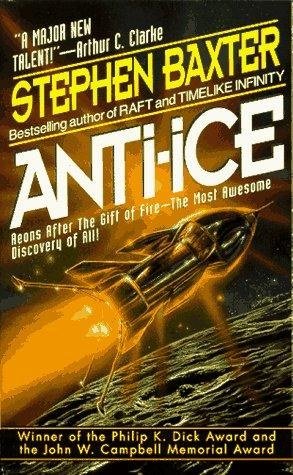
Stephen Baxter's Anti-Ice begins with the kind of alternate scientific discovery that makes empire lean forward, industry reach for a ledger and sensible people quietly look for a bunker.
Anti-Ice is one of the strong canon-forge titles of the early 1990s, arriving after The Difference Engine and showing another way to build steampunk alternate history. Where Gibson and Sterling use computation as the hinge, Baxter uses a miraculous energy source. The result is a Victorian world pushed into technological acceleration by a substance whose potential is thrilling, profitable and extremely worrying.
The title substance, anti-ice, functions as a super-fuel with enormous explosive and propulsive possibilities. In field-guide terms, this is classic alternate science: change one physical fact, then let history rearrange itself around the new pressure. Baxter, with his hard-SF instincts, is especially suited to this kind of exercise. He likes consequences, not merely ornaments.
The spreadsheet's motifs point to alternate Victorian super-fuel, lunar voyage and imperial technology. That places Anti-Ice firmly in the Vernean line. It looks back to scientific romance, especially the nineteenth-century dream of voyages made possible by extraordinary engineering. Yet it also belongs to post-Difference Engine steampunk because it knows the technology cannot remain innocent once states, armies and empires notice it.
The lunar element matters because it reconnects steampunk with one of scientific romance's grand old ambitions: leaving the Earth by means of improbable but confident machinery. Verne is in the ancestry here, not as a source to imitate slavishly, but as a model of speculative travel that treats engineering as narrative permission. Baxter updates the method with late twentieth-century awareness of power and hazard.
The imperial dimension gives the novel its bite. A super-fuel in the Victorian period is not just a marvel. It is a military asset, an industrial prize and a political accelerant. Steampunk often works best when it refuses to keep invention in the gentleman's laboratory. Once an energy source exists, the navy, treasury, factories and newspapers will all form opinions with alarming speed.
Anti-Ice is useful because it shows a purer alternate-science route into steampunk. It does not depend primarily on Gothic atmosphere, secret societies or literary crossover. Its engine is speculative physics inserted into a historical system. That makes it a close cousin of The Difference Engine, though with thrust, fire and moonward ambition in place of data and punched cards.
The energy-source premise is especially handy for explaining steampunk's relationship with industrial history. Steam power, coal, electricity, aether and imaginary fuels are not just technical details. They decide what can be built, who can travel, who can fight, and which institutions grow fat around the new resource. Baxter grasps that an energy miracle would create political weather as surely as it creates propulsion.
The lunar voyage also keeps the novel attached to the old romance of scientific travel. This is where the Vernean ancestry shows most clearly: the desire to leave ordinary geography behind by means of calculation, audacity and a machine that will probably void several insurance policies. Yet Baxter's later perspective makes the dream more dangerous. The voyage is not only wonder; it is evidence of a world being pushed beyond its existing limits.
Purists can count it as core steampunk, though with a hard-SF and Vernean flavour. It has steam-age setting, alternate technological development, imperial consequence and spectacular engineered travel. It is not merely adjacent. It is one of the works that helped keep the 1990s canon from narrowing into only clockwork Victoriana.
Is it really steampunk?
Yes. Anti-Ice is core steampunk in the alternate-science branch. Its speculative super-fuel reshapes Victorian technology and power structures, and its lunar voyage ties it directly to the scientific romance ancestry that steampunk repeatedly revisits.
The novel's appeal lies in seeing a single invention produce a cascade. That cascade is the steampunk sweet spot: discovery, wonder, militarisation, ambition, danger and the dawning suspicion that perhaps humanity should not be trusted with anything more energetic than a kettle. Baxter lets the marvel remain marvellous while making its consequences properly nervous.
Readers who prefer occult gaslamp fantasy may find it more engineering-minded than eerie. Readers who enjoy Verne, Wells, alternate history and serious speculation should find it a key stop. It also sits neatly beside Stephen Hunt's and other British steampunk-adjacent works in which empire, war and dangerous invention start jostling in the same corridor.
As canon, Anti-Ice helps balance the shelf. It proves that the 1990s steampunk moment was not only about Babbage computers or literary grotesques. It could also be hard-SF alternate history with a furnace heart, asking what happens when a discovery gives the nineteenth century a much bigger matchbox.
Find it
If you would like to track down Anti-Ice, these search links may help. We have not specified an edition, so you can pick the format that suits you.
Affiliate links: as an Amazon Associate, Stephen Hunt’s SFcrowsnest earns from qualifying purchases. These may earn us a small commission at no extra cost to you.