Jackelian novel
The Court of the Air
The opening novel of the Jackelian sequence, and the place the whole secondary world begins.
A quiet thing to remember about The Court of the Air is that it did not arrive with brass fanfare in 2007. It slipped onto the shelves at the exact moment the fantasy field was asking itself, again, whether steampunk had run its course. It had not; it had merely been waiting for someone to build it a country to live in. Stephen Hunt built it a country. Seventeen years and six sequels later, the country is still there, and this is the novel that draws its border.
You can approach The Court of the Air two ways. You can read it as a chase adventure — a proper one, with orphans, killers, a runaway on the roof of a train, a submarine, a mountain kingdom of intelligent machines, and a good honest confrontation at the end. Or you can read it as the front door of the Jackelian sequence, in which case what you are also doing, quite deliberately, is walking through a world so densely built that the story is basically the tourist’s excuse to open every drawer. Both readings work. Most people, in practice, do both at once and are quietly astonished by the volume.
The book itself
The novel follows two protagonists. Molly Templar is a poorhouse girl in Middlesteel with a price on her head she does not know about and a life she is about to lose. Oliver Brooks is a country boy under indefinite registration by the worldsingers, who have decided — on evidence not disclosed to Oliver — that he might be feybreed, which is what one calls a person the leylines have got to. His days are spent signing forms. His nights are spent wondering when the men with the paperwork will turn into the men with the locks.
Killers come for both of them, from different directions, for different reasons that are ultimately the same reason. They escape their old lives on rails that were laid before either of them was born. What pulls them together — and it is not a spoiler to say so; the book itself is halfway through before anyone will admit it out loud — is a much older business than the politics of the day. The men in the paperwork office are not the enemy. They are, at best, the enemy’s clerks.
Around them assemble the cast the whole Jackelian sequence will keep returning to. Commodore Jared Black is an exiled royalist u-boat captain of magnificent unreliability and unbudgeable loyalty, who arrives to complain and stays to fight, and whom several readers of my acquaintance have proposed to on the strength of Chapter Four alone. Coppertracks is a steamman scholar on extended sabbatical among Jackelian society, and is exactly the kind of character other fantasy novels are always promising and never delivering: a genuinely alien intellect, patient, courteous, and utterly clear that his hosts are not thinking the problem through. Harry Stave is a charming operative in a line of work he is not permitted to name, and readers of Le Carré will recognise the shape of him at fifteen paces.
And behind all of them, in a Middlesteel that Hunt draws with the gaslamp density of the best Dickens and the sheer wrongness of the best Mervyn Peake, is the institution the book takes its title from. The Court of the Air — the actual court — is a real thing in the book, and it is not what it sounds like, and no field guide worth reading is going to tell you what it is. Suffice it to say that the Kingdom of Jackals is not, in the end, run by parliament. Parliament thinks it is. That is part of the arrangement.
The world it opens up
If you have never read the sequence before, this is where Hunt spreads the world out on the table.
The Kingdom of Jackals, capital Middlesteel: a constitutional monarchy in which the monarch has been formally diminished for historical reasons involving a blade, a chapel, and a piece of ceremonial furniture nobody in the House is comfortable discussing. Parliament runs the country by day. Rather less obvious forces run the country by night. The pneumatic post delivers on time regardless.
The Steammen Free State, ruled by King Steam and served by orders of steamman knights: a sovereign nation of intelligent brass-bodied citizens who fought beside Jackals against the old aristocracy and never went home. They mine celgas, the lift-gas the entire Royal Aerostatical Navy depends on for its airships, and they hold the concession on carefully diplomatic terms. They also worship their ancestors — the Loas — and are exactly as offended as one would expect by the local human habit of getting religion wrong. Hunt’s Mechancia covers this civilisation in full.
The worldsingers, the Kingdom’s clerical order of magic-suppressing inquisitors, whose theology treats sorcery as a wound and whose job is emphatically not to wield it. Their most powerful magical citizens — the feybreed — are drafted into the Special Guard and collared, which is how a state polices what it cannot quite admit exists. The moral weight of this is not lost on Hunt, and it is not lost on Oliver either.
And, offstage in Book 1 but heavily on the horizon: the revolutionary Commonshare of Quatérshift, whose exiled sympathisers in the Kingdom are called Carlists after their theorist Benjamin Carl, and whose First Committee back home has spent three decades demonstrating that a revolution which wins and then keeps eating is not, in fact, a revolution any more. Hunt treats these people with the seriousness they deserve. Nobody in The Court of the Air is a straw man, which is why the politics land as hard as they do.
The invention
Steampunk readers will have a checklist. Hunt ticks it and then adds several boxes of his own. Airships lifted by celgas, and given the O’Brian-grade texture of a real working ship of the line. U-boats crewed by people you would happily buy a drink and never trust with your wallet. A capital city drawn in gas-lamp yellow and coal-soot grey. A pneumatic post that runs like clockwork because everything in Jackals runs like clockwork, and this is not accidental worldbuilding: the clockwork is the metaphor. Under the surface, however, is where Hunt is at his most interesting — the same machinery of state that later drives the kingdom’s Transaction Engines. Feybreed altered by leylines. Sorcery under state licence. A buried something — call it a machine, call it a god, the book itself is not sure the distinction survives contact with the object — sleeping deep enough that even the worldsingers pretend they are not thinking about it.
The result reads, at its best, like Miéville’s Perdido Street Station rewritten by someone who believes plot is a virtue. Not a knock at Miéville; a compliment to Hunt. There is a great deal of world here, and it is going somewhere.
Should you start here?
Yes. Start here.
The Jackelian novels are stand-alone adventures, and it is defensible — indeed, some readers of my acquaintance swear by it — to begin with The Kingdom Beyond the Waves or Secrets of the Fire Sea, both of which are more contained. But The Court of the Air is the book in which the world unfolds while you are inside it. Molly and Oliver do not know what they are looking at. Neither do you. You learn the Kingdom of Jackals by getting into trouble in it, which is the most honest way any novel can teach you a place.
Also, structurally, it is a chase, and Hunt is very good at chases. The second half of The Court of the Air runs at a pace that will keep you up later than you meant. Nobody in it ends the book where they thought they would begin it. This is what a first novel of a long sequence is supposed to do: teach the reader the rules by breaking them, and then leave the reader wanting six more books.
Which, as it happens, is what you can go and read next.
You have been warned about the airships. Mind the leylines on your way in.
 Core Steampunk Fantasy
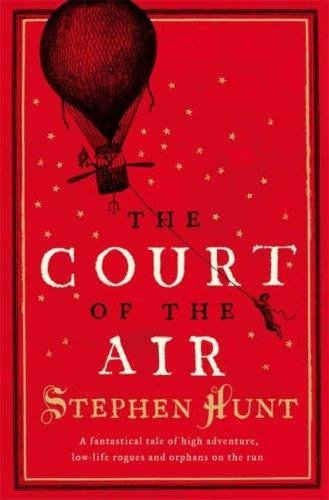
The Court of the Air
Stephen Hunt's The Court of the Air is core secondary-world steampunk fantasy, with airships, revolution and ancient powers.
Core Steampunk Fantasy
The Court of the Air
Stephen Hunt's The Court of the Air is core secondary-world steampunk fantasy, with airships, revolution and ancient powers.
Read the full entry
The complete field note, verdict and Amazon links live on the canon entry page.
Open the canon entry