
Why it matters
It turns the great Babbage-and-Lovelace might-have-been into a witty, scholarly and wonderfully eccentric comics machine.
Sydney Padua's The Thrilling Adventures of Lovelace and Babbage performs a splendid act of historical mischief: it lets Ada Lovelace and Charles Babbage build the machine, then gives them the comic career history denied them.
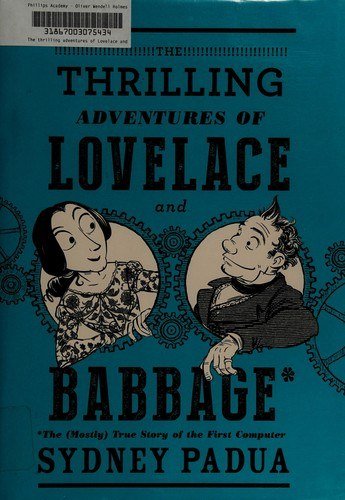
The Thrilling Adventures of Lovelace and Babbage is a graphic novel by Sydney Padua, expanding from her webcomic into a richly footnoted alternate-history comedy. Its conceit is irresistible: in our world, Babbage's Difference Engine and Analytical Engine remained unfinished. In Padua's pocket universe, Lovelace and Babbage get to build, calculate, argue and fight crime with mathematics.
This is one of the funniest routes into steampunk's computing branch. The Difference Engine gives us a grand alternate-history system shaped by mechanical computation. Padua gives us something more playful and scholarly: footnotes, jokes, diagrams, historical personalities and the sense that the nineteenth century's most interesting computer lab has finally been allowed to misbehave.
Ada Lovelace is central, not ornamental. Too often she is reduced to a decorative prophetess of computing. Padua restores the wit, difficulty, brilliance and mythic charge around her while also playing with the legend. The result is affectionate without being blandly reverent. Reverence rarely survives first contact with Babbage.
Babbage himself is treated with comic precision: ingenious, exasperating, visionary and socially hazardous. The book understands that invention is often made by people who are brilliant in one direction and impossible in several others. That is a very steampunk truth, even when the machinery is doing sums rather than boiling water.
The scholarship is part of the pleasure. Padua's notes and historical digressions do not feel like homework tacked onto a comic. They are part of the machine. The jokes work because the research is there, humming away underneath. It is one of the rare books where a footnote can deliver both the evidence and the punchline without asking permission first.
The book also performs a quiet act of correction. Lovelace and Babbage are often flattened into symbols: visionary programmer, eccentric inventor, unfinished machine. Padua keeps the symbols but gives them comic life, irritation, timing and stubbornness. History becomes less like a plaque and more like a room full of clever people interrupting one another for excellent reasons.
That matters because the Babbage-and-Lovelace story is often treated as a single melancholy footnote to computing history: brilliant idea, unfinished hardware, curtain. Padua refuses the curtain. She gives the might-have-been a stage, a supporting cast and enough mathematical nuisance value to make the lost future feel lively rather than merely regrettable.
Its relationship to steampunk is unusually healthy because it is honest about the difference between fact and fantasy. The alternate universe is openly playful, while the notes keep tugging the reader back to what really happened. That back-and-forth makes the book useful for readers who enjoy the dream of mechanical computing but do not want the actual history misfiled.
It also has broad audience appeal: comics readers, computing-history readers, Lovelace admirers, Babbage sufferers and steampunk fans can all find a way in. That is a rare machine, and Padua keeps it ticking with wit rather than pomp.
Is it really steampunk?
It is core-adjacent historical steampunk, especially for the Babbage-computing branch. The book is more comic alternate history than industrial adventure, but the Analytical Engine, Victorian science, Lovelace, Babbage and mechanical computation put it close to the centre.
Readers who enjoy The Difference Engine but want more jokes, more diagrams and less political fog should find it essential. Readers interested in real computing history will also enjoy the way Padua turns scholarship into comic timing.
Find it
If you would like to track down The Thrilling Adventures of Lovelace and Babbage, these search links may help. We have not specified an edition, so you can pick the format that suits you.
Affiliate links: as an Amazon Associate, Stephen Hunt’s SFcrowsnest earns from qualifying purchases. These may earn us a small commission at no extra cost to you.